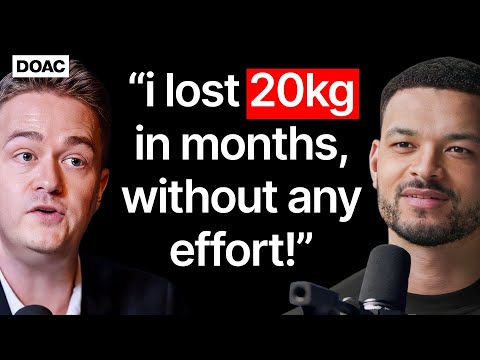
Johann Hari: They’re Lying To You About The Side Effects Of Ozempic!
Steven Bartlett (host), Johann Hari (guest)
In this episode of The Diary of a CEO, featuring Steven Bartlett and Johann Hari, Johann Hari: They’re Lying To You About The Side Effects Of Ozempic! explores ozempic’s Magic And Menace: Johann Hari Weighs The Trade‑Offs Johann Hari discusses his year-long experiment using Ozempic and related GLP‑1 drugs, during which he lost three stone while researching his book, *Magic Pill: The Extraordinary Benefits and Disturbing Risks of the New Weight-Loss Drugs*.
Ozempic’s Magic And Menace: Johann Hari Weighs The Trade‑Offs
Johann Hari discusses his year-long experiment using Ozempic and related GLP‑1 drugs, during which he lost three stone while researching his book, *Magic Pill: The Extraordinary Benefits and Disturbing Risks of the New Weight-Loss Drugs*.
He explains how these drugs work on gut hormones and the brain to suppress appetite, their extraordinary effectiveness for obesity and diabetes, and why uptake could reach half the population once prices fall and pill forms arrive.
Hari and host Steven Bartlett unpack the major physical and psychological risks: thyroid cancer signals, pancreatitis, muscle and bone loss, possible depression and suicidality, addiction transfer, eating‑disorder misuse, and unknown long‑term brain effects.
They contrast this medical “fix” with root causes—ultra‑processed food, an obesogenic environment, trauma, stress, and culture—and explore how countries like Japan have reshaped diets without mass medication, arguing society now faces a profound ethical, cultural, and policy crossroads.
Key Takeaways
GLP‑1 drugs radically suppress appetite by mimicking a satiety hormone and acting on the brain.
Ozempic and similar drugs are synthetic versions of GLP‑1, a gut hormone that tells the body it’s had enough food. ...
Get the full analysis with uListen AI
The benefits for obesity and diabetes are large and measurable—but must be weighed against serious risks.
For people with high BMI and/or type 2 diabetes, GLP‑1s can dramatically improve health: big trials show roughly 20% fewer heart attacks and strokes, and gastric‑surgery data suggest large weight loss can cut deaths from diabetes by 92% and overall mortality by ~40% over seven years. ...
Get the full analysis with uListen AI
Weight lost on GLP‑1s is usually not permanent; most users must stay on them long‑term.
In trials, within a year of stopping semaglutide, people regained on average about 70% of the weight they’d lost, implying that for most, the drug functions like statins: a lifelong treatment, not a cure. ...
Get the full analysis with uListen AI
Muscle loss and future frailty are under‑discussed but significant downsides, especially for already‑lean users.
All large, rapid weight loss causes loss of lean mass as well as fat. ...
Get the full analysis with uListen AI
The drugs can destabilize psychological coping: removing comfort‑eating can unmask trauma, depression, or drive addiction transfer.
Food is rarely just fuel; people eat for comfort, distraction, and emotional regulation. ...
Get the full analysis with uListen AI
Eating‑disorder misuse and thin‑ideal pressure could make GLP‑1s catastrophic for young people without strong safeguards.
Since COVID, adolescent anorexia and bulimia referrals have surged ~40%. ...
Get the full analysis with uListen AI
Treating obesity purely with drugs ignores the engineered food environment; countries like Japan show systemic change is possible.
Hari argues GLP‑1s are an “artificial solution to an artificial problem” created by ultra‑processed, hyper‑palatable foods that hijack our satiety systems, as shown in rat “Cheesecake Park” experiments where animals abandon natural food, then starve rather than go back to it. ...
Get the full analysis with uListen AI
Notable Quotes
“These drugs really do massively reduce or reverse obesity… but we have the most effective tool for self‑starvation human beings have ever come up with.”
— Johann Hari
“We live in as obesogenic an environment as human beings could possibly design.”
— Johann Hari (citing Prof. Michael Lowe)
“This is an artificial solution to an artificial problem.”
— Johann Hari (quoting Prof. Michael Lowe)
“When you take away comfort eating from people, for a lot of them it’s profoundly painful and distressing.”
— Johann Hari
“I think the choice for me was ongoing obesity or these drugs… I’d rather take the risks of Ozempic than the risks of ongoing obesity. But I might well turn out to be wrong.”
— Johann Hari
Questions Answered in This Episode
Given the French thyroid‑cancer signal and other emerging risks, what specific long‑term safety studies or registries would you like regulators to mandate before GLP‑1s are prescribed to children or for lifelong use?
Johann Hari discusses his year-long experiment using Ozempic and related GLP‑1 drugs, during which he lost three stone while researching his book, *Magic Pill: The Extraordinary Benefits and Disturbing Risks of the New Weight-Loss Drugs*.
Get the full analysis with uListen AI
If you were UK health minister tomorrow, which three concrete food‑environment interventions from Japan, Mexico, or Finland would you implement first to reduce our dependence on GLP‑1 drugs?
He explains how these drugs work on gut hormones and the brain to suppress appetite, their extraordinary effectiveness for obesity and diabetes, and why uptake could reach half the population once prices fall and pill forms arrive.
Get the full analysis with uListen AI
For someone with a BMI of 32, no diabetes yet, but a strong family history of heart attacks—how would you personally walk them through the decision of starting Ozempic versus doubling down on lifestyle change alone?
Hari and host Steven Bartlett unpack the major physical and psychological risks: thyroid cancer signals, pancreatitis, muscle and bone loss, possible depression and suicidality, addiction transfer, eating‑disorder misuse, and unknown long‑term brain effects.
Get the full analysis with uListen AI
How should celebrities and public figures ethically navigate disclosing GLP‑1 use, given the risk of both glamorizing the drugs and misleading people into believing extreme results are purely from willpower and gym time?
They contrast this medical “fix” with root causes—ultra‑processed food, an obesogenic environment, trauma, stress, and culture—and explore how countries like Japan have reshaped diets without mass medication, arguing society now faces a profound ethical, cultural, and policy crossroads.
Get the full analysis with uListen AI
If future trials confirm that GLP‑1s significantly reduce addiction to alcohol or opioids, should that change how we morally evaluate their use for weight loss—and could it justify wider prescribing despite the unknown‑unknown risks you describe?
Get the full analysis with uListen AI
Transcript Preview
We've not spoken for two years, but I have to say, you look remarkably different.
So, I lost three stone in a year, and there's a secret to that, Stephen.
Johann Hari, the best-selling author who's using his own body...
To unearth the extraordinary benefits and disturbing risks of the new weight-loss drugs.
Ozempic, it is literally the hottest drug in the country right now.
I really worry about the risks of these drugs. You're nine times more likely to get this particular condition, which is excruciatingly painful. And these drugs are working very hard on key parts of your brain. In fact, there are 12 significant risks, and we'll get into that. But it seems extraordinary that we've reached the point where we would inject ourselves with a potentially risky drug to stop us from eating. And we've had 40 years of relentlessly promoting diet and exercise as the only solutions. And only 10% of people really do lose huge amounts of weight on diets and keep it off. But now, we have the most effective tool for self-starvation human beings have ever come up with. When I started taking Ozempic, I was literally 80% less hungry than I normally am. These drugs really do massively reduce or reverse obesity. And a few years from now, we'll have 50% of the population taking it. It's the new miracle drug. Now, this when I go through the 12 big risks, some of which have not really been explained to the public. So, within a year of stopping, you regain 70% of the weight you've lost. Muscle mass loss is a real problem. There's concern that it may be causing suicidal feelings. And then there's one of the really big risks, and it's absolutely grim beyond belief, and that is...
Congratulations, Diary of a CEO gang. We've made some progress. 63% of you that listen to this podcast regularly don't subscribe, which is down from 69%. Our goal is 50%. So if you've ever liked any of the videos we've posted, if you like this channel, can you do me a quick favor and hit the subscribe button? It helps this channel more than you know. And the bigger the channel gets, as you've seen, the bigger the guests get. Thank you, and enjoy this episode. Johann, we've not spoken for two years, but I have to say, you look remarkably different.
(laughs) There's a secret to that, Stephen...
Really?
... (laughs) we can dig into. Yeah.
What is the secret?
So for me, it started... It's a kind of weird story. It started in the winter of 2020, so it was that weird period when kind of the world was opening up again after the pandemic. And I'd gained a lot of weight in lockdown, like loads of people. And because of that kind of weird moment of reopening, I went to a party for the first time in, like, I don't know, a year and a half, two years. And it was a party thrown by a kind of famous Hollywood actor. And on the way there, I remember thinking, "Oh, this is gonna be kind of funny, because all these Hollywood people are gonna put on weight as well, right? They're gonna have gained weight. What are they gonna look like?" So, I remember getting there, looking around, and having this really weird feeling. Because it's not just that they hadn't gained weight. Everyone was gaunt, right? Like, everyone looked like their own Snapchat filter. Like, they had...
Install uListen to search the full transcript and get AI-powered insights
Get Full TranscriptGet more from every podcast
AI summaries, searchable transcripts, and fact-checking. Free forever.
Add to Chrome