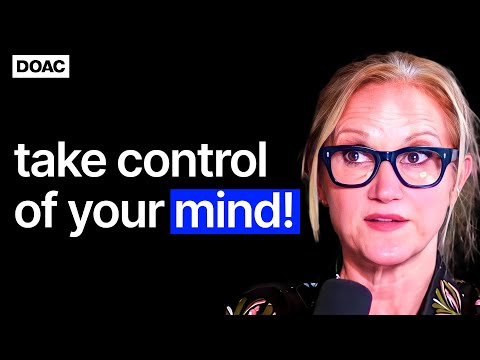
Mel Robbins: This One Hack Will Unlock Your Happier Life | E108
Mel Robbins (guest), Steven Bartlett (host), Narrator
In this episode of The Diary of a CEO, featuring Mel Robbins and Steven Bartlett, Mel Robbins: This One Hack Will Unlock Your Happier Life | E108 explores mel Robbins Reveals Simple Daily Rituals To Heal Anxiety And Self-Hate Mel Robbins shares how childhood trauma and lifelong anxiety shaped her patterns of dissociation, self-criticism, and constant survival-mode living, and how she slowly unwound them. She explains the science of trauma, nervous system dysregulation, and habit loops, and how simple physical interventions can reset both mind and body. The conversation covers her 5 Second Rule for taking action, her High 5 Habit for rebuilding self-worth, and a powerful reframe of anxiety as misinterpreted physiological arousal. Ultimately, she argues that healing means learning to feel safe in your own body, partnering with yourself, and treating stuckness as a signal to grow rather than a life sentence.
Mel Robbins Reveals Simple Daily Rituals To Heal Anxiety And Self-Hate
Mel Robbins shares how childhood trauma and lifelong anxiety shaped her patterns of dissociation, self-criticism, and constant survival-mode living, and how she slowly unwound them. She explains the science of trauma, nervous system dysregulation, and habit loops, and how simple physical interventions can reset both mind and body. The conversation covers her 5 Second Rule for taking action, her High 5 Habit for rebuilding self-worth, and a powerful reframe of anxiety as misinterpreted physiological arousal. Ultimately, she argues that healing means learning to feel safe in your own body, partnering with yourself, and treating stuckness as a signal to grow rather than a life sentence.
Key Takeaways
Treat anxiety as a body alarm you can reinterpret, not an identity you’re stuck with.
Physiologically, anxiety and excitement are almost identical: racing heart, butterflies, sweating, tight throat. ...
Get the full analysis with uListen AI
Use the 5 Second Rule to interrupt hesitation and break old habit loops.
When you know what you need to do but hesitate, a ~5‑second window opens where anxiety, procrastination, and self-doubt flood in. ...
Get the full analysis with uListen AI
Repairing your nervous system requires physical as well as mental work.
You don’t just ‘talk yourself out’ of trauma you didn’t talk yourself into. ...
Get the full analysis with uListen AI
The High 5 Habit is a simple daily way to rebuild self-trust and self-love.
Each morning, after brushing your teeth, look yourself in the mirror and physically high‑five your reflection. ...
Get the full analysis with uListen AI
Feeling ‘stuck’ is a signal you’ve stopped growing, not that you’re broken.
Just as hunger signals need for food and thirst signals need for water, the feeling of being stuck or stagnant signals an unmet need for growth. ...
Get the full analysis with uListen AI
Manifestation works when you visualize the hard bricks of the bridge, not just the finish line.
Vision boards of dream houses, IPO bells, or marathon medals alone can become demotivating as time passes with no visible change. ...
Get the full analysis with uListen AI
Your core ‘purpose’ is to be fully seen—starting by seeing yourself.
Robbins reframes purpose away from career labels toward a universal drive: to be seen, heard, and celebrated as your true self. ...
Get the full analysis with uListen AI
Notable Quotes
“The fundamental flaw in human design is that when something happens to you as a kid, you don’t say, ‘What’s wrong with them?’ You say, ‘What’s wrong with me?’”
— Mel Robbins
“You are one decision away from a different life.”
— Mel Robbins
“If you didn’t talk yourself into this shit, you’re not gonna talk yourself out of it.”
— Mel Robbins (quoting an idea she heard)
“The larger the problem, the smaller the solution. The bigger the dream, the smaller the actions you need to start taking.”
— Mel Robbins
“Your relationship with yourself is the foundation for everything in life. If you believe you’re a bad person, you will tend to do bad things.”
— Mel Robbins
Questions Answered in This Episode
You describe the High 5 Habit as dramatically shifting self-worth for people with depression and anxiety—what are the most common objections or ‘it feels stupid’ reactions you see, and how do you coach someone through their first uncomfortable week of doing it?
Mel Robbins shares how childhood trauma and lifelong anxiety shaped her patterns of dissociation, self-criticism, and constant survival-mode living, and how she slowly unwound them. ...
Get the full analysis with uListen AI
In your own EMDR and MDMA-assisted sessions, what specific body sensations or memories surprised you the most, and how did integrating those experiences change the way you now design tools for a mass audience?
Get the full analysis with uListen AI
You reframed the New York Times audiobook snub as a trigger of an old ‘outsider’ wound; if that had happened 15 years earlier, what cascade of decisions would your unhealed self likely have made differently?
Get the full analysis with uListen AI
For someone who feels chronically stuck in a job they hate but is also financially responsible for a family, what does a realistic, science-backed six-month ‘growth plan’ look like using your ideas on small bricks and nervous system regulation?
Get the full analysis with uListen AI
You argue that everyone’s purpose is to be fully seen, yet social media encourages highly curated, performative visibility—how can someone discern the difference between genuinely sharing their true self and just feeding another external validation loop?
Get the full analysis with uListen AI
Transcript Preview
And this is fricking genius. I've taught it to millions of people. It's curing people's anxiety.
There is nobody like Mel Robbins. There is nobody.
If I hadn't done what I did that morning, my life would have gone in a totally different direction. I'd probably be divorced, I'd probably be an alcoholic, my family would be torn apart. No idea what I'd be doing for a living or where I would be. I finally had the experience of being in my body, and being safe, and being okay, and I hadn't had that in a really long time. Um... So you asked me in the beginning, kind of, what is it that, that created all of this insight or this drive to figure it out? And I think I just figured it out. (laughs) You, you just fucking did it.
(Instrumental music)
They call her the female Tony Robbins, but she's so much more than that. She's one of the most incredibly vulnerable, honest, introspective, wise people I have ever met in my entire life, and she's written three best-selling books that offer a very simple solution to have a transformative impact on your entire life. I first found out about Mel Robbins some seven years ago when I watched a video of her talking about how to motivate yourself every single day, and when my team told me that she was coming to London for a short trip, I said, "We have to get her on this podcast." There is nobody like Mel Robbins. There is nobody. I've never seen Mel Robbins cry during an interview before, but in this podcast, it happens again. We have an epiphany. Mel removes her glasses. She begins to cry. And it's an incredibly touching moment. I think for a lot of you, this is gonna be the favorite podcast on this channel that you've ever listened to. So without further ado, I'm Steven Bartlett, and this is The Diary of a CEO. I hope nobody's listening, but if you are, then please keep this to yourself. Before we started recording, I said a lot of nice things about you just a few seconds ago, and, um, I talked about how sort of introspective you are, how much you've achieved, your remarkable ability to speak about ideas and things you've discovered in yourself. Um, you really are a standout individual, and so whenever I meet someone that I consider to be a s- really standout individual, it always begs the question to me, having a small background in like childhood psychology, what is it, what was the cauldron in which Mel was sculpted that made you the person you are today at the very start of your life?
I, I guess that... I'm trying to think about, like there's no defining moment, because I had great parents who did the best that they could with what they were handed in terms of their own childhoods and patterns and thinking, and, uh, I grew up in a tiny little town where nothing really happened, but one thing did happen, and that was in the fourth grade. I was, uh, at a family kinda ski trip thing, and, uh, in the middle of the night, I woke up and one of the kids was on top of me. And, yeah. Like, on top of me, molesting me. Uh, we're going here, like fast. I mean, you asked like what-
Install uListen to search the full transcript and get AI-powered insights
Get Full TranscriptGet more from every podcast
AI summaries, searchable transcripts, and fact-checking. Free forever.
Add to Chrome