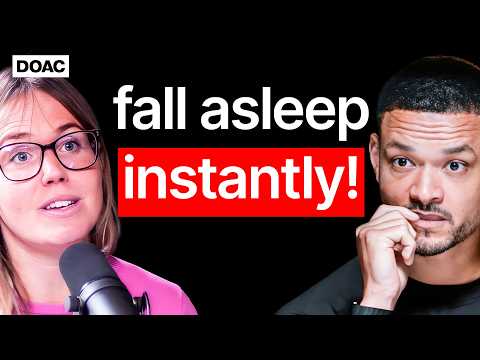
The Secret To A Good Nights Sleep with Stephanie Romiszewski | E64
Stephanie Romiszewski (guest), Narrator, Steven Bartlett (host)
In this episode of The Diary of a CEO, featuring Stephanie Romiszewski and Narrator, The Secret To A Good Nights Sleep with Stephanie Romiszewski | E64 explores stop Chasing Perfect Sleep: Retrain Your Brain, Ditch the Fear Sleep physiologist Stephanie Romiszewski argues that most modern sleep advice is anxiety-inducing, oversimplified, and often counterproductive, especially for insomniacs. She distinguishes between voluntarily sleep-deprived high performers and people desperately trying—but failing—to sleep, insisting the latter mostly suffer from learned patterns and fear, not permanent damage.
Stop Chasing Perfect Sleep: Retrain Your Brain, Ditch the Fear
Sleep physiologist Stephanie Romiszewski argues that most modern sleep advice is anxiety-inducing, oversimplified, and often counterproductive, especially for insomniacs. She distinguishes between voluntarily sleep-deprived high performers and people desperately trying—but failing—to sleep, insisting the latter mostly suffer from learned patterns and fear, not permanent damage.
Her core message is that quality and regularity of sleep opportunity, especially wake time, matter far more than rigid bedtimes, sleep trackers, or “8-hour rules.” She explains Cognitive Behavioral Therapy for Insomnia (CBT‑I), particularly sleep restriction, as the gold-standard approach to retrain the brain and rebuild healthy sleep drive.
Romiszewski strongly criticizes scare-based narratives, overuse of pills, supplements, and tracking tech, and the cultural glorification of sleeping less. She emphasizes mindset: worrying about sleep, over-optimizing routines, and compensating with lie-ins usually perpetuate insomnia more than lack of sleep itself.
Her practical advice: accept imperfect nights, keep a consistent wake time, avoid compensatory lie-ins, only go to bed when genuinely sleepy, get out of bed if you’re awake and anxious at night, and rebuild a regulated, active daytime life so your brain has a clear, reliable pattern to follow.
Key Takeaways
Stop chasing a perfect, fixed ‘8 hours’—focus on quality and patterns.
Romiszewski rejects the idea that everyone must get exactly 7–8 hours nightly. ...
Get the full analysis with uListen AI
Prioritize a consistent wake time over a rigid bedtime.
Dictating bedtime and lying awake in the dark tends to worsen insomnia by pairing bed with anxiety. ...
Get the full analysis with uListen AI
Differentiate fatigue from real sleepiness and use sleepiness as your only cue for bed.
Fatigue can be physical heaviness, buzzing thoughts, pain, or feeling ‘wiped,’ but true sleepiness means you’d fall asleep within minutes if you closed your eyes, with micro-sleeps and head-nodding. ...
Get the full analysis with uListen AI
Treat chronic insomnia by restricting time in bed, not by extending it.
People with long-term insomnia usually spend far more time in bed than they actually sleep, diluting their sleep drive and creating fragmented nights. ...
Get the full analysis with uListen AI
Stop compensating with lie-ins, snoozing, and daytime ‘protection’ behaviors.
Lying in after a bad night, going to bed earlier “just in case,” reducing social plans and exercise, or hitting the snooze repeatedly all undermine your sleep drive and body clock. ...
Get the full analysis with uListen AI
If you’re awake and anxious at night, get out of bed and do something you like.
Staying in bed while stressed and clock-watching teaches your brain that bed = anxiety and wakefulness. ...
Get the full analysis with uListen AI
Reduce fear: poor sleep rarely causes catastrophic next-day outcomes.
While acute sleep loss can reduce cognitive performance, Romiszewski emphasizes that one or a few bad nights almost never cost you your job or ruin a presentation. ...
Get the full analysis with uListen AI
Notable Quotes
“Perfection is the enemy of the good when it comes to sleep.”
— Stephanie Romiszewski
“You can dictate to your body when you don’t sleep, but you cannot dictate when you do.”
— Stephanie Romiszewski
“Sleep cannot force you to lose your job. Lack of sleep can’t do that. But our belief that it does is making this problem worse.”
— Stephanie Romiszewski
“If it’s not broken, do not fix it. Insomnia is just another pattern of sleep.”
— Stephanie Romiszewski
“Our own doctors do not have enough education in something that we do a third of our lives.”
— Stephanie Romiszewski
Questions Answered in This Episode
You argue that wake time is more important than bedtime—how would you adapt that principle for shift workers who can’t keep a fixed morning schedule?
Sleep physiologist Stephanie Romiszewski argues that most modern sleep advice is anxiety-inducing, oversimplified, and often counterproductive, especially for insomniacs. ...
Get the full analysis with uListen AI
In your CBT‑I sleep restriction protocols, what specific signs or metrics (beyond 90% efficiency) tell you it’s time to extend someone’s sleep window?
Her core message is that quality and regularity of sleep opportunity, especially wake time, matter far more than rigid bedtimes, sleep trackers, or “8-hour rules. ...
Get the full analysis with uListen AI
You’re critical of consumer sleep trackers, but could there be a way to use them constructively in therapy without triggering orthosomnia and anxiety?
Romiszewski strongly criticizes scare-based narratives, overuse of pills, supplements, and tracking tech, and the cultural glorification of sleeping less. ...
Get the full analysis with uListen AI
When someone has both severe depression and long-standing insomnia, how do you practically sequence or combine treatments so that working on one doesn’t sabotage the other?
Her practical advice: accept imperfect nights, keep a consistent wake time, avoid compensatory lie-ins, only go to bed when genuinely sleepy, get out of bed if you’re awake and anxious at night, and rebuild a regulated, active daytime life so your brain has a clear, reliable pattern to follow.
Get the full analysis with uListen AI
For parents of teenagers who naturally shift later but still face early school start times, what realistic sleep strategies would you prioritize to protect their health without creating more pressure?
Get the full analysis with uListen AI
Transcript Preview
They just don't have the education. So our own doctors do not have enough education in something that we do a third of our lives. If you are waking up in the middle of the night and it's been happening to you over and over again, to resolve the habit you're going to have to-
(Instrumental music)
Sleep, it's a thing that we all do every day. But for some reason in our society, it's still a little bit of a mystery. How many hours should we be sleeping? What is sleep debt? Is there a perfect sleep routine? Should I wake up at a certain time? Why do I get sleep paralysis, insomnia? Why do I have these dreams? My next guest, Stephanie Romiszewski, worked with NASA and Harvard Medical School to understand these questions. Stephanie currently works as a sleep physiologist helping people cure and understand their insomnia and sleep disorders. So without further ado, my name is Stephen Bartlett, and this is The Diary of a CEO. I hope nobody is listening, but if you are, then please keep this to yourself.
(Instrumental music)
Stephanie, the first question I wanted to ask you, and I've got millions and millions of questions to ask you, because this is a- a topic which I- I- as I said before we started chatting on air, um, has really piqued an interest over the last three years. I've never had so many of my friends in my sort of close circle ask me questions about sleep, send me articles about sleep. And I don't know what's happened, but as a nation and as a- as a species, I think we've got really, really curious about this idea of sleep and also its importance. The first question I wanted to ask you was- was how important sleep is. But I think a better way to understand that and the answer is to actually look at the consequences you've seen in your line of work, um, for people that have bad sleep or that have insomnia. Um, so could you speak to that a little bit?
I can. That's a big, big question.
Yeah.
Um, what I have seen over the last 16 years of my career is not people coming in dying because they aren't sleeping or, uh, with really, really significant illnesses. I've seen people very anxious, very stressed, very low because their sleep is poor and they are extremely worried about it. And I've seen people who are, you know, at the top of their game and doing really well in life, but are completely crippled by these sleep problems. But it is the fear of bad things, worse things happening to them that is keeping them as stressed and upset as they are.
Mm.
So it's quite interesting because I think the f- the things that bring people to me to get their sleep treated are exactly that- that fear is actually what I'm trying to alleviate rather than, um, fixing their sleep because I think they're going to get so sick that something terrible is going to happen to them.
Install uListen to search the full transcript and get AI-powered insights
Get Full TranscriptGet more from every podcast
AI summaries, searchable transcripts, and fact-checking. Free forever.
Add to Chrome