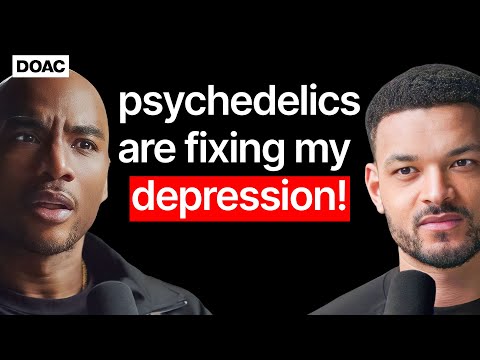
Charlamagne tha God Opens Up About His Depression & Childhood Trauma!
Charlamagne tha God (guest), Steven Bartlett (host)
In this episode of The Diary of a CEO, featuring Charlamagne tha God and Steven Bartlett, Charlamagne tha God Opens Up About His Depression & Childhood Trauma! explores charlamagne Tha God: From Childhood Trauma To Radical Adult Honesty Charlamagne Tha God candidly traces his journey from a turbulent childhood in rural South Carolina—marked by molestation, bullying, a fear-driven father, and jail time—to becoming one of America’s most influential radio voices. Despite professional success and fame with The Breakfast Club, he describes ongoing battles with anxiety, depression, and suicidal thoughts that forced him to confront the limits of money, status, and performance. Through therapy, spiritual work, plant medicine, and deep self-inquiry, he developed a philosophy summarized in his book title: “Get Honest or Die Lying,” arguing that self-deception and curated personas are a direct path to mental illness. He now centers his life on service, integrity, and being the adult he needed as a child, using his platform to normalize Black men’s mental health, challenge toxic role models, and push for more nuanced, authentic conversations.
Charlamagne Tha God: From Childhood Trauma To Radical Adult Honesty
Charlamagne Tha God candidly traces his journey from a turbulent childhood in rural South Carolina—marked by molestation, bullying, a fear-driven father, and jail time—to becoming one of America’s most influential radio voices. Despite professional success and fame with The Breakfast Club, he describes ongoing battles with anxiety, depression, and suicidal thoughts that forced him to confront the limits of money, status, and performance. Through therapy, spiritual work, plant medicine, and deep self-inquiry, he developed a philosophy summarized in his book title: “Get Honest or Die Lying,” arguing that self-deception and curated personas are a direct path to mental illness. He now centers his life on service, integrity, and being the adult he needed as a child, using his platform to normalize Black men’s mental health, challenge toxic role models, and push for more nuanced, authentic conversations.
Key Takeaways
Unresolved childhood trauma silently shapes adult behavior until it’s consciously addressed.
Charlamagne’s molestation at eight and subsequent bullying didn’t fully register as trauma until adulthood and therapy. ...
Get the full analysis with uListen AI
Parents model more through their contradictions than their words.
His father preached, “If you don’t change your lifestyle, you’ll end up in jail, dead, or broke,” while secretly using drugs, selling drugs, and being unfaithful. ...
Get the full analysis with uListen AI
Success does not cure anxiety or depression; it often amplifies them if rooted in fear.
After four firings, unemployment, and moving back home, he believed getting another job would fix his panic attacks. ...
Get the full analysis with uListen AI
“Get honest or die lying”: self-deception is a direct route to depression and imposter syndrome.
At a spiritual Ayahuasca retreat he received a clear message: stop lying to yourself and stop volunteering those lies to others. ...
Get the full analysis with uListen AI
Male role models matter, but only if they live their values and share their wounds.
Charlamagne stresses that his father could have been a powerful role model if he had been honest earlier about his own anxiety, suicide attempt, and medications. ...
Get the full analysis with uListen AI
Social media-driven identities and “micros turned macros” are eroding independent thought and emotional health.
He criticizes academics and creators who let Twitter and Reddit dictate their talking points, calling it emotional illiteracy: “You might as well be looking up to mannequins. ...
Get the full analysis with uListen AI
Service to others is not just noble; it’s a sustainable source of meaning and stability.
Having grown up with a grandmother and father who shared food and space even while poor, Charlamagne now channels resources into scholarships, podcast festivals, HBCU summits, and his Mental Wealth Alliance (aiming to fund 10,000 free therapy slots). ...
Get the full analysis with uListen AI
Notable Quotes
“If you don’t get honest with yourself, you’re gonna die lying.”
— Charlamagne Tha God
“My father used to discipline me for things he never taught me.”
— Charlamagne Tha God
“Whatever I wanna be doing five years from now, I gotta start doing now.”
— Charlamagne Tha God
“God can’t bless who you pretend to be.”
— Charlamagne Tha God
“Your true purpose in life will come through service to others.”
— Charlamagne Tha God
Questions Answered in This Episode
You describe realizing very late that your childhood ‘encounters’ were actually molestation; what specific questions or exercises in therapy helped you finally name it and connect it to your adult behavior?
Charlamagne Tha God candidly traces his journey from a turbulent childhood in rural South Carolina—marked by molestation, bullying, a fear-driven father, and jail time—to becoming one of America’s most influential radio voices. ...
Get the full analysis with uListen AI
If your father had sat you down at 15 and told you about his suicide attempt, medications, and therapy, how do you think that single conversation would have changed your choices over the next five years?
Get the full analysis with uListen AI
You’ve spoken about Ayahuasca stripping away falsehoods—if someone doesn’t have access to plant medicine, how can they practically pursue that same level of radical self-honesty without a psychedelic experience?
Get the full analysis with uListen AI
You admitted your early Breakfast Club persona was rooted in fear and pain; looking back, are there specific interviews or moments you now regret, and would you publicly address or repair any of those today?
Get the full analysis with uListen AI
Given your critique of social media’s influence on academics and creators, what concrete boundaries or protocols would you recommend a young podcaster adopt to protect their originality and mental health while still growing an online audience?
Get the full analysis with uListen AI
Transcript Preview
I didn't realize it until I got older. (instrumental music plays) I was just a young kid, and I was molested. Oof. Shit. Please welcome Charlamagne Tha God. Co-host of the Breakfast Club.
And America's most influential radio host.
Growing up, my father was telling me, "If you don't change your lifestyle, you're gonna end up in jail, dead, or broke." The problem was, he wasn't practicing what he was preaching. When I started selling drugs, I found out he was selling drugs, and then he had an affair on my mom. So I became a player, because I felt I had to be like my pops. But then, I ended up getting in a situation where a shooting happened and then going to jail. But I was able to finally wake up. And I was smart enough to realize, whatever I want to be doing five years from now, I gotta start doing now.
And then the microphone ultimately changed your life, but I didn't know that you'd had 12 years of rejection.
I got fired four times. I just collected my last unemployment check. I was scared to death. But you can't live life with fear. You gotta live life with faith. Next gig I got was the Breakfast Club. Fast-forward three, four years, I'm having more success than I've ever had in my life. But I just was not happy. I was losing myself. And, um, those suicidal thoughts just cross your mind for no reason, you know? And even, even now. What, what am I still doing here? Man.
We've just hit six million subscribers on the Diary of a CEO. Um, so me and my team would like to do something we've never done before as a little thank you, and we're calling it the Diary of a CEO Subscriber Raffle, and here is how it works. Every episode this month, we're going to pick three current subscribers at random, and we'll send one of you a 1,000 pound voucher, one of you tickets to come and watch the Diary of a CEO behind the scenes live with our team, and one of you will have a 10-minute phone call with me to discuss whatever you want to talk about. If you're a subscriber, you're in the raffle. Thank you from the bottom of my heart for allowing me to do something that me and my team love doing so much. It is the greatest honor of my lifetime, and I hope it, I hope it continues, uh, off into the future. Let's get to the episode. (instrumental music plays) Get Honest or Die Lying. Why did you choose those words? Why did you choose that title?
Um, it's a play, it's a play on 50 Cent's Get Rich or Die Tryin'. You know, um, I'm always gonna have, you know, some, some, some ode to hip hop, you know, somewhere. Like, my last book was, was Shook One, you know, that was paying homage to Mobb Deep. But also, um, you know, just talking about how I felt my whole life when I would get in, get panic attacks, get anxiety attacks. And Get Honest or Die Lying, that's, you know, not just a play on 50 Cent's title. That's how I truly feel. It's like, yo, if you don't get honest with yourself, you're gonna die lying. Like, you know, I had a, um ... I, I went to a spiritual retreat, you know, back in February, me and my wife, and like, that's one of the things that came up for me, you know, that, that, that weekend at the retreat there, one of the things that came up for me was, stop lying to yourself, and stop volunteering those lies to others. And I think a lot of us do that, you know, a lot. Like, we, we lie to ourselves, and then we just volunteer those lies to other people, like nobody even asked us, (laughs) you know? When I think, I think social media, you know, uh, contributes to a lot of that, because every day, you feel like you have to, you know, feed this beast. And like, you know, you might go look at your feed, and at some point you gotta ask yourself, "Who is this person?" You know? Or just the, just the things that you, you know, say to people, you know, in your life as you're, as you're, as you're just, you know, growing, and, and, and evolving, just as a human. You might just volunteer lies, you know, for security purposes, or to mask, to mask insecurities, or, you know, to mask fears. And so it's just like, yo, if you don't start getting honest with yourself, you're gonna, you're gonna die, die a liar.
Install uListen to search the full transcript and get AI-powered insights
Get Full TranscriptGet more from every podcast
AI summaries, searchable transcripts, and fact-checking. Free forever.
Add to Chrome