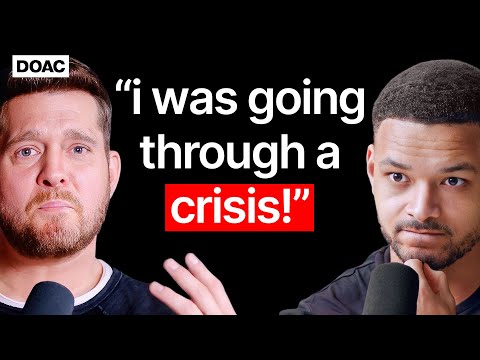
Michael Buble: "I Will NEVER Be Carefree Again!", Rejection, Cancer & Stealing!
Michael Bublé (guest), Steven Bartlett (host), Narrator, Narrator
In this episode of The Diary of a CEO, featuring Michael Bublé and Steven Bartlett, Michael Buble: "I Will NEVER Be Carefree Again!", Rejection, Cancer & Stealing! explores michael Bublé On Fame, Family, Cancer, Reinvention And Relentless Belief Michael Bublé traces his journey from a tight‑knit, working‑class Canadian family to global stardom, emphasizing how his grandfather’s obsession with the Great American Songbook and his family’s total support forged his career. He describes a decade of brutal industry rejection, funded demos, and an against‑the‑odds pitch that finally landed him a record deal and international success.
Michael Bublé On Fame, Family, Cancer, Reinvention And Relentless Belief
Michael Bublé traces his journey from a tight‑knit, working‑class Canadian family to global stardom, emphasizing how his grandfather’s obsession with the Great American Songbook and his family’s total support forged his career. He describes a decade of brutal industry rejection, funded demos, and an against‑the‑odds pitch that finally landed him a record deal and international success.
Bublé explains how his son’s cancer diagnosis instantly reordered his priorities, shattering his previous career‑first mindset and anchoring his life in faith, family, and gratitude. He talks candidly about ego, mental health, and the danger of lying to yourself, contrasting his on‑stage persona "Michael Bublé" with the off‑stage "Mike."
Now at a crossroads, he wants to spend more time expressing the comedic, improvisational “Mike” side of himself through acting, branding and business ventures like his Fraser & Thompson whiskey, while keeping music as his emotional home rather than his sole identity.
Throughout, he frames success as perseverance plus self‑belief: using rejection to build humility, obsessively honing his craft by "stealing" from many greats, and trusting that genuine passion and ability eventually find an audience—especially in an age of platforms like TikTok that bypass traditional gatekeepers.
Key Takeaways
Relentless practice plus ‘stealing from everyone’ can help you find an authentic style.
From childhood, Bublé saturated himself in Sinatra, Dean Martin, Nat King Cole, Elvis and more, literally impersonating their phrasing and tone for his grandfather. ...
Get the full analysis with uListen AI
A decade of rejection can be an asset if you combine humility with an unshakable core of self‑belief.
Bublé spent 10+ years singing in clubs, malls, weddings and funerals, hearing every agent and label say, “We will never sign you. ...
Get the full analysis with uListen AI
Sometimes the only way through a gatekeeper is to change the terms—and show up with a solution.
David Foster told Bublé flatly that he’d never produce his record and that Warner would never sign him. ...
Get the full analysis with uListen AI
Life‑altering crises can instantly reorder priorities and permanently end ‘carefree’ living.
His son Noah’s cancer diagnosis acted as a “sledgehammer” that tore down the filter over his reality. ...
Get the full analysis with uListen AI
Guard rails and intentional ‘financial irresponsibility’ can protect family life from career excess.
Remembering what it felt like when his fisherman father was gone for long stretches, Bublé deliberately structures “irresponsible” touring schedules—three weeks on, two off; or aligning tours with his wife’s filming—so he can be physically present. ...
Get the full analysis with uListen AI
Separating your public persona from your private self can both protect and constrain you.
Bublé describes himself as two people: “Michael Bublé,” the flawless, Teflon, suited showman who walks on stage, and “Mike,” the fantasy‑football‑obsessed goofball closer to Michael Scott from The Office. ...
Get the full analysis with uListen AI
Success doesn’t immunize you from loneliness, identity confusion, or the fear of decline.
Even with Grammys and multi‑platinum albums, Bublé often feels like he doesn’t belong anywhere—neither fully pop, jazz, nor classical. ...
Get the full analysis with uListen AI
Notable Quotes
“The reason that I didn’t stop in those ten years was because I knew I was the best in the world. If the right person sees me, I am one of the greatest entertainers on Earth.”
— Michael Bublé
“I could play 50,000 people, and if there’s one looking at their watch, I will play to that man. I’m not leaving here until I break you.”
— Michael Bublé
“My son’s cancer diagnosis was a sledgehammer to my reality. I will never be carefree again in my life and that’s okay.”
— Michael Bublé
“Rich isn’t what you think it is, kid. Rich is having a strong faith, a great family, and great friendships. Those rich things they’re talking about—the money—have nothing to do with it.”
— Michael Bublé
“People aren’t gonna remember shit when I die… but 200 years from now they’ll still be singing ‘Have a holly, jolly Christmas.’ I’m gonna be there. It’s so cool.”
— Michael Bublé
Questions Answered in This Episode
You said you ‘knew’ you were one of the greatest entertainers on Earth long before the industry believed in you. Looking back now with more humility and context, would you still use that same language, and how do you distinguish healthy self‑belief from dangerous delusion for a young artist?
Michael Bublé traces his journey from a tight‑knit, working‑class Canadian family to global stardom, emphasizing how his grandfather’s obsession with the Great American Songbook and his family’s total support forged his career. ...
Get the full analysis with uListen AI
When you confronted David Foster after the financing deal collapsed, you essentially engineered a confrontation he dislikes by using a script from Umberto Gatica. If Warner had said no that day, do you think you would genuinely have stopped asking—or would you have found yet another way around the wall?
Bublé explains how his son’s cancer diagnosis instantly reordered his priorities, shattering his previous career‑first mindset and anchoring his life in faith, family, and gratitude. ...
Get the full analysis with uListen AI
You described your son’s cancer diagnosis as a ‘sledgehammer’ that ensured you’ll never be carefree again. How do you stop that ever‑present dread from turning into overprotection or anxiety that limits your children’s freedom to live normal lives?
Now at a crossroads, he wants to spend more time expressing the comedic, improvisational “Mike” side of himself through acting, branding and business ventures like his Fraser & Thompson whiskey, while keeping music as his emotional home rather than his sole identity.
Get the full analysis with uListen AI
You’re actively trying to let ‘Mike’ out more—through acting, comedy‑driven ads and business ventures—while Michael Bublé the brand still sells arenas and Christmas albums. How do you plan to manage situations where what’s best for ‘Mike’ in terms of authenticity conflicts directly with what’s safest for the ‘Michael Bublé’ business?
Throughout, he frames success as perseverance plus self‑belief: using rejection to build humility, obsessively honing his craft by "stealing" from many greats, and trusting that genuine passion and ability eventually find an audience—especially in an age of platforms like TikTok that bypass traditional gatekeepers.
Get the full analysis with uListen AI
On TikTok you’ve become a kind of unexpected talent scout, DM’ing creators you love. If you were building a modern label or talent incubator from scratch today, based on everything you know about gatekeepers, rejection and discovery, what would it look like and how would it treat artists differently from the system you came up through?
Get the full analysis with uListen AI
Transcript Preview
Another summer day has come and gone away in Paris or Rome, but I wanna go home 'cause this place sucks.
(laughs)
I shoulda, I shoulda that- that should've been the lyric.
Michael Buble, smoothest singer in town. The king of Christmas.
Have a holi-jolly Christmas. Everything I did was music. I would listen to Frank Sinatra, Bobby Darin, Dean Martin. I don't know why. I just do. Emulate them, and then I would steal it all, 'cause if you steal from one person, you're just a thief, but when you steal from everybody, it's research. But there's 10 years of clubs, 10 years of every agent saying the exact same thing: "We will never sign you." But the reason I didn't stop in those 10 years was because if the right person sees me, I am one of the greatest entertainers on Earth. I could play 50,000 people, and if there's one looking at their watch, I will play to that man. I'm not leaving here until I break you. And I'm a-feeling good. But in a moment, my son's cancer diagnosis was a sledgehammer to my reality. And I remember saying to myself, "If we get out of this, um, if we get out of this, I'm living a different life." And I feel like I'm at, uh, this point where I wanna do something different.
Michael, you're, you're not gonna quit music, are you? Quick one. This is really, really fascinating to me. On the back end of our YouTube channel, it says that 69.9% of you that watch this channel frequently over the lifetime of this channel haven't yet hit the subscribe button. I just wanted to ask you a favor. It helps this channel so much if you choose to su- subscribe. Helps us scale the guests, helps us scale the production, and it makes the show bigger. So if I could ask you for one favor, if you've watched the show before and you've enjoyed it, could you please hit the subscribe button? Thank you so much, and I will repay that gesture by making sure that everything we do here gets better and better and better and better. That is a promise I'm willing to make you. Do we have a deal? Michael, what do I need to know about your earliest context to understand the way that you are now? 'Cause you are a unique individual personality-wise, talent-wise. Your life is full of uniqueness. So where is the, what is the oven? 'Cause I always think about humans like an oven.
Yeah.
Um, you know, they get cooked in this oven when they're young. What is that oven? What is that environment?
Well, the environment was probably having the most incredible family, and everybody says that. Everybody says... And of course, that's beautiful that people always think their family is the most special, but if you met them, you'd like them all more than me. And then for me, personally, I think being the first child who, um, got way too much attention, pre- you know, prob- (laughs) probably got told like, "You're amazing, and you're good at ev-" and like, uh, it's probably the reason I talk so much.
Install uListen to search the full transcript and get AI-powered insights
Get Full TranscriptGet more from every podcast
AI summaries, searchable transcripts, and fact-checking. Free forever.
Add to Chrome