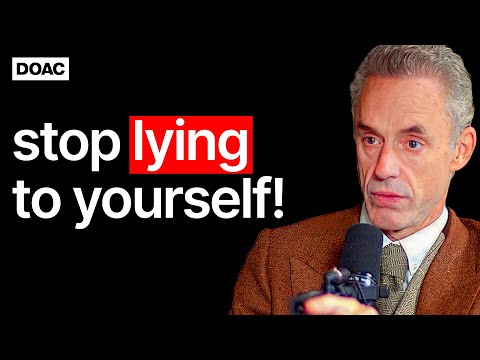
Jordan Peterson: How To Become The Person You’ve Always Wanted To Be | E113
Jordan Peterson (guest), Steven Bartlett (host)
In this episode of The Diary of a CEO, featuring Jordan Peterson and Steven Bartlett, Jordan Peterson: How To Become The Person You’ve Always Wanted To Be | E113 explores jordan Peterson Explains Truth, Suffering, and Designing a Meaningful Life Jordan Peterson and Steven Bartlett explore how radical honesty, self-awareness, and personal responsibility form the basis of a meaningful life. Peterson explains the dangers of living through a persona, the power of setting courageous goals, and practical ways to escape dead-end careers and emotional ruts. They discuss privilege, struggle, technology, the pandemic response, and why aiming at 'happiness' is a shallow life strategy compared to pursuing goodness and meaning. The conversation is emotionally intense, culminating in Peterson describing the almost unbearable weight and beauty of hearing how his work has pulled people back from despair.
Jordan Peterson Explains Truth, Suffering, and Designing a Meaningful Life
Jordan Peterson and Steven Bartlett explore how radical honesty, self-awareness, and personal responsibility form the basis of a meaningful life. Peterson explains the dangers of living through a persona, the power of setting courageous goals, and practical ways to escape dead-end careers and emotional ruts. They discuss privilege, struggle, technology, the pandemic response, and why aiming at 'happiness' is a shallow life strategy compared to pursuing goodness and meaning. The conversation is emotionally intense, culminating in Peterson describing the almost unbearable weight and beauty of hearing how his work has pulled people back from despair.
Key Takeaways
Drop the mask to build real relationships and a real life
Peterson argues that many people live through a 'persona'—a socially optimized mask built to appear desirable and competent while hiding underlying insecurity and inadequacy. ...
Get the full analysis with uListen AI
Treat feeling 'trapped' as a strategic problem you can solve
When stuck in a miserable job or situation, Peterson recommends a structured, strategic approach rather than impulsive escape. ...
Get the full analysis with uListen AI
Use brutally honest self-inquiry to kickstart self-awareness
Peterson offers a specific exercise: sit on your bed at night and sincerely ask, “What is one thing I’m doing wrong, that I know I’m doing wrong, that I could fix, that I would fix? ...
Get the full analysis with uListen AI
Pay for your privilege with virtue, not guilt or denial
Peterson accepts that much of what we have—intelligence, health, wealth, a stable culture—is fundamentally unearned, which naturally generates existential guilt, especially against a backdrop of historical atrocities. ...
Get the full analysis with uListen AI
Aim at an endless uphill climb, not a life of ease
Happiness, in Peterson’s view, is a by-product, not a worthy life goal. ...
Get the full analysis with uListen AI
Don’t outsource wisdom to technology, experts, or political systems
On remote work and online education, Peterson warns that we don’t understand our embodied environments well enough to virtualize them safely. ...
Get the full analysis with uListen AI
Help others by listening, not by directing their destiny
When trying to 'encourage' people you love, Peterson cautions against assuming you know what’s best for them. ...
Get the full analysis with uListen AI
Notable Quotes
“If you want to know something about yourself, sit on your bed one night and say, 'What's one thing I'm doing wrong that I know I'm doing wrong, that I could fix, that I would fix?'”
— Jordan Peterson
“Without that [truthfulness], you don't have the adventure of your life. You have the role that you've acquiesced to. And that'll take all the meaning out of your life.”
— Jordan Peterson
“The way you pay for your privilege is with your virtue.”
— Jordan Peterson
“We're built to walk uphill, and when you reach the pinnacle of the hill, you want to stop and appreciate the vision, but the next thing you want is a higher hill in the distance.”
— Jordan Peterson
“Aim to be good and pray for happiness.”
— Jordan Peterson
Questions Answered in This Episode
When you tell people to 'imagine who you could be and then aim single‑mindedly at that,' how do you suggest they distinguish between a genuinely meaningful ideal and an ego-driven fantasy shaped by social media and status?
Jordan Peterson and Steven Bartlett explore how radical honesty, self-awareness, and personal responsibility form the basis of a meaningful life. ...
Get the full analysis with uListen AI
In your example of negotiating a 40% raise with a boss, where do you think the ethical line is between healthy 'thinking like a snake' and becoming manipulative or Machiavellian in career strategy?
Get the full analysis with uListen AI
You argue that pandemic policies were driven largely by fear and opinion polls rather than science; what specific decision-making framework would you have recommended governments adopt instead, and how would it have balanced public health with civil liberties?
Get the full analysis with uListen AI
Your self-awareness exercise focuses on asking what we are doing wrong that we could fix—how do you prevent that from sliding into obsessive self-criticism or perfectionism in people already prone to guilt and shame?
Get the full analysis with uListen AI
You say the way to pay for privilege is with virtue; in very unequal societies, do you think there is also a political or structural obligation beyond individual virtue, and if so, what would that look like without collapsing into resentment or authoritarianism?
Get the full analysis with uListen AI
Transcript Preview
If you want to know something about yourself, sit on your bed one night and say, "What's one thing I'm doing wrong that I know I'm doing wrong, that I could fix, that I would fix?" You meditate on that, you'll get an answer, and it won't be one you want, but it'll be the necessary one. (whoosh) When you're trapped, some of it's your own inadequacy. What you can do to begin with is every bloody thing you possibly can do to put yourself in the most virtuous and powerful negotiating position possible. (whoosh) Wherever I go in the world, people come up to me, and they often have a pretty rough story to relate. It's an awful thing, because you see, even in the revelation of their triumph, the initial depth of their despair. (choking up) So I wouldn't change that. But it's not nothing. (choking up) And it's certainly not just happiness. (choking up) It's better than happiness, but it's almost unbearable.
Quick one. Can you do me a favor if you're listening to this and hit the subscribe button, the follow button, wherever you're listening to this podcast? Thank you so much. The conversation you guys have been waiting for. I say that because of the thousands and thousands of messages I've had since I announced that Jordan Peterson, the man himself, all the way from Canada, came here to sit in my kitchen and have a conversation with me. And what a conversation it was. One of the most moving moments in the history of this podcast takes place in this conversation. And I think the thing that people love about Jordan Peterson is his unrelenting desire to just say what he believes to be true, not what he believes to be correct, not what people want to hear, not what people will be happy to hear. And it's because of that, it's because of his pursuit of truth, that he's managed to change millions and millions and millions of people's lives. That is absolutely no understatement. So without further ado, I'm Steven Bartlett, and this is the Diary of a CEO. I hope nobody's listening, but if you are, then please keep this to yourself. (instrumental music) Jordan, um, first, I, I feel, I feel like I owe you a debt of gratitude, and I want to say thank you for the, the impact you've had on my life. And I'll, I'll point at the, the specific impact you've had on my life.
Mm-hmm.
Um, I... And you asked me before we started recording why this podcast had been successful. One of the reasons is actually something I've, I've gained from, from reading and listening to your work, and that's this real commitment to trying to be your true self and trying to be your truth. Th- This podcast wouldn't be successful, and I wouldn't have been successful in terms of, um, pursuing myself, had I not understood the m- the importance of truth across all facets of life and in my relationships, which was a real pivotal thing for me.
Install uListen to search the full transcript and get AI-powered insights
Get Full TranscriptGet more from every podcast
AI summaries, searchable transcripts, and fact-checking. Free forever.
Add to Chrome