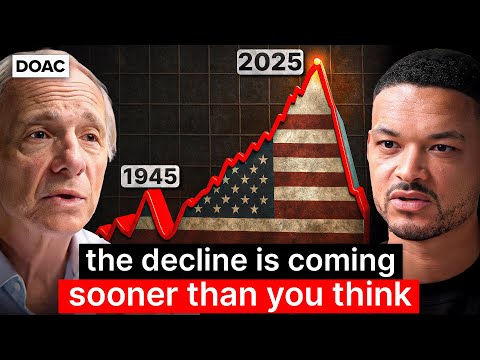
Ray Dalio: We’re Heading Into Very, Very Dark Times! America & The UK’s Decline Is Coming!
Ray Dalio (guest), Steven Bartlett (host), Narrator, Narrator
In this episode of The Diary of a CEO, featuring Ray Dalio and Steven Bartlett, Ray Dalio: We’re Heading Into Very, Very Dark Times! America & The UK’s Decline Is Coming! explores ray Dalio Warns: Democracies Teeter As Debt, AI, And Conflict Rise Ray Dalio explains why he is pessimistic about the future of both the UK and the US, arguing they are deep into a repeating 80‑year historical cycle driven by debt, internal conflict, geopolitical rivalry, nature, and technology.
Ray Dalio Warns: Democracies Teeter As Debt, AI, And Conflict Rise
Ray Dalio explains why he is pessimistic about the future of both the UK and the US, arguing they are deep into a repeating 80‑year historical cycle driven by debt, internal conflict, geopolitical rivalry, nature, and technology.
He outlines how rising debt burdens, widening wealth gaps, and eroding trust in institutions create conditions for social unrest, authoritarian temptations, and potential conflict between great powers, particularly the US and China.
Amid this, Dalio gives practical advice for individuals: understand your own nature and life cycle, build financial strength and geographic flexibility, cultivate principled thinking and radical open‑mindedness, and leverage technology (including AI) rather than be replaced by it.
He also shares personal principles from his life arc—from founding Bridgewater to coping with the death of his son—emphasising meditation, reflection, meaningful work and relationships, and building idea‑driven, truth‑seeking organisations.
Key Takeaways
Understand the Five Forces Driving Long‑Term National Cycles
Dalio argues that history moves in roughly 80‑year cycles driven by five interacting forces: (1) money and debt dynamics, (2) internal social and political conflict, (3) geopolitical conflict and changing world orders, (4) acts of nature (pandemics, climate, disasters), and (5) human inventiveness, especially technology. ...
Get the full analysis with uListen AI
The UK and US Are in Late, Risky Stages of Their Cycles
Dalio is not optimistic about either the UK or the US. ...
Get the full analysis with uListen AI
For Individuals: Know Your Nature And Design Your Life Arc Around It
Dalio insists the most important starting point for individuals is understanding their own ‘nature’—their innate preferences, inclinations, and ways of thinking—and then choosing paths, careers, and geographies consistent with that. ...
Get the full analysis with uListen AI
Build Financial Strength And Geographic Flexibility (“Three Holes For The Smart Rabbit”)
In unstable times, Dalio stresses the importance of personal resilience: earn, spend, and save prudently; invest intelligently; and maintain the flexibility to move yourself and your capital to safer or more promising jurisdictions if necessary. ...
Get the full analysis with uListen AI
Turn Pain Into Progress Through Reflection, Principles, And (Optionally) Meditation
Dalio’s core formula is “Pain + Reflection = Progress. ...
Get the full analysis with uListen AI
Practice Radical Open‑Mindedness To Avoid Catastrophic Errors
Dalio calls the greatest tragedy of mankind “holding a strong opinion that is wrong” when it could have been corrected with more open‑mindedness. ...
Get the full analysis with uListen AI
Leverage Others, Culture, And Technology Instead Of Just Working Harder
While hard work is crucial (it builds strength and power), Dalio cautions that scaling impact requires leverage: exceptional people, clear principles, and systems. ...
Get the full analysis with uListen AI
Notable Quotes
“Pain plus reflection equals progress.”
— Ray Dalio
“People always think that the future will be a slightly modified version of the present. And it’s not.”
— Ray Dalio
“The greatest tragedy of mankind is holding a strong opinion that is wrong, that you could’ve made better if you were open to learning more.”
— Ray Dalio
“A smart rabbit has three holes… the ability to go to good places and away from bad places.”
— Ray Dalio
“What brings people happiness is meaningful work and meaningful relationships… beyond a certain level, money doesn’t correlate much with well‑being.”
— Ray Dalio
Questions Answered in This Episode
You argue that technology winners will ‘win all wars’; what specific indicators or metrics would you personally track over the next decade to judge whether the US or China is actually ahead in the technology war?
Ray Dalio explains why he is pessimistic about the future of both the UK and the US, arguing they are deep into a repeating 80‑year historical cycle driven by debt, internal conflict, geopolitical rivalry, nature, and technology.
Get the full analysis with uListen AI
You’re sceptical that the UK can reverse its decline, yet you also say that ‘pockets’ of excellence can spread; if you were forced to design a realistic 20‑year turnaround blueprint for the UK, what would be the first three non‑negotiable policy moves?
He outlines how rising debt burdens, widening wealth gaps, and eroding trust in institutions create conditions for social unrest, authoritarian temptations, and potential conflict between great powers, particularly the US and China.
Get the full analysis with uListen AI
You recommend geographic flexibility and even question home ownership, but for someone with children rooted in school and community, how should they weigh the trade‑off between resilience (moving) and stability (staying) in a potentially deteriorating country?
Amid this, Dalio gives practical advice for individuals: understand your own nature and life cycle, build financial strength and geographic flexibility, cultivate principled thinking and radical open‑mindedness, and leverage technology (including AI) rather than be replaced by it.
Get the full analysis with uListen AI
Your idea meritocracy at Bridgewater demanded radical transparency and no gossip, a culture many people find extremely uncomfortable; in hindsight, what parts of that system do you think are essential and transplantable to most organisations, and which parts don’t generalise well?
He also shares personal principles from his life arc—from founding Bridgewater to coping with the death of his son—emphasising meditation, reflection, meaningful work and relationships, and building idea‑driven, truth‑seeking organisations.
Get the full analysis with uListen AI
On AI and robotics, you’re simultaneously ‘excited’ and deeply worried about inequality and social fracture; if you were designing a concrete policy and social framework to avoid an underclass of ‘useless’ people, what would that look like in practice beyond simple income redistribution?
Get the full analysis with uListen AI
Transcript Preview
Pay attention. (instrumental music plays) Pain plus reflection equals progress. And from that principle, my company became the largest hedge fund in the world.
Managing how much?
$150 billion. But I learned that history of things that never happened in my lifetime before were important things to understand in order to predict the future, and we can get into that if you want.
Please.
So...
Ray Dalio is the legendary billionaire investor... ... who decoded the cycles of human history to predict financial crashes. ... build the world's largest hedge fund... And now to warn us about what lies ahead. Are you optimistic about the future of the UK?
No.
What about the United States?
No.
Why?
Okay. In order to bet on what's going to happen on the global economy, I learned that there's five big forces that create a big cycle that's repeated through history, which lasts about 80 years. The first is the money/debt force. That creates wealth and opportunities gaps, and it's connected to the second force, the internal conflict, where you don't trust the system, causing wars between the left and the right. And it's not easy answers like, "Tax the rich," and we can get into that. But the third is geopolitical force, in other words, international conflict. Then there's acts of nature. And then number five is man's inventiveness, particularly of new technologies. Now, the question is who wins the technology war? Because the winner of that determine how the new world order works.
Is it something to be concerned about?
No (beep) . The question is how you as an individual handle it.
How do I as an individual handle it?
So there's building your financial strength, flexibility, the importance of being open-minded, and how to get more out of the minute, not how to work harder, and I really urge your audience to learn all of this. So first of all...
I see messages all the time in the comments section that some of you didn't realize you didn't subscribe, so if you could do me a favor and double check if you're a subscriber to this channel, that would be tremendously appreciated. It's the simple, it's the free thing that anybody that watches this show frequently can do to help us here to keep everything going and this show in the trajectory it's on. So, please do double check if you've subscribed, and, uh, thank you so much. Because in a strange way, you are, you're part of our history, and you're on this journey with us, and I appreciate you for that. So, yeah, thank you. (instrumental music plays) Ray, I, I want to describe to you who's listening right now, and I... the question I have for you is, what is the most important thing that this persona or person should be thinking about at the highest level right now? So the, the person that's listening is someone who is intent on improving their life. They're, they're really interested in business, potentially starting their own business. They, they care about where they're investing their, their time and energy, and also where they're setting up their home, based on ge- in terms of geography. They are aspiring to accomplish some goal. They're probably between the age of 18 and 50, predominantly, and they are very, very interested in understanding what's happening in a world that feels incredibly scary, fast-paced, and uncertain at the moment. This is a very difficult question, but if anyone... I was gonna ask anyone, it would have to be you. Wh- wh- what, what's one of the first things they should be considering at this moment to safeguard their future, their family, their finances?
Install uListen to search the full transcript and get AI-powered insights
Get Full TranscriptGet more from every podcast
AI summaries, searchable transcripts, and fact-checking. Free forever.
Add to Chrome