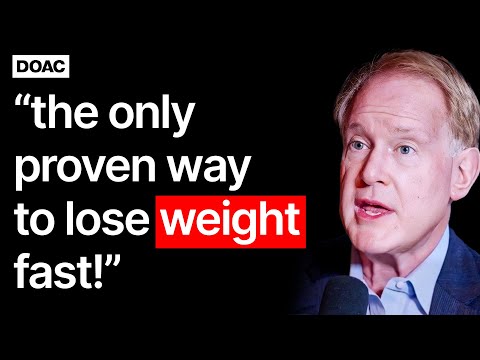
The Glucose Expert: The Only Proven Way To Lose Weight Fast! Calorie Counting Is A Load of BS!
Dr. Robert Lustig (guest), Steven Bartlett (host)
In this episode of The Diary of a CEO, featuring Dr. Robert Lustig and Steven Bartlett, The Glucose Expert: The Only Proven Way To Lose Weight Fast! Calorie Counting Is A Load of BS! explores glucose Expert Exposes Sugar, Fat Loss Myths, And Food Industry Deceit Endocrinologist Dr. Robert Lustig argues that sugar—not calories—is the primary dietary driver of obesity, diabetes, fatty liver, and widespread mental and metabolic illness. He explains how fructose, ultra-processed foods, and environmental chemicals damage mitochondria, the liver, and the brain, while the food industry has systematically concealed these harms.
Glucose Expert Exposes Sugar, Fat Loss Myths, And Food Industry Deceit
Endocrinologist Dr. Robert Lustig argues that sugar—not calories—is the primary dietary driver of obesity, diabetes, fatty liver, and widespread mental and metabolic illness. He explains how fructose, ultra-processed foods, and environmental chemicals damage mitochondria, the liver, and the brain, while the food industry has systematically concealed these harms.
Lustig distinguishes pleasure from happiness at a neurochemical level (dopamine vs. serotonin), showing how addictive, hyper-palatable foods and digital stimuli hack our reward circuitry and increase depression and anxiety. He contends that most weight-loss failures stem from insulin resistance rather than lack of willpower or calorie-counting discipline.
He presents a metabolic framework—“protect the liver, feed the gut, support the brain”—to evaluate food, emphasizes fiber and real food, and outlines how reducing sugar and refined carbohydrates can reverse metabolic disease in many cases. He also calls for regulatory action, industry reform, and better tools (like his “Perfect” filtering system) so individuals aren’t left to navigate a “minefield” of deceptive food marketing alone.
Key Takeaways
Stop focusing on calories; target insulin and liver fat instead.
Lustig argues that “a calorie is not a calorie” because different nutrients act very differently at the mitochondrial level. ...
Get the full analysis with uListen AI
Fructose (the sweet half of sugar) behaves like alcohol in the body.
Table sugar (sucrose) is half glucose, half fructose. ...
Get the full analysis with uListen AI
Sugar and sweeteners hijack brain chemistry, driving addiction and unhappiness.
Pleasure runs on dopamine, happiness on serotonin. ...
Get the full analysis with uListen AI
Ultra-processed food is often not “food” in a biological sense.
Lustig defines food as something that supports growth or burning (mitochondrial energy production). ...
Get the full analysis with uListen AI
Fiber and the microbiome are central to metabolic and immune health.
Juicing and refining remove fiber, which is critical not for you directly, but for your gut bacteria. ...
Get the full analysis with uListen AI
Diet sodas are “half as bad,” not good.
Though diet sodas contain no sugar or calories, Lustig cites data showing their overall toxicity is about half that of sugared soda: sweet taste triggers a cephalic insulin response (“sugar’s coming”), accentuating insulin release with meals, and artificial sweeteners alter the gut microbiome, increasing intestinal permeability and systemic inflammation. ...
Get the full analysis with uListen AI
Personal “willpower” is overestimated; environment and industry design are underestimated.
Sugar is inherently addictive, and 73% of supermarket products contain added sugar under 200+ names. ...
Get the full analysis with uListen AI
Notable Quotes
“Calories are not the issue. The whole issue of calories has to go down the tubes. I am here to hashtag kill the calorie as a unit of measure.”
— Dr. Robert Lustig
“The more pleasure you seek, the more unhappy you get, and we’ve been told for the last 100 years that pleasure is happiness.”
— Dr. Robert Lustig
“If you consume one sugared beverage per day, your risk for diabetes goes up by 29%. If you have two, 58%.”
— Dr. Robert Lustig
“We have neonatal obesity. These kids did not get obese by gluttony and sloth. They came out of the womb behind the eight-ball.”
— Dr. Robert Lustig
“Food can be medicine. Food can also be poison, and the question is, how do you figure out which is which?”
— Dr. Robert Lustig
Questions Answered in This Episode
You argue fructose is toxic above about 12 g/day in adults—how should an average person practically estimate their daily fructose load when so much of it is hidden and renamed on labels?
Endocrinologist Dr. ...
Get the full analysis with uListen AI
In your 10-day sugar-removal study, children improved dramatically on low-sugar but still highly processed foods; what additional benefits (or risks) do you expect if you repeated the experiment with whole, unprocessed foods and lots of fiber?
Lustig distinguishes pleasure from happiness at a neurochemical level (dopamine vs. ...
Get the full analysis with uListen AI
You equate sugar’s toxic-addictive profile with substances like alcohol and tobacco—where do you draw the line on regulation without provoking backlash about “nanny state” control and loss of personal freedom?
He presents a metabolic framework—“protect the liver, feed the gut, support the brain”—to evaluate food, emphasizes fiber and real food, and outlines how reducing sugar and refined carbohydrates can reverse metabolic disease in many cases. ...
Get the full analysis with uListen AI
For someone already diagnosed with type 2 diabetes, what specific steps and timelines do you see as realistic for reversing the disease through insulin-lowering strategies rather than medication alone?
Get the full analysis with uListen AI
You describe environmental obesogens and endocrine disruptors as unavoidable in air and water—if you had to prioritize three concrete changes an average family can make this year to reduce that burden, what would they be and why those over all the others?
Get the full analysis with uListen AI
Transcript Preview
Let's be clear and honest about this. Calories are not the issue. This is all about... That's the problem. That's how you lose weight. Dr. Robert Lustig is an endocrinologist whose firsthand research has explored- ... the role sugar has on fueling the world's most destructive human conditions.
And answers how we can regain control of our health.
If you consume one sugared beverage per day, your risk for diabetes goes up by 29%, so this is a big problem. We also know that if you have high sugar consumption, it's got multiple detrimental effects, such as mental health problems, cognitive decline, early death. We also know that it's the primary driver of ADD, but the problem is, sugar's addictive. And 73% of all of the items in the grocery store are spiked with added sugar by the food industry 'cause they know when they add it, you buy more. You can't believe what they're telling you. If they say something is healthy, it's usually the opposite, and I'm part of numerous lawsuits suing the food industry because they knew that sugar was a problem, but they paid off scientists to say it wasn't. You've been hacked.
But a lot of people don't have time to be doing a fine-tooth comb over every single thing that they're putting into their body.
Correct.
They're not a scientist.
Agreed.
So, what advice do we give that is simple and actionable?
Food can be medicine. Food can also be poison, and the question is, how do you figure out which is which? So here's the secret.
Congratulations, Diary of a CEO gang. We've made some progress. 63% of you that listen to this podcast regularly don't subscribe, which is down from 69%. Our goal is 50%, so if you've ever liked any of the videos we've posted, if you like this channel, can you do me a quick favor and hit the subscribe button? It helps this channel more than you know, and the bigger the channel gets, as you've seen, the bigger the guests get. Thank you, and enjoy this episode. Dr. Robert Lustig, on the front of your book, it says, "The Hacking of the Mind." Very strong words to use.
Indeed.
Whose mind has been hacked, and who is doing the hacking?
Yours, mine, everyone's. Who's been doing it? Well, (laughs) pretty much anyone with a, a belief system that's not yours, and that's pretty much everybody. The bottom line is, uh, we have been sold a bill of goods. We as a society, we as individuals, have been sold a bill of goods, and the idea of the book, the reason I put the book together, is because it actually makes us miserable. It has stolen our birthright, and our birthright is to be happy, and we are not. If anything, we're the opposite of happy. We're extraordinarily unhappy. Just look at the incidents of depression around the world, not just in America, not just in the UK, but everywhere. The World Health Organization now says that 5% of all of the people on the planet are clinically depressed, and here in America, it's at 22%, so we're really unhappy. (laughs) So the question is, why is this if, you know, our goal is to be happy? It's in the Declaration of Independence, "Life, liberty, and the pursuit of happiness." Well, we're not. So, why? And the reason is because we have substituted pleasure for happiness. What's the difference between pleasure and happiness? Well, pleasure's short-lived, happiness is long-lived. Pleasure is visceral, you feel it in your body. Happiness is ethereal, you feel it above the neck. Pleasure is taking, like from a casino. Happiness is giving, like Habitats for Humanity. Pleasure is experienced alone. Happiness is usually experienced in social groups. Pleasure can be achieved with substances. Happiness cannot be achieved with substances. (laughs) The extremes of pleasure, whether they be substances or behaviors, so substances like cocaine, amphetamine, nicotine, alcohol, sugar, or behaviors, uh, shopping, gambling, social media, internet gaming, pornography, in the extreme, all lead to addiction. There's an -aholic after every one of those, shopaholic, sexaholic, chocoholic, alcoholic, et cetera. But there's no such thing as being addicted to too much happiness. And lastly, number seven, the one that is the reason for the book, pleasure's dopamine, happiness is serotonin, and they are not the same. So, two different neurotransmitters, two different sets of receptors, two different areas of the brain, two different mechanisms of action, two different clearance mechanisms. Dopamine is an excitatory neurotransmitter.
Install uListen to search the full transcript and get AI-powered insights
Get Full TranscriptGet more from every podcast
AI summaries, searchable transcripts, and fact-checking. Free forever.
Add to Chrome