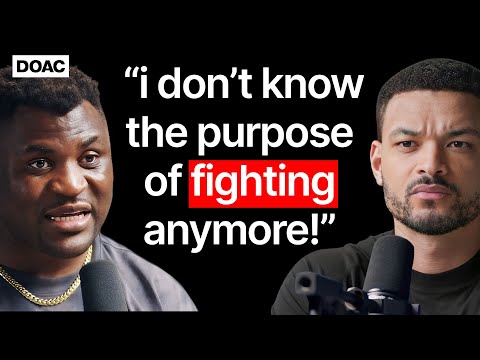
Francis Ngannou Breaks Down Sharing Heartbreaking Story: “I Don’t Know How To Deal With This!”
Francis Ngannou (guest), Steven Bartlett (host)
In this episode of The Diary of a CEO, featuring Francis Ngannou and Steven Bartlett, Francis Ngannou Breaks Down Sharing Heartbreaking Story: “I Don’t Know How To Deal With This!” explores from Desert Crossings To Devastating Loss: Francis Ngannou’s Relentless Fight Francis Ngannou traces his journey from extreme poverty in rural Cameroon to becoming UFC heavyweight champion and a headline boxing star, detailing the brutal realities that shaped his mindset. He recounts working in sand mines as a child, crossing the Sahara on a pickup truck, surviving nearly a year in Moroccan forests, and making seven attempts to reach Europe, including six failed sea crossings. In Paris, he slept in a car park while pursuing boxing and then MMA, eventually reaching the UFC, clashing with Dana White over contractual freedom, and earning life‑changing purses against Tyson Fury and Anthony Joshua. The conversation culminates in his raw account of losing his 15‑month‑old son, his struggle with grief, and his attempt to find a new purpose in fighting and life.
From Desert Crossings To Devastating Loss: Francis Ngannou’s Relentless Fight
Francis Ngannou traces his journey from extreme poverty in rural Cameroon to becoming UFC heavyweight champion and a headline boxing star, detailing the brutal realities that shaped his mindset. He recounts working in sand mines as a child, crossing the Sahara on a pickup truck, surviving nearly a year in Moroccan forests, and making seven attempts to reach Europe, including six failed sea crossings. In Paris, he slept in a car park while pursuing boxing and then MMA, eventually reaching the UFC, clashing with Dana White over contractual freedom, and earning life‑changing purses against Tyson Fury and Anthony Joshua. The conversation culminates in his raw account of losing his 15‑month‑old son, his struggle with grief, and his attempt to find a new purpose in fighting and life.
Key Takeaways
Extreme hardship can crystallize purpose early in life.
Kicked out of class at 13 for unpaid school fees, Ngannou decided that day he would become a professional fighter to change his family’s circumstances. ...
Get the full analysis with uListen AI
Relentless pursuit of a dream often looks irrational from the outside.
Ngannou attempted to reach Europe seven times—surviving a Sahara crossing in a cramped pickup, drinking foul water with dead animals, living months in Moroccan forests, being cut up on barbed‑wire fences, and being dumped back in the desert every time patrols caught his dinghy. ...
Get the full analysis with uListen AI
One person’s belief and practical help can profoundly alter a life trajectory.
Arriving homeless in Paris, Ngannou walked into a boxing gym and honestly explained he had no money or place to sleep but wanted to be a world champion. ...
Get the full analysis with uListen AI
Understanding contracts and leverage is critical for athletes’ long‑term freedom.
Ngannou describes the UFC contract as heavily one‑sided: lifetime‑style clauses, strict exclusivity, the promotion’s ability to starve fighters of bouts, and extension triggers if a fighter declines a fight for any reason, while the UFC had almost no binding obligations. ...
Get the full analysis with uListen AI
Institutional gamesmanship in elite boxing can materially affect performance.
In contrast to what he calls a fair, straightforward promotion around the Tyson Fury fight, Ngannou alleges that the Anthony Joshua fight week was full of “tricks”: deliberately mis‑timed transport, long enforced waits, and a fight‑night schedule that left him in the locker room for roughly four and a half hours and nodding off from fatigue, while Joshua arrived much later. ...
Get the full analysis with uListen AI
Grief from losing a child can shatter identity and past definitions of strength.
When his 15‑month‑old son Kobe died suddenly, without illness or a chance to intervene, Ngannou says it erased the very reason he’d fought his whole life—to protect his family from suffering. ...
Get the full analysis with uListen AI
Purpose and forward motion can be a lifeline in the aftermath of trauma.
Even while acknowledging that no therapist or action can remove the pain or bring his son back, Ngannou is choosing to train, return to Cameroon, and fight again—framing it as searching for a new purpose. ...
Get the full analysis with uListen AI
Notable Quotes
“When your dream is so big, it’s hard to give up.”
— Francis Ngannou
“I bought my freedom. Freedom is not free—you have to give something in order to get that.”
— Francis Ngannou
“The failure is not actually that you don’t succeed. The failure is not taking action, is not even try.”
— Francis Ngannou
“What’s the purpose of fighting if I will end up not being able to fight for the only person that I could fight for?”
— Francis Ngannou
“Just being tired being tough—I think it’s exhausting.”
— Francis Ngannou
Questions Answered in This Episode
Looking back now, would you still take the same migration risks—crossing the Sahara, the barbed wire, and the dinghy attempts—knowing what you know about the trauma and scars they left?
Francis Ngannou traces his journey from extreme poverty in rural Cameroon to becoming UFC heavyweight champion and a headline boxing star, detailing the brutal realities that shaped his mindset. ...
Get the full analysis with uListen AI
Can you walk through one concrete example of a contract clause you refused to sign with the UFC and explain exactly how it would have limited your life or career if you had accepted it?
Get the full analysis with uListen AI
You’ve suggested there were ‘tricks’ used before the Anthony Joshua fight to tire you out—if you had full control over fight‑week logistics, what specific rules or standards would you implement to protect fighters from that kind of gamesmanship?
Get the full analysis with uListen AI
When you say you’re now fighting to honor Kobe, how does that intention practically change the way you train, choose opponents, or think about risk compared to when your primary goal was lifting your family out of poverty?
Get the full analysis with uListen AI
You often say the real failure is not trying—how would you advise a young fighter in Africa who has a dream like yours but is considering a dangerous migration, to balance courage with self‑preservation and alternative options at home?
Get the full analysis with uListen AI
Transcript Preview
Just getting tired, being tough was the purpose of fighting if I will end up not being able to fight for the only person that I could fight for. (instrumental music plays)
(crowd cheering) Presenting Francis Ngannou! UFC Heavyweight Champion of the World!
I was 13 years that I decided that I was going to be a professional fighter, but I have no money. We don't have shoes, we don't have food. There's not a gym. I have to do something for that dream, so I left Cameroon.
You need to get to Spain. I was reading that people died.
Oh, a lot.
And you were drinking water that had dead animals.
We had no choice. I attempt in the ocean, I fell six time. I tried to climb the fence, the barbed wire, it was the toughest part.
Why didn't you give up?
When your dream is so big, it's hard to give up, and the day that we arrive in Paris, I could start that dream to become a world champion.
Francis Ngannou! Francis Ngannou! The greatest heavyweight in the world! You left the UFC because of a disagreement with Dana White. What's the truth?
Easy, he didn't want to (censored) .
And then you fought Anthony Joshua.
Honestly, on that fight, there was a lot of unfairness.
What do you mean?
They have a lot of tricks.
Do you think they were doing that intentionally?
Yeah. It was so messy.
And then life shows how cruel it's capable of being.
When my boy pass away, that was the moment that I really felt like, like a failure.
Have you been able to grieve? (instrumental music plays) The Diary of a CEO raffle is about to close. Anyone that subscribes to The Diary of a CEO before we hit seven million subscribers, which is probably gonna be in a couple of days time, you will be included in the raffle, and on the day we hit seven million subscribers, we are giving away a lot of money can't buy prizes to all of you. So hit the subscribe button, get in before seven million, and I'll announce the prizes and the winners in the comments below when we hit seven million subscribers. (instrumental music plays) Francis, we met in a hotel room in Paris.
Mm-hmm.
It was me, you, Thierry Henry, and, uh, Chemi, and several other people, and, um-
Yeah.
... I knew you from TV. I'd watched you fight, but I had no idea about your story, and it's funny 'cause we all went around one at a time, Thierry, me, um, and then you, and shared our early story. And when y- we came to your story, I just couldn't believe it was true.
Mm.
I couldn't believe it was true.
Really?
Of c- course. I'd never heard, and I sit here and interview people for a living. I've never in my life heard- heard a story like that, from where you started to where you ultimately ended up. And I know you've told it before to some people, but I have to start there because it, I think it creates the context of everything that you are today and the man that sits in front of me. So if you take me back to West Cameroon in 1986-
Install uListen to search the full transcript and get AI-powered insights
Get Full TranscriptGet more from every podcast
AI summaries, searchable transcripts, and fact-checking. Free forever.
Add to Chrome