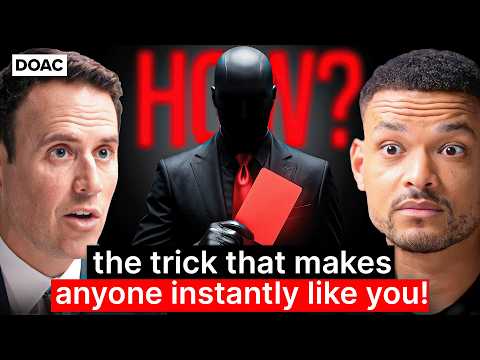
Oz Pearlman (Mentalist): This Small Mistake Makes People Dislike You! They Do This, They’re Lying!
Oz Pearlman (guest), Steven Bartlett (host)
In this episode of The Diary of a CEO, featuring Oz Pearlman and Steven Bartlett, Oz Pearlman (Mentalist): This Small Mistake Makes People Dislike You! They Do This, They’re Lying! explores world’s Top Mentalist Reveals How Tiny Habits Transform Your Influence Oz Pearlman, a former Wall Street analyst turned world‑class mentalist, explains that he doesn’t read minds but reads people, using micro‑behaviors, preparation, and psychology to influence and connect. He demonstrates mentalism live, then unpacks the real, repeatable habits behind his apparent “mind reading.”
World’s Top Mentalist Reveals How Tiny Habits Transform Your Influence
Oz Pearlman, a former Wall Street analyst turned world‑class mentalist, explains that he doesn’t read minds but reads people, using micro‑behaviors, preparation, and psychology to influence and connect. He demonstrates mentalism live, then unpacks the real, repeatable habits behind his apparent “mind reading.”
Central themes include overcoming fear of rejection, structuring persuasive communication, improving memory, reading truth vs. lies, and making interactions unforgettable through small details. Oz argues that true ‘mentalism’ is understanding how others think and feel, then shaping your behavior around them, not yourself.
He offers concrete tactics: how to open conversations, how to sell by making it all about the other person, how to benchmark lies, and how to remember people’s names and details so they feel uniquely valued. Woven through is his own story of leaving Merrill Lynch to pursue an unlikely passion, and what it really took to reach the top of such a niche field.
Key Takeaways
Stop trying to read minds; learn to read people and situations.
Oz is explicit that mind reading is impossible; what he actually does is read patterns in human behavior—micro‑cues, habitual reactions, and context. ...
Get the full analysis with uListen AI
Overcome fear of rejection by ‘splitting’ your identity and reframing failure.
As a teenager doing restaurant magic, Oz was rejected all the time. ...
Get the full analysis with uListen AI
Lead every interaction with benefits for them, not credentials about you.
In sales or pitches, most people talk about how great they or their product are. ...
Get the full analysis with uListen AI
Use structured curiosity hooks to capture attention in seconds.
Oz engineers what Steven calls a ‘positive curiosity gap’—open‑ended, upbeat lines that compel continuation and make it hard to say no (e. ...
Get the full analysis with uListen AI
Benchmark people to spot lies and interest instead of relying on myths.
Lie detection isn’t about single “tells”; it’s about knowing how someone behaves when telling the truth and comparing deviations. ...
Get the full analysis with uListen AI
Treat memory as a competitive advantage: ‘listen, repeat, reply.’
Because everyone outsources memory to phones, remembering details has become rare and disproportionately powerful. ...
Get the full analysis with uListen AI
Shape what people remember, not just what actually happens.
Oz discovered that minor staging choices change how spectators later describe an event. ...
Get the full analysis with uListen AI
Notable Quotes
“My whole job is to make you believe that I can read minds, but here is the honest truth: I can’t read minds. I read people.”
— Oz Pearlman
“The number one factor between failure and success is the fear of rejection.”
— Oz Pearlman
“It’s not about you, it’s always about them. That’s been the number one secret to my success.”
— Oz Pearlman
“The most interesting person in the room tends to be the most interested person in the room.”
— Oz Pearlman
“If you assign your self‑esteem to something others can give you—fame, money—it’s fleeting.”
— Oz Pearlman
Questions Answered in This Episode
When you told the Merrill Lynch CFO you already worked there and he replied, “What are you doing working here?”, what were the practical first steps you took in the following weeks to de‑risk leaving Wall Street?
Oz Pearlman, a former Wall Street analyst turned world‑class mentalist, explains that he doesn’t read minds but reads people, using micro‑behaviors, preparation, and psychology to influence and connect. ...
Get the full analysis with uListen AI
In your restaurant pitch example, how would you adapt that ‘positive curiosity gap’ approach for a high‑stakes B2B sales meeting where the prospect is skeptical and under time pressure?
Central themes include overcoming fear of rejection, structuring persuasive communication, improving memory, reading truth vs. ...
Get the full analysis with uListen AI
You emphasize benchmarking someone’s normal behavior to detect lies—have you ever misjudged a person’s honesty in a consequential way, and what did you learn about your own biases from that experience?
He offers concrete tactics: how to open conversations, how to sell by making it all about the other person, how to benchmark lies, and how to remember people’s names and details so they feel uniquely valued. ...
Get the full analysis with uListen AI
Your “listen, repeat, reply” framework is powerful for names; what would a similarly simple three‑step framework look like for remembering and later using key details from a 60‑minute client meeting without it feeling manipulative?
Get the full analysis with uListen AI
You talked about designing experiences so that people remember a particular story rather than the literal sequence of events; where do you personally draw the ethical line between shaping memory and outright deception, especially in non‑entertainment contexts like marketing or leadership?
Get the full analysis with uListen AI
Transcript Preview
I've spent three decades reverse engineering the human mind to show you how you can use it to know what somebody's thinking when they meet you, or if somebody is telling you the truth or lying. So, let's do something fun. (instrumental music plays) Imagine that in front of you was an invisible deck of cards. Spread them out in front of you. And I want you to reach down and imagine you just grabbed a card at random. Now, look at it. Look at me. Okay, close your eyes. Hold your hand out, please. Now, before you open your eyes, tell us, what was that card?
Three of diamonds.
Hmm. Open your eyes. Take a look. And it's not magic. I can teach you this. And these secrets, these habits, they're applicable all throughout life. So trust me, you don't wanna miss the rest of this.
Oz Pearlman walked away from Wall Street to become the world's leading mentalist, unlocking the skills we need... ... to read people, win trust, spot a liar, and influence anyone.
My whole job is to make you believe that I can read minds, but here is the honest truth, that's impossible. But I read people, through small, minute details. For example, we're hardwired from thousands of years that if I approach you directly with two eyes, it can create fear, versus if I turn ever so slightly and approach you with one eye, that one eye is less danger. So it's all about the smallest little nuances. Like think of someone, think of their first name. I got it. Five letters, isn't it? Tell us all, what is their first name?
Jules.
Jules. So this is a huge tactical advantage when you ask your boss for a raise, or when you ask someone out on a date. And I'll explain what to do, as well as how you form habits, eliminating that fear of rejection, and also the fast track for confidence. But the next thing is how to improve your memory, which is a huge secret to success, and I have a tip. I've repurposed the instructions on a shampoo bottle, and the first step is what 95% of us do wrong. So...
I see messages all the time in the comments section that some of you didn't realize you didn't subscribe, so if you could do me a favor and double-check if you're a subscriber to this channel, that would be tremendously appreciated. It's the simple, it's the free thing that anybody that watches this show frequently can do to help us here to keep everything going in this show and the trajectory it's on. So, please do double-check if you've subscribed, and, uh, thank you so much. Because in a strange way, you are- you're part of our history, and you're on this journey with us, and I appreciate you for that. So, yeah, thank you. (instrumental music plays) Oz Pearlman, you're a guy who can apparently read people's minds. In fact, the book you've just written is called Read Your Mind: Proven Habits for Success from the World's Greatest Mentalist. So for anyone that isn't familiar with your work and what you do, why did you name your book Read Your Mind? And can you read my mind?
Install uListen to search the full transcript and get AI-powered insights
Get Full TranscriptGet more from every podcast
AI summaries, searchable transcripts, and fact-checking. Free forever.
Add to Chrome