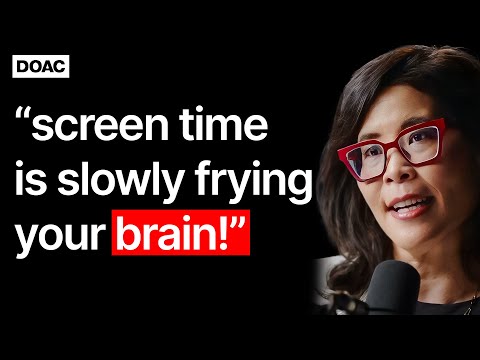
The Exercise Neuroscientist: NEW RESEARCH, The Shocking Link Between Exercise And Dementia!
Wendy Suzuki (guest), Steven Bartlett (host), Narrator
In this episode of The Diary of a CEO, featuring Wendy Suzuki and Steven Bartlett, The Exercise Neuroscientist: NEW RESEARCH, The Shocking Link Between Exercise And Dementia! explores exercise, Anxiety, And Love: How To Build A Fluffy Brain Neuroscientist Wendy Suzuki explains how exercise, sleep, social connection, and mindfulness literally change the structure and function of the brain, protecting against dementia and sharpening cognition at any age.
Exercise, Anxiety, And Love: How To Build A Fluffy Brain
Neuroscientist Wendy Suzuki explains how exercise, sleep, social connection, and mindfulness literally change the structure and function of the brain, protecting against dementia and sharpening cognition at any age.
She walks through the science of brain plasticity, highlighting how movement releases growth factors that enlarge the hippocampus and strengthen the prefrontal cortex, improving memory, attention, mood, and long‑term resilience.
Suzuki also reframes anxiety, sadness, and grief as meaningful signals that can be transformed into insight and even “superpowers,” drawing on her own experience of family loss and her students’ rising anxiety in a hyper-digital world.
Throughout, she and host Steven Bartlett connect neuroscience to everyday choices—exercise routines, diet, sleep, social media, relationships, and love—showing how they either build a “big, fat, fluffy brain” or slowly shrink and damage it.
Key Takeaways
Regular aerobic exercise is the single most powerful everyday tool to protect your brain from aging and dementia.
Studies in adults 65+ show that walking three times a week reduces the risk of developing dementia in the next five years by about 30%. ...
Get the full analysis with uListen AI
Every drop of sweat counts: more movement generally means more brain benefit.
In low-fit individuals, just 2–3 weekly 45-minute spin classes improved mood, memory, and attention. ...
Get the full analysis with uListen AI
You can deliberately make information more memorable by using four principles: repetition, association, novelty, and emotional resonance.
The hippocampus stores long-term memories for facts and events and works best when information is repeated, tied to something familiar (association), presented in a novel or surprising way, and linked to emotion via the amygdala. ...
Get the full analysis with uListen AI
Sleep and social connection are non‑negotiable pillars of brain health.
During sleep, the hippocampus consolidates memories and cerebrospinal fluid clears metabolic ‘garbage’; chronic sleep loss leads to a “gunky brain” and poorer function. ...
Get the full analysis with uListen AI
Modern digital habits—sedentary behavior, social media overuse, and constant comparison—erode brain health and drive anxiety.
Excess screen and social media time is linked with increases in anxiety, depression, and suicidality, especially in young girls. ...
Get the full analysis with uListen AI
Anxiety, sadness, and grief are painful but invaluable signals, not flaws to erase.
Suzuki argues that anxiety functions as a warning system that points to what we most care about—e. ...
Get the full analysis with uListen AI
You can build daily ‘brain routines’ that compound over time into a healthier, happier mind.
Suzuki’s personal routine includes a 45-minute tea meditation, ~30 minutes of mixed exercise, and a hot–cold contrast shower to boost alertness. ...
Get the full analysis with uListen AI
Notable Quotes
“Every drop of sweat counted. The more you exercised, the more change in your brain we noted.”
— Wendy Suzuki
“A big, fat, fluffy brain is a healthy brain… It is a pathway to a happy life.”
— Wendy Suzuki
“Our stress and our threat system is not very smart. It isn’t differentiating between the lion that could physically kill us and the DM that might wound our pride.”
— Wendy Suzuki
“The only reason why I was feeling that unfathomable grief is because of the deep love that I had… the grief was a sign of the love.”
— Wendy Suzuki
“You only have one brain, and there are things you can do right now today to make it stronger.”
— Wendy Suzuki
Questions Answered in This Episode
You referenced a 30% reduction in dementia risk from walking three times a week—what level of intensity and duration did those ‘walks’ actually involve, and do we know if shorter, more frequent walks confer similar protection?
Neuroscientist Wendy Suzuki explains how exercise, sleep, social connection, and mindfulness literally change the structure and function of the brain, protecting against dementia and sharpening cognition at any age.
Get the full analysis with uListen AI
In your spin-class studies where ‘every drop of sweat counted,’ did you observe a plateau in cognitive benefits at very high exercise frequencies, or could there be a point where more exercise starts to introduce stress rather than benefit?
She walks through the science of brain plasticity, highlighting how movement releases growth factors that enlarge the hippocampus and strengthen the prefrontal cortex, improving memory, attention, mood, and long‑term resilience.
Get the full analysis with uListen AI
Given the strong role of social connection in brain health, how would you design a ‘brain-healthy’ urban environment or school system that counteracts the isolating effects of phones and social media?
Suzuki also reframes anxiety, sadness, and grief as meaningful signals that can be transformed into insight and even “superpowers,” drawing on her own experience of family loss and her students’ rising anxiety in a hyper-digital world.
Get the full analysis with uListen AI
You described grief as a sign of deep love and anxiety as a signal of what we value—what practical steps can someone take, day by day, to map their recurring anxieties into a concrete list of values and then act on that insight?
Throughout, she and host Steven Bartlett connect neuroscience to everyday choices—exercise routines, diet, sleep, social media, relationships, and love—showing how they either build a “big, fat, fluffy brain” or slowly shrink and damage it.
Get the full analysis with uListen AI
As both a neuroscientist and a person of faith, how would you advise someone who feels their spiritual practices help them psychologically but worries they are ‘irrational’ because they’re not empirically provable?
Get the full analysis with uListen AI
Transcript Preview
In this box is a real preserved human brain named Betty. And I think you should hold it.
Oh my God, it's wet.
And now we're gonna go through all the tools and tricks to make your brain as healthy as it can be. Are you ready? Wendy Suzuki, a neuroscientist and professor at New York University.
Whose firsthand research on the brain is helping to improve memory, learning, and higher cognitive abilities in humans.
Let me start with exercise. All the research shows the more you exercise, the more change in your brain we notice. Every drop of sweat counted. And the best kind of exercise that you can do is...
What about things that we consume? Food, drink, and alcohol?
If it's on the Mediterranean diet, go ahead.
Coffee. And then my memory's not great.
Most people feel that. But there's four things that you can do to make memories stick. Number one is...
Is it true that if we have less friends then our brain will shrink?
Yes, loneliness damages the brain.
Can you see if someone's in love in the brain?
Yes, in the side here a lot of the reward areas are activated.
Doesn't that mean then that if we don't fall in love, the love part of my brain gets smaller? And would that make it more difficult to love in the future?
That's a great question, so...
Wendy, do you have any brain routines?
Absolutely. So every morning I like to... Oh, and then I do the most powerful tool that you can do to protect your brain from aging and neurodegenerative disease states, which is...
We've just hit six million subscribers on The Diary of a CEO, so me and my team would like to do something we've never done before as a little thank you, and we're calling it The Diary of a CEO Subscriber Raffle, and here is how it works. Every episode this month, we're going to pick three current subscribers at random, and we'll send one of you a 1,000 pound voucher, one of you tickets to come and watch The Diary of a CEO behind the scenes live with our team, and one of you will have a ten minute phone call with me to discuss whatever you want to talk about. If you're a subscriber, you're in the raffle. Thank you from the bottom of my heart for allowing me to do something that me and my team love doing so much. It is the greatest honor of my lifetime, and I hope that, I hope that continues, uh, off into the future. Let's get to the episode. You just said to me that much of your work is focused on making sure people have big, fat, fluffy brains.
Yes.
Why does that matter?
It matters because a big, fat, fluffy brain is a healthy brain, and my whole first book, Healthy Brain, Happy Life, was about how I learned to use all the tools and tricks and magic of neuroscience and psychology to make my brain work better. And I so needed it at that moment. My life got better. I got happier. It is a pathway to a happy life, I think, having a very healthy, big, fat, fluffy brain.
Install uListen to search the full transcript and get AI-powered insights
Get Full TranscriptGet more from every podcast
AI summaries, searchable transcripts, and fact-checking. Free forever.
Add to Chrome