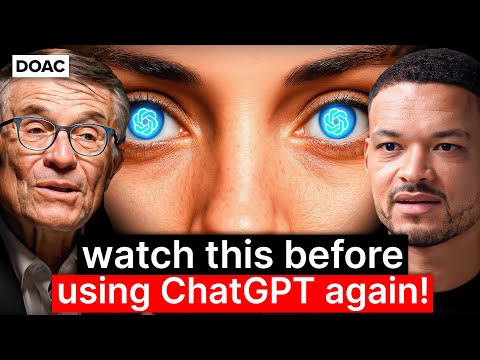
Brain Experts WARNING: Watch This Before Using ChatGPT Again! (Shocking New Discovery)
Dr Daniel Amen (guest), Dr Terry Sejnowski (guest), Steven Bartlett (host), Narrator
In this episode of The Diary of a CEO, featuring Dr Daniel Amen and Dr Terry Sejnowski, Brain Experts WARNING: Watch This Before Using ChatGPT Again! (Shocking New Discovery) explores aI Convenience Versus Cognitive Decline: Brain Experts Sound Urgent Warning Two leading brain experts, psychiatrist Dr. Daniel Amen and computational neuroscientist Dr. Terry Sejnowski, discuss how large language models like ChatGPT may erode critical thinking, memory, and long‑term brain health if used as a cognitive replacement rather than a thinking partner.
AI Convenience Versus Cognitive Decline: Brain Experts Sound Urgent Warning
Two leading brain experts, psychiatrist Dr. Daniel Amen and computational neuroscientist Dr. Terry Sejnowski, discuss how large language models like ChatGPT may erode critical thinking, memory, and long‑term brain health if used as a cognitive replacement rather than a thinking partner.
They dissect a headline‑grabbing (yet not peer‑reviewed) MIT study showing a 47% drop in brain activity and sharply worse memory when people wrote with ChatGPT versus unaided, and connect lowered cognitive load to higher long‑term dementia risk under the “use it or lose it” principle.
The conversation broadens to SSRI and benzo links with dementia, AI companions and sexualized agents like “Annie,” children’s brain development, loneliness, learning science, and practical protocols for protecting brain health across the lifespan.
Both argue we have repeatedly “embraced convenience before understanding consequence” (social media, ultra‑processed food, smartphones) and warn that AI—especially for kids—could be more dangerous unless we deliberately legislate, study, and personally self‑regulate how we use it.
Key Takeaways
Use AI to amplify, not replace, your thinking
Amen and Sejnowski stress that the damaging pattern is deferring cognition to ChatGPT—e. ...
Get the full analysis with uListen AI
Low cognitive load today can raise dementia risk tomorrow
Amen links reduced brain “work” from over‑automation (AI writing, GPS, calculators, etc. ...
Get the full analysis with uListen AI
Children’s brains are especially vulnerable to AI, porn, and screens
Both experts are alarmed about early, unregulated AI exposure: 0–8 year‑olds using AI for learning, teens immersed in social media, and now sexualized AIs like Musk’s “Annie. ...
Get the full analysis with uListen AI
AI companions can hack the limbic system but not replace real relationships
Sexual and romantic AIs (e. ...
Get the full analysis with uListen AI
Core brain health pillars still matter more than any app
Beyond AI, the experts repeatedly return to fundamentals: regular physical exercise (Amen’s BRIGHT MINDS framework; Sejnowski calls it the best ‘drug’ for brain and body), quality sleep for memory consolidation, anti‑inflammatory nutrition (omega‑3s, whole foods, less aspartame/sucralose), breathwork to calm the nervous system, and minimizing toxins and chronic stressors like noise and ultra‑processed foods. ...
Get the full analysis with uListen AI
Learning is a skill: spaced repetition, breaks, and “sleeping on it” work
Sejnowski outlines robust, century‑old learning science that schools largely ignore: spaced repetition (reviewing material over days/weeks instead of one cram session) vastly improves long‑term retention; breaks and physical activity allow the subconscious to integrate and sort information; and starting tasks in small 20‑minute chunks reduces procrastination while letting overnight consolidation clarify thinking. ...
Get the full analysis with uListen AI
Ask yourself constantly: ‘Is this good for my brain or bad for it?’
Amen argues a single question should govern personal choices and public policy: is this behavior, technology, or policy good or bad for the brain? ...
Get the full analysis with uListen AI
Notable Quotes
“We’ve embraced convenience before understanding consequence. We’ve done it with video games, cellphones, social media, marijuana, alcohol, opiates, high‑fructose corn syrup and aspartame—and now we’re doing it with AI.”
— Dr. Daniel Amen
“If you misuse these large language models… your brain’s gonna go downhill. There’s no doubt about that.”
— Dr. Terry Sejnowski
“Use it to amplify, not replace, thinking. If you don’t have a relationship with AI, it’s going to turn toxic.”
— Dr. Daniel Amen
“By far, the best drug you can take for your brain—and not just your brain but your entire body—is exercise.”
— Dr. Terry Sejnowski
“I wonder if one of the great hedges of the next decade is to go left when everyone’s going right—to refrain and do it the hard way.”
— Steven Bartlett
Questions Answered in This Episode
In the MIT study you discussed, which specific brain regions showed the 47% reduction in activity with ChatGPT use, and what kinds of follow‑up experiments would you design to test whether interactive AI use reverses that pattern?
Two leading brain experts, psychiatrist Dr. ...
Get the full analysis with uListen AI
If you were building an AI tutor for children from scratch, what concrete guardrails and design features (e.g., reward schedules, content filters, interaction limits) would you insist on to protect the developing prefrontal cortex and promote genuine learning rather than shortcut‑seeking?
They dissect a headline‑grabbing (yet not peer‑reviewed) MIT study showing a 47% drop in brain activity and sharply worse memory when people wrote with ChatGPT versus unaided, and connect lowered cognitive load to higher long‑term dementia risk under the “use it or lose it” principle.
Get the full analysis with uListen AI
You drew a strong parallel between sexualized AIs like ‘Annie’ and pornography’s impact on the dopamine system; what would an evidence‑based regulatory framework for these AI companions look like that still respects adult autonomy but shields minors’ brains?
The conversation broadens to SSRI and benzo links with dementia, AI companions and sexualized agents like “Annie,” children’s brain development, loneliness, learning science, and practical protocols for protecting brain health across the lifespan.
Get the full analysis with uListen AI
Given the association between SSRIs, benzodiazepines, and dementia risk, how should front‑line clinicians practically change their prescribing practices today—especially when many patients can’t access brain imaging or high‑end integrative care?
Both argue we have repeatedly “embraced convenience before understanding consequence” (social media, ultra‑processed food, smartphones) and warn that AI—especially for kids—could be more dangerous unless we deliberately legislate, study, and personally self‑regulate how we use it.
Get the full analysis with uListen AI
If governments actually adopted your proposal to evaluate every policy through the lens of ‘Is this good for our brains or bad for them?,’ which current mainstream technologies or practices do you think would be first in line for serious restriction or redesign—and how would you justify that politically?
Get the full analysis with uListen AI
Transcript Preview
ChatGPT is gonna potentially increase your risk of dementia.
I'm sorry, but you've- you've pressed my button, and actually, it is possible to use it to help you become a smarter person, but it requires education. You have to look at the risks and the benefits.
But we embrace convenience before understanding consequence.
So we have to talk about this. This is a study that came out that sent a shockwave across the world, and astonishingly, MIT found a 47% collapse in brain activity when people wrote with ChatGPT compared with writing unaided. Their memory scores plunged. And you're both masters of the brain. I mean, you've probably scanned more brains than any other human on Earth at this point. And you invented the Boltzmann machine with Geoffrey Hinton, a computer that simulated how the brain works. So my question is, what are your concerns?
If you misuse these large language models, like using it as a convenience to speed things up, your brain's gonna go downhill. There's no doubt about that.
What about children?
We have the sickest young generation in history because of cellphones, social media, and I think AI is much more dangerous on the developing brain.
So are we raising mentally weak kids?
There is that argument, and I think it's true.
And then there's many examples of people falling in love with AIs, like Annie.
I thought you might have forgotten about me, handsome.
Can you talk to Daniel and Terry, please?
Oh, baby, I'm ready to charm the socks off them. Picture me t-
Okay, so I'll stop it there. So what advice would you give as it relates to AI and other things outside of AI that we can do to have healthy brains?
I'll tell you how to use ChatGPT to improve our cognitive abilities.
And if you wanna keep your brain healthy, you have to treat the 11 major risk factors.
So here we go.
I see messages all the time in the comment section that some of you didn't realize you didn't subscribe, so if you could do me a favor and double-check if you're a subscriber to this channel, that would be tremendously appreciated. It's the simple, it's the free thing that anybody that watches this show frequently can do to help us here to keep everything going in this show and the trajectory it's on. So, please do double-check if you've subscribed, and, uh, thank you so much, because in a strange way, you are- you're part of our history, and you're on this journey with us, and I appreciate you for that. So, yeah, thank you. Dr. Daniel, Dr. Terry, I have asked you both to sit with me today to help me understand the impact of these tools that we call large language models, the ChatGPTs, the Geminis of the world, the Groks of the world, are having on our brains, and I guess more broadly, on our lives. And you two are experts in your field. You're two people that I admire tremendously. So by way of introduction, Terry, what is your academic background and what is your experience? And I also know that you know one of our friends of the show, Geoffrey Hinton. Can you give me an overview of your- your academic and your sort of, um, professional background?
Install uListen to search the full transcript and get AI-powered insights
Get Full TranscriptGet more from every podcast
AI summaries, searchable transcripts, and fact-checking. Free forever.
Add to Chrome