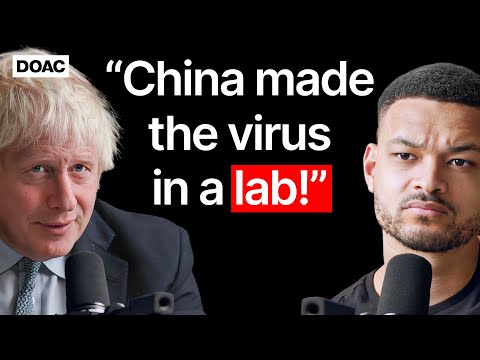
Boris Johnson: "They Were Looking at Engineering the Virus” & “The Government Tried To Bribe Me!"
Boris Johnson (guest), Steven Bartlett (host), Narrator, Narrator, Narrator, Narrator
In this episode of The Diary of a CEO, featuring Boris Johnson and Steven Bartlett, Boris Johnson: "They Were Looking at Engineering the Virus” & “The Government Tried To Bribe Me!" explores boris Johnson Defends Brexit, Lockdowns, And ‘Partygate’ In Fiery Interview Boris Johnson’s long-form interview on The Diary of a CEO covers his childhood, political rise, Brexit, the COVID-19 pandemic, Partygate, and his public persona. He frames Brexit as a democratic and regulatory liberation whose economic benefits he believes will emerge over time, while rejecting prevailing data that suggest economic harm. On COVID, Johnson defends his reliance on scientific advice, the timing of lockdowns, and the vaccine rollout, but admits deep uncertainty about whether lockdown benefits outweighed social costs, especially for children. The conversation becomes most heated around Partygate and political patronage, where Johnson apologizes in narrow terms, resists moral culpability, and acknowledges the perception gap between Westminster and a grieving public.
Boris Johnson Defends Brexit, Lockdowns, And ‘Partygate’ In Fiery Interview
Boris Johnson’s long-form interview on The Diary of a CEO covers his childhood, political rise, Brexit, the COVID-19 pandemic, Partygate, and his public persona. He frames Brexit as a democratic and regulatory liberation whose economic benefits he believes will emerge over time, while rejecting prevailing data that suggest economic harm. On COVID, Johnson defends his reliance on scientific advice, the timing of lockdowns, and the vaccine rollout, but admits deep uncertainty about whether lockdown benefits outweighed social costs, especially for children. The conversation becomes most heated around Partygate and political patronage, where Johnson apologizes in narrow terms, resists moral culpability, and acknowledges the perception gap between Westminster and a grieving public.
Key Takeaways
Johnson’s early family instability shaped his work-obsessed coping style and competitive persona.
He describes a loving but turbulent upbringing: frequent moves, a busy and often absent father, his mother’s OCD and eight-month psychiatric inpatient stay when he was 10, and his parents’ divorce at 14. ...
Get the full analysis with uListen AI
His ‘comic’ political persona is partly cultural, partly strategic, and not, he claims, a trauma shield.
Pressed repeatedly on whether his bumbling, high-energy persona is a calculated marketing device or a psychological defense, Johnson insists it stems from a family culture that abhorred dullness and demanded everyone be entertaining. ...
Get the full analysis with uListen AI
Johnson argues Britain’s core problem is unequal opportunity, not innate talent, and sees ‘levelling up’ as the central political mission.
His scholarship to Eton convinced him that intelligence and drive are ‘evenly distributed’ across the UK, while opportunity is not. ...
Get the full analysis with uListen AI
On Brexit, he portrays himself as torn intellectually but ultimately driven by a belief in democratic sovereignty, not detailed post‑Brexit planning.
Johnson concedes there were ‘good arguments both ways’ and that his unpublished pro‑Remain article was a deliberate exercise to stress-test his thinking. ...
Get the full analysis with uListen AI
He credits Brexit with enabling the UK’s rapid COVID vaccine rollout, while remaining ambivalent about the true effectiveness of lockdowns.
Johnson argues that regulatory freedom post‑Brexit allowed the UK to authorize vaccines faster, vaccinate high‑risk groups by early 2021, and exit restrictions ahead of European peers, which he says boosted economic recovery. ...
Get the full analysis with uListen AI
Johnson now leans toward a lab‑leak origin for COVID-19 and criticizes international reluctance to confront China.
He recounts early calls with Xi Jinping, when the working assumption was a ‘wet market’ origin in Wuhan. ...
Get the full analysis with uListen AI
On Partygate, he offers a narrow apology for rule breaches but strongly rejects the public narrative of wild parties and personal hypocrisy.
Johnson insists he was fined only for briefly entering the Cabinet Room during his birthday, denies seeing cake, music, or dancing, and says the famous ‘cheese and wine in the garden’ event was work-related and cleared by police. ...
Get the full analysis with uListen AI
Notable Quotes
“If you come out and support leave, I will fuck you up forever. But if you support remain, you can have a top five job in the Cabinet.”
— Boris Johnson (quoting David Cameron)
“I now think that almost certainly it was a lab accident… They were looking at engineering viruses and ways that they could manipulate it. Sadly, something went wrong.”
— Boris Johnson
“The problem was that we had no plans for government, no plans for negotiations, because it was not our job. It was up to the government to announce the plan to withdraw.”
— Boris Johnson (paraphrasing his book)
“Did the benefits of lockdown outweigh the very, very severe damage done to kids’ life chances at school? Honestly, I think we did the right thing, but I’m conscious there are lots of people who disagree.”
— Boris Johnson
“Do you really think I was deliberately partying and breaking the rules? To say it was a party is a complete travesty.”
— Boris Johnson
Questions Answered in This Episode
You repeatedly frame Brexit as a democratic imperative despite credible short‑ to medium‑term economic costs. If in 10–15 years the data still show a persistent GDP drag, would you consider that evidence that the trade‑off was misjudged, or would sovereignty still justify the outcome?
Boris Johnson’s long-form interview on The Diary of a CEO covers his childhood, political rise, Brexit, the COVID-19 pandemic, Partygate, and his public persona. ...
Get the full analysis with uListen AI
On COVID, you acknowledge uncertainty over how much lockdowns versus natural epidemic dynamics saved lives, yet you’re confident you ‘did the right thing.’ What specific quantitative or counterfactual evidence—if any—would have to emerge from the Hallett inquiry to make you revise that conclusion?
Get the full analysis with uListen AI
You described Cameron’s ‘top five job’ offer and threat to ‘fuck you up forever’ as almost normal political behavior. What concrete reforms, if any, would you support to reduce patronage and perceived corruption in ministerial appointments, or do you think the current system is acceptable?
Get the full analysis with uListen AI
You now say you ‘almost certainly’ believe in a lab‑leak origin for COVID and that scientists and WHO were too cautious about blaming China. As prime minister at the time, is there anything you wish you had done differently in publicly challenging China or reforming global health governance?
Get the full analysis with uListen AI
On Partygate, you focus on legal findings and false allegations, but the core public anger is about moral leadership during shared sacrifice. If you could replay just one decision related to Number 10’s internal culture during COVID—rules on gatherings, messaging to staff, or your own behavior—what exactly would you change and why?
Get the full analysis with uListen AI
Transcript Preview
Do you really think I was deliberately partying and breaking the rules?
But it's all about leading by example, isn't it? I-
Well, what's ... But, sorry, but to say it was a party is a complete travesty.
Seeing that photo when one of my friends couldn't go to their grandmother's funeral is the most enraging thing.
Yeah, I-
I think all gatherings should have been banned at Number 10 because I think-
What do you mean gatherings?
Gatherings with alcohol and music-
So there was-
... and cake. You should never have allowed that to happen.
I apologize for that.
Boris Johnson.
The former Prime Minister of the UK whose reign included Brexit, COVID, and the Ukraine War.
He's one of the world's most famous politicians. On this point of Brexit, how did David Cameron react when you said you're going to vote leave?
He said, "If you come out and, and support leave, I will (censored) you up forever. But if you support remain, you can have a top five job in the Cabinet."
But is that not a bit corrupt? And is that how the jobs are dished out in the government at the moment?
Look, I'm sad to say that it's probably been the way politics has been since the dawn of time.
And then this letter you wrote about the decision to leave or stay within the EU, which was unpublished. You seemed torn. So, do you regret Brexit?
Well...
The next big thing was the pandemic.
There was a lot of stuff we, we didn't know and I think it almost certainly was a lab accident. They, they were looking at engineering viruses and ways that they could manipulate it. Sadly, something went wrong.
When you talk about lockdowns, you refer to them as bonkers, which is strange hearing it from the guy that put the rules in place.
Well, did the benefits of lockdown outweigh the very, very severe damage done to kids? Um-
What do you think the answer to that question is?
Honestly, I think-
Boris, I just wanted to ask a few more things. Trump or Kamala?
Yeah.
Who's the best for international relations? How many kids do you have? Charlotte Owen, you're not related to her, are you? And then you have quite a distinct persona. People describe you as being a buffoon. When I first saw you, I thought you were a parody from Bo' Selecta.
No. (laughs)
Is it calculated?
Well, to get people interested in politics, you gotta sugar the pill.
But also, your mother said you had certain mechanisms to cope with pain because your mother is sent to a psychiatric facility when you were 10. I read there was physical violence in the house. And then at 14, your parents get divorced.
Install uListen to search the full transcript and get AI-powered insights
Get Full TranscriptGet more from every podcast
AI summaries, searchable transcripts, and fact-checking. Free forever.
Add to Chrome