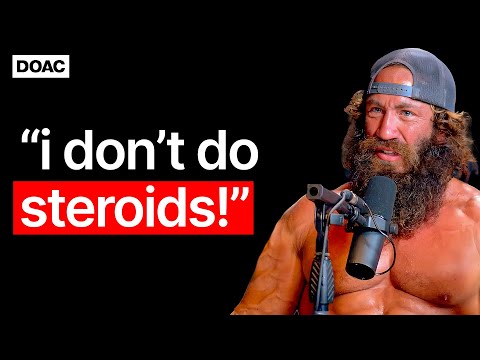
Liver King Responds To Steroid Accusations! | E171
Liver King (guest), Steven Bartlett (host)
In this episode of The Diary of a CEO, featuring Liver King and Steven Bartlett, Liver King Responds To Steroid Accusations! | E171 explores liver King Confronts Pain, Purpose, Steroids Rumors, And Modern Weakness Brian Johnson, known as Liver King, discusses how childhood bullying, fatherlessness, and harsh parenting forged his obsession with strength, control, and his Liver King persona. He lays out his ‘9 ancestral tenets’—sleep, eat, move, shield, connect, cold, sun, fight, bond—as a holistic cure for modern physical and mental suffering, citing his own family’s health crises and visits to indigenous tribes.
Liver King Confronts Pain, Purpose, Steroids Rumors, And Modern Weakness
Brian Johnson, known as Liver King, discusses how childhood bullying, fatherlessness, and harsh parenting forged his obsession with strength, control, and his Liver King persona. He lays out his ‘9 ancestral tenets’—sleep, eat, move, shield, connect, cold, sun, fight, bond—as a holistic cure for modern physical and mental suffering, citing his own family’s health crises and visits to indigenous tribes.
He addresses Joe Rogan’s steroid accusations, insisting his physique comes from decades of extreme training and lifestyle rather than drugs, and explains why he wants a face‑to‑face conversation about self‑limiting beliefs. The conversation also dives into his parenting philosophy, including extreme rites of passage like “The Barbarian” workout, and his belief that modern men have become too soft and unaccountable.
Johnson reveals he secretly suffers from crippling public‑speaking anxiety despite his bombastic online persona, and describes pushing through terror to spread his message because of the letters and transformations he sees from followers. Throughout, he returns to themes of responsibility, hardship as a gift, radical honesty, deep family bonding, and becoming a ‘self‑made king’ by living more like our ancestors.
Key Takeaways
Hardship can be a formative ‘rite of passage’—but often needs guidance.
Johnson’s brutal bullying from ages 10–14 gave him a ‘living hell’ that forged his drive, self‑reliance, and obsession with the gym. ...
Get the full analysis with uListen AI
Strength and self‑ownership are central to his model of mental and physical health.
He frames strength as an ‘alpha virtue across time and space’ and ties modern anxiety, depression, obesity, and infertility to a loss of hard challenges and personal accountability. ...
Get the full analysis with uListen AI
His ‘9 ancestral tenets’ offer a simple, behavior‑driven health framework.
The tenets—sleep, eat, move, shield, connect, cold, sun, fight, bond—are presented as levers that modulate hormones, neurochemistry, and mood. ...
Get the full analysis with uListen AI
Food simplicity and organ meats are central to his health narrative.
He argues modern diets of processed foods, seed oils, and liquid calories have replaced ancestral nose‑to‑tail eating. ...
Get the full analysis with uListen AI
Modern hyper‑connectivity is causing loneliness; in‑person bonding must be rebuilt deliberately.
He links rising loneliness and mental distress to screens displacing real human contact. ...
Get the full analysis with uListen AI
Engineered extreme challenges can redefine self‑belief and bleed into other domains.
His ‘Barbarian’ workout—1 mile carrying 70‑lb kettlebells in each hand, 70 lbs on the back, 120‑lb sled, 20‑lb ankle weights—functions as a modern rite of passage. ...
Get the full analysis with uListen AI
Behind the persona is real vulnerability: family health crises and crippling public‑speaking fear.
He describes his son Rad’s severe PANDAS (intrusive thoughts, wanting to damage his brain to escape), and the desperation of nearly ‘losing’ him mentally until dietary changes (removing cacao and honey, strict keto‑carnivore) coincided with recovery. ...
Get the full analysis with uListen AI
Notable Quotes
“It was like a living fucking hell… I got the shit kicked out of me every single day.”
— Liver King (Brian Johnson)
“Hard times make strong men, and there’s no requirement for hard times in the modern world.”
— Liver King
“I haven’t brushed in a decade… Our early ancestors didn’t brush, didn’t floss, didn’t get cavities.”
— Liver King
“Cheating doesn’t scale. It’s not sustainable and it doesn’t scale.”
— Liver King
“Part of the reason why I never wanted to publicly come out as the Liver King is because I’ve been completely terrified of public speaking.”
— Liver King
Questions Answered in This Episode
You’ve said you would ‘press the button’ for your sons to endure a 10–14‑style hell with your guidance. Given how many peers didn’t survive your original environment, what specific guardrails or interventions would you put in place so that their rite of passage builds them instead of breaking them?
Brian Johnson, known as Liver King, discusses how childhood bullying, fatherlessness, and harsh parenting forged his obsession with strength, control, and his Liver King persona. ...
Get the full analysis with uListen AI
In your son Rad’s PANDAS recovery, how do you distinguish between correlation and causation regarding removing cacao and honey and going keto‑carnivore, and would you support a controlled clinical trial to test those observations rather than relying on a single compelling anecdote?
He addresses Joe Rogan’s steroid accusations, insisting his physique comes from decades of extreme training and lifestyle rather than drugs, and explains why he wants a face‑to‑face conversation about self‑limiting beliefs. ...
Get the full analysis with uListen AI
You argue that society is suffering because men have become ‘soft, manicured’ and lack hard times; how do you reconcile that with the data on male suicide and mental health, where ‘just toughen up’ messaging has often been part of the problem rather than the solution?
Johnson reveals he secretly suffers from crippling public‑speaking anxiety despite his bombastic online persona, and describes pushing through terror to spread his message because of the letters and transformations he sees from followers. ...
Get the full analysis with uListen AI
Your companies now generate over $100M a year selling supplements and related products built around ancestral living, much of which is supposed to be free and simple; how do you ensure your business incentives don’t slowly push you toward complicating the message in the same way you criticize the wider wellness industry for doing?
Get the full analysis with uListen AI
You frame steroid accusations as dangerous self‑limiting beliefs, but they also arise from real patterns of dishonesty in fitness culture; if trusted, independent testing showed you were using any performance‑enhancing compounds, how would that affect your message about accountability and extreme ownership, and what would you do next?
Get the full analysis with uListen AI
Transcript Preview
It was like a living fucking hell. And I got the shit kicked out of me every single day. And all I wanted to do was just be different.
This is Liver King.
What up, primals? This is what we evolved with.
Cheap intesticle lungs.
You are not replacing these nutrients with fucking vegetables. 70 pound kettlebells in each hand, 70 pounds in a backpack, that's 120 pounds on top of a sled, and you go one mile. Uh, I made my son do it when he turned 15.
That sounds like toxic parenting. That's...
You know what? There's nothing toxic about this.
Joe Rogan criticized you, alluded that you're on steroids.
The Liver King thing drives me nuts.
(laughs)
'Cause that guy's on steroids. All I ask is for the opportunity to have the conversation with him face-to-face. Most people are suffering with something. 50% on prescription medication, 20% can't have babies, 70% overweight. The six tribes that I've gone and visited with, it seems non-existent.
You're making over $100 million a year from your businesses. True or false?
True. I own 10 or 12 companies right now, where every single company is based on taking this ancestral message mainstream. The world's really hurting.
What has the hardest moment of your adult life been?
The hardest moment was when my, my son, Rad, got sick. We thought we, we thought we were losing him.
Why?
Oh, God. Don't make me do this again. Part of the reason why I never wanted to publicly come out as the Liver King is because-
Without further ado, I'm Steven Bartlett, and this is The Diary of a CEO. I hope nobody's listening, but if you are, then please keep this to yourself. Liver King, I am... I'm gonna start where I always start, but for you, I'm particularly interested in this. Can you tell me the context I would need to know about your earliest years that went into shaping the man that you went on to become?
Mm-hmm.
I'm talking before 10 years old. What is that context?
Well, before 10 years old? Um, I grew up with a brother and with a mom that was mom and dad. I have no memory of my dad. When I was two or three years old, he died. He was serving in the Air Force, and he, he died. And so, my mom was really tough on us. Really tough on us. What I mean by that is, it, it seemed like, uh, you know, brothers together are always raising hell, getting in trouble. And, uh, she seemed to just beat the shit out of us. (laughs) And it's just normal. It's just normal. And then sometimes she would drop us off at, uh, her parents' house in California, and they would do the same thing. And later on, I realized, my mom got it from her dad. And they're just doing the best, right? They're, they're doing the best that they can. And, uh, and so I'll say my mom was really, really tough on me growing up. Um, she had us enrolled in all the typical sports, all the traditional sports. And, um, my b- I, I just wanted to be just like my brother. He's a year and a half older than me. I just wanted to be exactly like my brother. And here's the thing. We had two friends up the street, best friends, Chris and Aaron. And, um, they were everything. You know, going to play sports, going to hang out with these guys, going skateboarding. It just seemed like every day was full of activity. And every... And you said describe it up to 10. That was about 10. It's interesting that you said describe it up to 10, because I would say just to about 10, life was incredible. It was, like, perfect. Everything. I mean, just, like, every day was full of laughter, no responsibility. You know, falling off the skateboard, getting banged up, you know. And, and back then, you know, you could, you could take your skateboard anywhere. You know, my mom would let us go to the movies, you know, on the, on the skateboard. And so, growing up, um, I just remember things were just, up to about 10, it was just filled with so much joy. Yeah.
Install uListen to search the full transcript and get AI-powered insights
Get Full TranscriptGet more from every podcast
AI summaries, searchable transcripts, and fact-checking. Free forever.
Add to Chrome