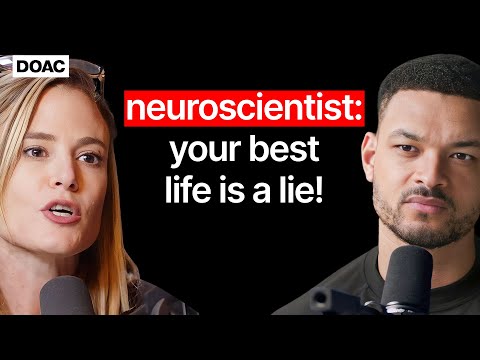
No.1 Neuroscientist: NEW RESEARCH Your Life, Your Work & Your Sex Life Will Get Boring! (THE FIX)
Steven Bartlett (host), Dr. Tali Sharot (guest)
In this episode of The Diary of a CEO, featuring Steven Bartlett and Dr. Tali Sharot, No.1 Neuroscientist: NEW RESEARCH Your Life, Your Work & Your Sex Life Will Get Boring! (THE FIX) explores neuroscientist Reveals Why Life Gets Boring—and How To Fix It Neuroscientist Dr. Tali Sharot explains habituation—the brain’s tendency to stop responding to things that stay the same—and how it quietly erodes our joy, motivation, relationships, and creativity over time.
Neuroscientist Reveals Why Life Gets Boring—and How To Fix It
Neuroscientist Dr. Tali Sharot explains habituation—the brain’s tendency to stop responding to things that stay the same—and how it quietly erodes our joy, motivation, relationships, and creativity over time.
She shows that even objectively ‘good’ lives, jobs, and relationships can start feeling flat simply because they’re too constant, and argues we must deliberately add variety, breaks, and learning to feel alive again.
Drawing on studies of vacations, music, sex, work, midlife crisis, social media, and risk-taking, she offers practical ways to “de-habituate” your life without blowing it up: small experiments, new experiences, and structured breaks.
The conversation closes with tools for behavior change, discipline, and meaning—plus a stark look at how social media and expectations shape our mood and beliefs far more than we realize.
Key Takeaways
Habituation Silently Flattens Both Joy and Pain
The brain quickly reduces its response to anything that doesn’t change—colors in a static image, a familiar smell, a stable relationship, or a long-held job. ...
Get the full analysis with uListen AI
To Feel More Alive, Engineer Variety and “Firsts”
Studies show people enjoy songs, massages, and vacations more when they’re broken up by brief breaks or re-starts, because novelty repeatedly resets enjoyment. ...
Get the full analysis with uListen AI
Relationships and Sex Need Both Breaks and New Shared Experiences
Data shows sexual desire rises when partners spend time apart; distance shifts attention back to the partner and interrupts habituation. ...
Get the full analysis with uListen AI
Progress and Learning Are More Motivating Than Raw Rewards
In lab tasks, people feel best when they learn something or improve, not just when they get money. ...
Get the full analysis with uListen AI
Work Engagement Requires Variety, Challenge, and Meaning
Employees often disengage when doing the same thing for 12+ months, even in ‘good’ jobs. ...
Get the full analysis with uListen AI
Happiness Is Dynamic: Hedonic Treadmill and Midlife Dip
People have a baseline level of happiness influenced by genetics and early life. ...
Get the full analysis with uListen AI
Expectations, Social Media, and Belief Are Easily Manipulated
Our brains more readily believe information that is easy to process or that we’ve heard repeatedly (illusory truth effect). ...
Get the full analysis with uListen AI
Notable Quotes
“What is thrilling on Monday becomes boring on Friday.”
— Dr. Tali Sharot
“People can have really great things in their life, but after a while those things don’t bring us the daily joy that they should.”
— Dr. Tali Sharot
“Pleasure results from incomplete and intermittent satisfaction of desires.”
— Dr. Tali Sharot quoting economist Tibor Scitovsky
“A lot of time, people may not feel so much joy in their life and they conclude their relationship or job isn’t good—but maybe they are good, they’ve just been the same for a while.”
— Dr. Tali Sharot
“We assume happiness will be derived from us being on autopilot… but the research shows we actually need to keep dismantling or disrupting our own experience.”
— Steven Bartlett (host)
Questions Answered in This Episode
You showed that people enjoy songs and massages more when they’re broken up; how would you design a ‘break structure’ for an ordinary workday to maximize enjoyment and productivity without becoming chaotic?
Neuroscientist Dr. ...
Get the full analysis with uListen AI
In your study where vacation enjoyment peaked at 43 hours, did any specific personality traits or travel styles (e.g., planners vs. spontaneous travelers) shift when that peak occurred?
She shows that even objectively ‘good’ lives, jobs, and relationships can start feeling flat simply because they’re too constant, and argues we must deliberately add variety, breaks, and learning to feel alive again.
Get the full analysis with uListen AI
You mentioned that people with slower habituation are more creative but also that slower habituation is linked to depression; how can someone leverage a ‘slow-adapting’ brain for creativity without sliding into rumination and low mood?
Drawing on studies of vacations, music, sex, work, midlife crisis, social media, and risk-taking, she offers practical ways to “de-habituate” your life without blowing it up: small experiments, new experiences, and structured breaks.
Get the full analysis with uListen AI
Given the evidence that leaving Facebook for a month significantly improves wellbeing, what concrete policies would you recommend schools or workplaces adopt around social media use, if any?
The conversation closes with tools for behavior change, discipline, and meaning—plus a stark look at how social media and expectations shape our mood and beliefs far more than we realize.
Get the full analysis with uListen AI
If a midlife listener suspects they’re misattributing their unhappiness to the ‘wrong’ causes (like their marriage or job), what specific one-week experiment would you prescribe to help them test whether habituation—not the situation itself—is the real problem?
Get the full analysis with uListen AI
Transcript Preview
What advice would you give me to make sure that my relationship stays fresh and new and spicy?
Actually, there's a great study that when people ... the sexual desire for the partner goes up.
Dr. Tali Sharot. She's a neuroscientist, author, one of the world's leading researchers on emotion, decision-making ...
And how to change our brains for the better. This is negatively affecting your life and you don't know it. We have a study where we asked people, "What was your favorite part on your vacation?" And we found the peak of enjoyment was 43 hours into the vacation, and people used one word more than any other word, and it was the word "first". The first view of the ocean, the first cocktail. And then the joy goes down and down and down. Why? It's because the input into your neurons is constant, and when things are not changing, our brain just stops responding. And the problem is that even if you're living your absolute best life, great relationship, a good job, comfortable home, after a while, those things don't bring us the joy that they should. 'Cause when something is always in front of you, you stop attending to it. That's true also for the not-so-great thing around us: sexism, racism, cracks in our relationships. After a while, we don't notice them, and if we don't notice them, we don't change them. One reason why happiness is low in midlife is because things are a little bit more routine. The problem is, we really don't like risk-taking.
So how do we change that?
Two main things. One is ...
Quick one. This is really, really fascinating to me. On the back end of our YouTube channel, it says that 69.9% of you that watch this channel frequently over the lifetime of this channel haven't yet hit the subscribe button. I just wanted to ask you a favor. It helps this channel so much if you choose to su- subscribe. Helps us scale the guests, helps us scale the production, and it makes the show bigger. So if I could ask you for one favor, if you've watched the show before and you've enjoyed it and you like this episode that you're currently watching, could you please hit the subscribe button? Thank you so much, and I will repay that gesture by making sure that everything we do here gets better and better and better and better. That is a promise I'm willing to make you. Do we have a deal? Tali, welcome back.
Thank you for having me back. Lovely to be here.
For those people that aren't familiar with your career, can you give us a little bit of an overview of your academic background, but really, I guess, the summary of the mission that you're on and the work that you've done. What are you trying to understand? What is it that you're, you're trying to do with your professional life?
Install uListen to search the full transcript and get AI-powered insights
Get Full TranscriptGet more from every podcast
AI summaries, searchable transcripts, and fact-checking. Free forever.
Add to Chrome