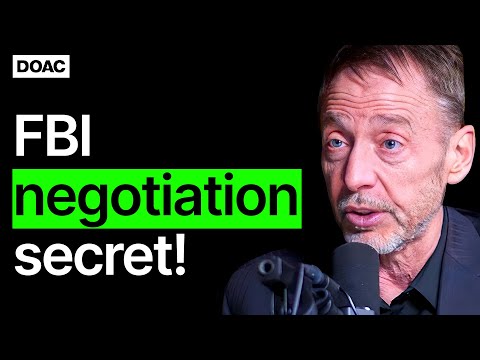
FBI’s Top Hostage Negotiator: The Art Of Negotiating To Get Whatever You Want: Chris Voss | E147
Chris Voss (guest), Steven Bartlett (host)
In this episode of The Diary of a CEO, featuring Chris Voss and Steven Bartlett, FBI’s Top Hostage Negotiator: The Art Of Negotiating To Get Whatever You Want: Chris Voss | E147 explores fBI Negotiator Chris Voss Reveals Psychology Behind Life-Or-Death Deals Chris Voss, former FBI lead international hostage negotiator, explains how the same psychological tools that save lives in hostage crises also drive effective business and personal negotiations.
FBI Negotiator Chris Voss Reveals Psychology Behind Life-Or-Death Deals
Chris Voss, former FBI lead international hostage negotiator, explains how the same psychological tools that save lives in hostage crises also drive effective business and personal negotiations.
He traces his path from a blue‑collar upbringing and SWAT work, through volunteering on a suicide hotline, to leading complex international kidnap cases.
Voss breaks down core negotiation skills—deep listening, tactical empathy, labeling emotions, mirroring, tone control, and guided discovery—showing how they change behavior by shifting how people think and feel.
He also confronts the emotional cost of the work, describing failed cases, post‑traumatic growth, and the strain high‑stakes decision‑making places on family and intimate relationships.
Key Takeaways
Listening is the fastest long‑term way to close more and better deals.
Voss emphasizes that every serious negotiation framework treats listening as an advanced skill, not a basic one. ...
Get the full analysis with uListen AI
Volunteer in real emotional crises if you want world‑class negotiation skills.
Voss only got into hostage negotiation because he followed the gatekeeper’s advice to volunteer on a suicide hotline—something almost no one actually did. ...
Get the full analysis with uListen AI
Human behavior is driven more by fear of loss than desire for gain.
Drawing on Kahneman and Tversky’s work, Voss explains that loss looms roughly 2–9 times larger than equivalent gain. ...
Get the full analysis with uListen AI
Use tactical empathy: label emotions and aim for “That’s right,” not “You’re right.”
Rather than trying to cheerlead or argue, Voss advocates plainly naming what the other person seems to feel (e. ...
Get the full analysis with uListen AI
Tone of voice is a neurochemical tool; use it deliberately.
Voss distinguishes three broad “voices” reflecting fight/flight/make‑friends tendencies: the blunt, assertive voice (highly counterproductive long‑term), the calm, downward‑inflecting “late‑night FM DJ” voice that literally calms others neurochemically, and the warm, smiling voice that creates instant likability. ...
Get the full analysis with uListen AI
Simple verbal mirroring gently steers conversations while making people talk more.
Instead of body‑language mirroring (which he views as often manipulative), Voss teaches repeating the last 1–3 key words someone said or a short gist phrase. ...
Get the full analysis with uListen AI
High‑stakes skills must be anchored in integrity and long‑term thinking.
Voss refuses to lie in negotiations, even under extreme hypotheticals (e. ...
Get the full analysis with uListen AI
Notable Quotes
“Loss looms larger than gain. Your vision of the loss is going to determine your behavior.”
— Chris Voss
“If I take the time to really hear somebody out in our first deal, then every deal after that will come to me faster.”
— Chris Voss (relaying Mark Cuban)
“If you don’t use empathy, then you’re the hostage‑taker.”
— Chris Voss
“‘That’s right’ is what people say when they feel understood.”
— Chris Voss
“Two of the three remaining hostages were killed, and they were shot by friendly fire.”
— Chris Voss
Questions Answered in This Episode
In the Philippines Burnham/Soberano case, what specific strategic changes did you implement afterward that you can point to as having clearly saved lives in later kidnappings?
Chris Voss, former FBI lead international hostage negotiator, explains how the same psychological tools that save lives in hostage crises also drive effective business and personal negotiations.
Get the full analysis with uListen AI
When a counterpart is deeply loss‑averse but in denial about what they stand to lose, how do you surface that fear empathetically without triggering a defensive backlash or seeming manipulative?
He traces his path from a blue‑collar upbringing and SWAT work, through volunteering on a suicide hotline, to leading complex international kidnap cases.
Get the full analysis with uListen AI
You argue strongly against lying in any negotiation; have you ever faced a real‑world scenario where telling the truth in the moment clearly increased short‑term risk, and how did you navigate that trade‑off?
Voss breaks down core negotiation skills—deep listening, tactical empathy, labeling emotions, mirroring, tone control, and guided discovery—showing how they change behavior by shifting how people think and feel.
Get the full analysis with uListen AI
In romantic relationships, how do you distinguish between using labeling and mirroring as genuine tools for connection versus subtly weaponizing them to “win” arguments or avoid accountability?
He also confronts the emotional cost of the work, describing failed cases, post‑traumatic growth, and the strain high‑stakes decision‑making places on family and intimate relationships.
Get the full analysis with uListen AI
Given that about 7% of hostage negotiations still end in tragedy despite best practices, what concrete criteria or signals tell you early on that a case is likely to fall into that 7%, and how does that change your approach in real time?
Get the full analysis with uListen AI
Transcript Preview
Two of the three remaining hostages were killed, and they were shot by friendly fire. That was the first time that I'd worked anything where people had gotten killed. (music) Former FBI kidnapping negotiator.
Best-selling co-author, and the founder and principal of the Black Swan Group.
I'm Chris Voss.
How important is it generally in negotiations to listen?
Whether it's business or law enforcement, if I take the time to, to really hear somebody out in our first deal, then every deal after that will come to me faster. It's critical.
I'm so compelled to ask you, like, what is the cost that we don't get to see of your job?
You know, you get, you get really wrapped up in your work, and I think you tend to become distant in your personal life. The closer you are to someone, sometimes you just... It's really harder for you to see things from their perspective. The truth sometimes is a knife to the heart, right? Like, you go through a traumatic event. Are you traumatized by it, then never recover? Or is there post-traumatic stress growth, where you took that and decided to be better than you ever were before because you never wanna let that happen again?
So without further ado, I'm Steven Bartlett, and this is the Diary of a CEO, USA Edition. I hope nobody's listening, but if you are, then please keep this to yourself. (music) Chris, you've lived a extraordinary life for many, many reasons, which I'm sure we're gonna go into. But, um, I guess my first question is, what do I need to know about your upbringing, your early years, if I am to understand the man you are today?
I, uh, I think really that my father just required that, that we work hard and that we figure stuff out. Like, my father was an entrepreneur. And then no matter how old you are, even... And I started working for him probably when I was about 11, but the downside of working for a guy that would never ask you to do anything he wouldn't do himself, if there isn't anything that he wouldn't do himself just 'cause it needed to be done, then, like, you get asked to figure out some crazy stuff. Like, you know, middle, middle-class entrepreneur, you know, little- blue, blue-collar, you know, guy. And I remember, I think I was about 11, he decided he wanted a, a new garage in the backyard, and we had to get rid of the old garage. And, you know, he handed me and my 13-year-old sister crowbars and said, "Go out and tear down the old garage." (laughs)
Hmm.
So you just gotta, you know, you just gotta figure stuff out. And so I really grew up in an environment of working really hard. It, he never preached to us ethics, but we were, you know, very ethical, you know, honest, hardworking, and figure stuff out, which is, if that's your attitude, there isn't that much you can't do. And that was kind of drilled into me at an early age. Figure it out, work hard, be honest.
Install uListen to search the full transcript and get AI-powered insights
Get Full TranscriptGet more from every podcast
AI summaries, searchable transcripts, and fact-checking. Free forever.
Add to Chrome