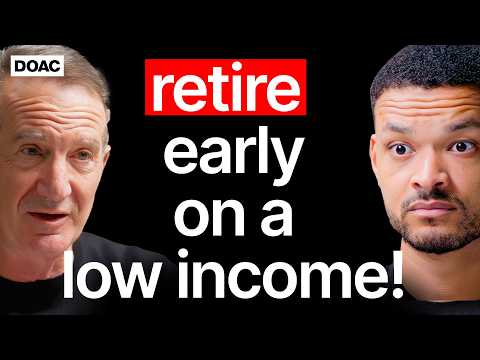
Early Retirement Expert: A House Vs Stocks... (Here Is The Truth)
David Bach (guest), Steven Bartlett (host), Steven Bartlett (host), David Bach (guest)
In this episode of The Diary of a CEO, featuring David Bach and Steven Bartlett, Early Retirement Expert: A House Vs Stocks... (Here Is The Truth) explores david Bach argues automation, homeownership, and boring investing build wealth fast David Bach explains how “automatic” systems—not budgeting willpower—drive long-term wealth, drawing from his Morgan Stanley experience and stories like his grandmother and ordinary clients who became millionaires.
David Bach argues automation, homeownership, and boring investing build wealth fast
David Bach explains how “automatic” systems—not budgeting willpower—drive long-term wealth, drawing from his Morgan Stanley experience and stories like his grandmother and ordinary clients who became millionaires.
He argues that most people underestimate how small daily leaks (the “Latte Factor,” subscriptions, convenience spending) compound into life-changing sums if redirected into index funds and retirement accounts.
A major debate is renting versus buying: Bach claims homeownership is a primary wealth escalator due to leverage, tax advantages, forced savings, and rising rents, despite common critiques about net returns after costs.
He also covers getting out of debt with a snowball-style payoff, increasing income through skill/value, and preventing relationship/estate chaos by making finances transparent, planning for emergencies, and aligning couples on values.
Key Takeaways
Automation beats discipline for most people.
Bach claims financial plans fail when they rely on manual effort; setting automatic transfers from paycheck to retirement/savings turns wealth-building into a background system similar to taxes or subscriptions.
Get the full analysis with uListen AI
Keep the first hour of your income for yourself.
He frames wealth-building as investing ~12. ...
Get the full analysis with uListen AI
The “70/30” allocation is a common millionaire blueprint.
Citing Fidelity 401(k) millionaire data, he says consistent high contributions (around the mid-teens percent including match) plus growth-oriented investing (roughly 70% stocks/30% bonds) is a repeatable formula.
Get the full analysis with uListen AI
Boring investments outperform exciting ones for most people.
He warns that trading, meme assets, and “get rich quick” behavior often leads to losses and discouragement; diversified index funds and target-date funds reduce decision errors and keep investors in the market.
Get the full analysis with uListen AI
Homeownership often functions as forced wealth creation.
Bach argues homeowners end up far wealthier than renters because mortgage payments build equity, leverage amplifies returns on the down payment, and rents typically rise—while many renters don’t invest the difference.
Get the full analysis with uListen AI
Small daily leaks can equal $10,000+ per year.
He highlights $27. ...
Get the full analysis with uListen AI
Debt requires a simple, visible win sequence.
His “DOLP” (done on last payment) method mirrors the snowball: automate minimums on all debts, throw extra cash at the smallest balance first to build momentum, then negotiate APRs or hardship programs as needed.
Get the full analysis with uListen AI
Couples must run a ‘financial fire drill’ before crisis hits.
Because widowhood, illness, and divorce can rapidly destabilize finances, he urges shared access to accounts/passwords, annual reviews, wills, adequate term life insurance, and—when appropriate—prenups with separate attorneys.
Get the full analysis with uListen AI
The next decade may widen the gap between prepared and unprepared.
He sees AI as a historic wealth-creation engine for markets and productivity, but warns job displacement and underfunded government benefits mean individuals must build independent safety nets and retirement assets.
Get the full analysis with uListen AI
Notable Quotes
“Unless your financial plan is automatic, it will fail.”
— David Bach
“Your life should be interesting—your investments should be boring.”
— David Bach
“Homeowners in America are worth 40 times more than renters.”
— David Bach
“You can’t live inside an index fund.”
— David Bach
“People who try to get rich quick stay broke forever.”
— David Bach
Questions Answered in This Episode
On the “homeowners are 40× wealthier” claim: what evidence best isolates causation from selection effects (income, education, geography)?
David Bach explains how “automatic” systems—not budgeting willpower—drive long-term wealth, drawing from his Morgan Stanley experience and stories like his grandmother and ordinary clients who became millionaires.
Get the full analysis with uListen AI
How should someone decide between buying a home and investing more in equities if they *will* reliably invest the difference while renting?
He argues that most people underestimate how small daily leaks (the “Latte Factor,” subscriptions, convenience spending) compound into life-changing sums if redirected into index funds and retirement accounts.
Get the full analysis with uListen AI
What’s your threshold for ‘buy vs rent’ (price-to-rent ratio, expected years in home, mortgage rate, transaction costs)?
A major debate is renting versus buying: Bach claims homeownership is a primary wealth escalator due to leverage, tax advantages, forced savings, and rising rents, despite common critiques about net returns after costs.
Get the full analysis with uListen AI
You recommend ~12.5% to retirement plus ~10% split between emergency and dreams—how should this change for high-debt households or single parents?
He also covers getting out of debt with a snowball-style payoff, increasing income through skill/value, and preventing relationship/estate chaos by making finances transparent, planning for emergencies, and aligning couples on values.
Get the full analysis with uListen AI
Your debt method prioritizes smallest balance over highest APR—when do you switch to an interest-rate-first approach, if ever?
Get the full analysis with uListen AI
Transcript Preview
If you don't get in the game of homeownership, and you rent in your 20s, and you rent in your 30s, you're gonna turn around in your 40s and having not built any net worth. And in fact, homeowners in America are worth 40 times more than renters, and I'm talking about ordinary Americans.
But that doesn't mean that buying a home made them rich, right?
It actually does, and I'm gonna go through that.
But am I not better off renting and investing in the stock market?
I wanna bust this myth 'cause I have spent the last 33 years of my life helping millions of people with ordinary incomes become financially free, including nine years as a financial advisor at Morgan Stanley, and I got to see firsthand how everyone who came into my office with an ordinary income built wealth. And there's a formula to getting rich, but there's also a system to how you put your financial life on autopilot in less than ten minutes. And it doesn't require discipline, a budget, and you don't have to make a lot of money to get started. But unless your financial plan is automatic, it will fail. But more importantly, I believe the next ten years will be the greatest opportunity to build wealth in our lifetime, and yet seven out of ten people right now are living paycheck to paycheck. More than 50% of Americans don't have savings, and most people don't know where their money goes. And in fact, when we ask people, "How much money would it take to totally change your life?" They say $10,000. Now, how much money do you need to spend a day to build $10,000 a year? $27.40 a day. If you invested that a day for forty years, you'd have over $4,424,000. That would be life-changing.
But just before we get into all of the specifics and the strategies, do you have any specific advice to people that are currently struggled with debt?
Absolutely. There's a very simple formula of getting out of debt called DOLE. I'd tell you to-
Listen, my, my team gave me a script that they asked me to read, but I'm just gonna ask you, um, in the nicest way I possibly can. Thank you, first and foremost, for choosing to subscribe to this channel. It is, um, it's been one of the most incredible, crazy years of my life. I never could have imagined. I had so many dreams in my life, but this was not one of them. And the very fact that these conversations have resonated with you, and you've given me so much feedback, is something I will always be appreciative of. And I almost carry a weight, a sort of burden of, uh, responsibility to pay you back. And the favor I would like to ask from you today is to subscribe to the channel, if you, um, would be so obliged. It's completely free to do that. Roughly about forty-seven percent of you that listen to this channel frequently currently don't subscribe to this channel. So if you're one of those people, please come and join us. Hit the subscribe button. It's the single free thing you can do to make this channel better, and every subscriber sort of pays into this show and allows us to do things bigger and better and to push ourselves even more. And I will not let you down if you hit the subscribe button, I promise you. And if I do, please do unsubscribe, but I promise I won't. Thank you. [upbeat music] David, what has your mission been for the last three decades?
Install uListen to search the full transcript and get AI-powered insights
Get Full TranscriptGet more from every podcast
AI summaries, searchable transcripts, and fact-checking. Free forever.
Add to Chrome