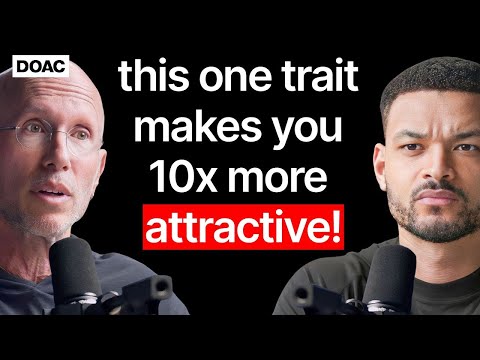
The Sex Psychologist: We're Not Having Enough Sex! Fat Makes You Attractive! Dr Bill Von Hippel
Steven Bartlett (host), Dr Bill (William) von Hippel (guest), Narrator
In this episode of The Diary of a CEO, featuring Steven Bartlett and Dr Bill (William) von Hippel, The Sex Psychologist: We're Not Having Enough Sex! Fat Makes You Attractive! Dr Bill Von Hippel explores why Modern Freedom Makes Us Miserable: Sex, Cities, Robots, Evolution Evolutionary psychologist Dr. William Von Hippel explains how instincts that once helped humans thrive now clash with modern life, driving loneliness, lower happiness, and even collapsing birth rates. He argues that we’re dramatically overvaluing autonomy (doing what we want, alone) and undervaluing connection (family, tribe, community), especially in wealthy, urban, educated Western societies.
Why Modern Freedom Makes Us Miserable: Sex, Cities, Robots, Evolution
Evolutionary psychologist Dr. William Von Hippel explains how instincts that once helped humans thrive now clash with modern life, driving loneliness, lower happiness, and even collapsing birth rates. He argues that we’re dramatically overvaluing autonomy (doing what we want, alone) and undervaluing connection (family, tribe, community), especially in wealthy, urban, educated Western societies.
Using data from hunter‑gatherers, cities vs. countryside, marriage, religion, dating apps, porn use, and fertility, he shows that modern comforts, money, and individual choice have not made us happier and may be making us less so. At the same time, sexual selection and evolutionary pressures still shape what we find attractive, how we date, and why certain people are left out of the mating market.
Von Hippel also explores provocative frontiers: how pornography and social media are changing sex and relationships, how “robot nannies” might shape the future of parenting and fertility, and why neurodivergence and anxiety exist from an evolutionary standpoint. He concludes that a good life in the modern world means deliberately rebuilding connection, using autonomy wisely, and aligning daily habits with what our brains and bodies actually evolved for.
Key Takeaways
We are massively over‑choosing autonomy, and it’s making us less happy
Von Hippel argues that modern Westerners, especially the wealthy, urban, and educated, consistently choose “doing what I want” over connecting with others in both big and small ways (e. ...
Get the full analysis with uListen AI
Cities and wealth increase options and income, but often reduce happiness
Half of humanity now lives in cities, and urban dwellers in places like the US are about 25% wealthier than rural residents. ...
Get the full analysis with uListen AI
Our mating psychology is ancient, but dating apps and porn are new and distorting it
Men and women still look for “honest signals” of evolutionary quality: in men, risk‑taking, physical robustness, status/wealth, ambition, humor, and especially kindness; in women, youth, health, body fat reserves and a stable waist‑to‑hip ratio as proxies for fertility. ...
Get the full analysis with uListen AI
Fertility is collapsing because we evolved to want sex, not children
In every rich, industrialized country, total fertility is below the 2. ...
Get the full analysis with uListen AI
Marriage, religion, and structured social commitments still powerfully boost wellbeing
Longitudinal data show that marriage itself is a net zero on average over 10 years—some marriages flourish, some stagnate, some become miserable—but cross‑sectionally, married people are far more likely to report being “very happy” than the never‑married. ...
Get the full analysis with uListen AI
Technologies like robot nannies and AI will amplify our existing evolutionary tensions
Von Hippel expects advanced robot caregivers to arrive soon and sees them as a logical extension of “alloparenting” (shared childcare) humans have always used via relatives and nannies. ...
Get the full analysis with uListen AI
To be happier now, deliberately engineer habits that fuse autonomy with connection
Von Hippel finishes with very concrete advice: keep family at the center (or build a chosen family if necessary), routinely choose joint activities over solo ones (e. ...
Get the full analysis with uListen AI
Notable Quotes
“The big thing that we’ve got wrong right now is doing what I want to do right now rather than connecting.”
— Dr. William Von Hippel
“Compared to the Hadza, I’m a zillionaire, and yet they’re probably happier than we are.”
— Dr. William Von Hippel
“We never evolved to want children. We evolved to want sex.”
— Dr. William Von Hippel
“Humans evolved to be serial monogamists who cheat a little bit.”
— Dr. William Von Hippel
“If life is truly devoid of meaning, then you make the best of this meaningless thing that you can — and that means being kind and connecting.”
— Dr. William Von Hippel
Questions Answered in This Episode
You argue that hunter‑gatherers like the Hadza are significantly happier than us despite extreme hardship. If a Western listener wanted to realistically apply one or two Hadza‑like practices without moving to the bush, what specific daily or weekly routines would you start with?
Evolutionary psychologist Dr. ...
Get the full analysis with uListen AI
Your data show that on dating apps, 20% of men get 80% of the swipes. If you were designing a new dating platform from an evolutionary‑psychology standpoint, how would you change the mechanics to reduce that skew and surface ‘honest signals’ like kindness and reliability?
Using data from hunter‑gatherers, cities vs. ...
Get the full analysis with uListen AI
You’re surprisingly optimistic about robot nannies as superior alloparents. What concrete developmental safeguards or limits would you insist on so we don’t end up with children more attached to machines than to their human caregivers?
Von Hippel also explores provocative frontiers: how pornography and social media are changing sex and relationships, how “robot nannies” might shape the future of parenting and fertility, and why neurodivergence and anxiety exist from an evolutionary standpoint. ...
Get the full analysis with uListen AI
You said money improves individual happiness but not societal happiness, and that we keep moving the bar on what ‘enough’ is. Practically, how would you advise a 30‑year‑old founder to set and stick to a personal ‘enough’ target so they don’t sacrifice their entire 20s–40s to the autonomy trap?
Get the full analysis with uListen AI
You believe life is devoid of intrinsic meaning, yet your own work emphasizes deep connection and kindness. How do you respond to someone who worries that adopting a ‘meaningless universe’ view will undermine their motivation to be moral, have children, or commit to long‑term relationships?
Get the full analysis with uListen AI
Transcript Preview
Do you believe the robots are gonna raise our kids? 'Cause it feels like a slippery slope.
Well, it's not too far away from us, and we never evolved to want children. Look, the fertility rates are going way down and a lot of countries are gonna be literally half their size by the year 2100 because they're shrinking so fast. And the list is really long about how hard it is to raise the child in today's world. So, you wanna make having kids to be as much of a plus as it possibly can be. And with the perfect robot nanny, you would never worry at all.
Interesting. Dr. William Von Hippel is the world-renowned evolutionary psychologist who has spent decades studying and finding the answers to how instincts that once helped our ancestors survive still drive us today, often in ways we don't even realize. As a species, what are we getting wrong?
Well, young people are having less sex than they were 20 years ago. Marriage, steadily going down. And our lives are so much better, but we're not any happier. And part of the problem is that we're constantly choosing to do our own thing rather than connect. So, here's the data. In 1850, one in a hundred of Americans lived alone. Now it's one in seven. In the 1970s, one in three people spent time with their neighbors. Now that's completely reversed. Now, let's dive a little deeper. 50% of humanity now lives in the city, and they're about 25% wealthier than people who live in the country. And yet the data shows people in the country are happier because cities are all about, "I wanna do what I want." And the problem is that we can't introduce social connection into our life willy-nilly, or we won't keep it up.
So, what do we do about that?
Two things. One.
And then what does evolution tell us about how to attract the opposite sex?
You want honest signals of quality. And bizarrely, one of the clearest honest signals for men to demonstrate for women is...
I have been forced into a bet with my team. We're about to hit 10 million subscribers on YouTube, which is our biggest milestone ever, thanks to all of you, and we wanna have a massive party for the people that have worked on this show for years behind the scenes. So, they said to me, "Steve, for every new subscriber we get in the next 30 days, can $1 be given to our celebration fund for the entire team?" And I've agreed to the bet. So, if you want to say thank you to the team behind the scenes at Diary of a CEO, all you've gotta do is hit the subscribe button. So actually, this is the first time I'm gonna tell you not to subscribe (laughs) because it might end up costing me an awful... (laughs)
(Cheers) (applause)
Install uListen to search the full transcript and get AI-powered insights
Get Full TranscriptGet more from every podcast
AI summaries, searchable transcripts, and fact-checking. Free forever.
Add to Chrome