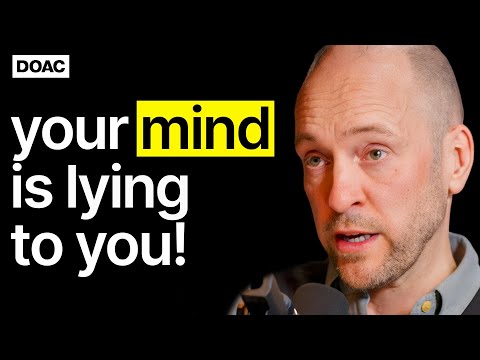
Derren Brown: UNLOCK The Secret Power Of Your Mind! | E212
Steven Bartlett (host), Derren Brown (guest), Narrator
In this episode of The Diary of a CEO, featuring Steven Bartlett and Derren Brown, Derren Brown: UNLOCK The Secret Power Of Your Mind! | E212 explores derren Brown Reveals How Stories Shape Suffering, Success, And Self Derren Brown discusses his journey from an introverted, religious, shame‑filled child to a world‑famous psychological illusionist, unpacking how performance, control, and hidden sexuality shaped his craft. He argues that our suffering is often amplified by the stories we tell ourselves, not the events themselves, and critiques cultural obsessions with goal-setting, toxic positivity, and “manifestation.”
Derren Brown Reveals How Stories Shape Suffering, Success, And Self
Derren Brown discusses his journey from an introverted, religious, shame‑filled child to a world‑famous psychological illusionist, unpacking how performance, control, and hidden sexuality shaped his craft. He argues that our suffering is often amplified by the stories we tell ourselves, not the events themselves, and critiques cultural obsessions with goal-setting, toxic positivity, and “manifestation.”
Drawing on stoicism, psychology, and his own stage experiments, Brown explains how anxiety, shame, and adversity can become sources of connection and meaning rather than pathologies to eradicate. He illustrates the psychological component of pain through his faith‑healing show, where no physical changes occur, yet people experience profound relief.
The conversation ranges across childhood compulsions, leaving religion, coming out, love and long‑term relationships, motivation, and the dangers of simplistic self‑help narratives. Brown emphasizes living by values and daily practice over distant life goals, and allowing both our work and relationships to ‘grow up’ with us.
Ultimately, he suggests that happiness is less a stable mood than a byproduct of meaning, self‑acceptance, and making peace with a universe that doesn’t care about our plans.
Key Takeaways
Your suffering is amplified by the story you attach to events, not the events themselves.
Brown repeatedly returns to the stoic idea that it’s not life’s events but our judgments and narratives about them that cause much of our distress. ...
Get the full analysis with uListen AI
Anxiety and discomfort are not enemies to eliminate; they’re signals for change.
He criticizes self‑help and even some modern stoic interpretations that imply you can or should reach a state of no anxiety. ...
Get the full analysis with uListen AI
Trying to ‘heal’ trauma or insecurity to zero is unrealistic and harmful.
Brown agrees with Steven that promises to completely erase trauma or insecurity are “bullshit. ...
Get the full analysis with uListen AI
Self‑help systems that blame you for failure (like Law of Attraction) are structurally abusive.
He likens ‘The Secret’ and prosperity gospel faith healers: both demand total belief, promise material rewards, and when results don’t come, insist you lacked faith. ...
Get the full analysis with uListen AI
Long‑term goal‑fixation can strip life of meaning once the goal is reached.
Brown tells of a workaholic friend who spent years building a company to sell, only to be miserable in early ‘retirement’ and join a support group for unhappy millionaires. ...
Get the full analysis with uListen AI
Motivation improves when you cultivate gratitude, compassion, and healthy pride, not just willpower.
Citing David DeSteno’s work, Brown notes that people primed to feel gratitude or compassion value their future selves more—e. ...
Get the full analysis with uListen AI
Deep connection in love means allowing the other person to remain a mystery.
He argues that relationships often begin as projections—trying to get someone to be what we need. ...
Get the full analysis with uListen AI
Notable Quotes
“It's not the things in life that cause your problems, it's the story that you tell yourself about them.”
— Derren Brown
“There’s a lot of people that are trying to sell you on this bullshit that they can take your traumas or your insecurities to zero. I’ve never seen it happen.”
— Steven Bartlett
“We used to call people unfortunate. Now we call them losers.”
— Derren Brown
“The things that feel most isolating are the things that tend to connect us.”
— Derren Brown
“If you don’t have meaning in your life, that’s when you have problems… It’s when we feel meaningless that things get bad.”
— Derren Brown
Questions Answered in This Episode
In ‘Miracle,’ when someone regained movement in a paralyzed limb, what specific psychological mechanisms do you believe were at play, and how would you explain that outcome to a neurologist who’s deeply skeptical?
Derren Brown discusses his journey from an introverted, religious, shame‑filled child to a world‑famous psychological illusionist, unpacking how performance, control, and hidden sexuality shaped his craft. ...
Get the full analysis with uListen AI
You’ve described shame as your ‘easy resting place.’ If you were designing a practical exercise for someone with the same pattern, what would a week‑long protocol to begin relating differently to shame actually look like?
Drawing on stoicism, psychology, and his own stage experiments, Brown explains how anxiety, shame, and adversity can become sources of connection and meaning rather than pathologies to eradicate. ...
Get the full analysis with uListen AI
When you liken Law of Attraction and prosperity gospel to the same blame cycle, is there any version of ‘positive visualization’ you think is psychologically legitimate, or should we discard the whole paradigm?
The conversation ranges across childhood compulsions, leaving religion, coming out, love and long‑term relationships, motivation, and the dangers of simplistic self‑help narratives. ...
Get the full analysis with uListen AI
You talk about midlife as a shift from external cues to internal signals. For someone in their late 20s who already feels alienated from classic ambition, how do they know if they’re wisely ‘skipping ahead’ or just prematurely disengaging?
Ultimately, he suggests that happiness is less a stable mood than a byproduct of meaning, self‑acceptance, and making peace with a universe that doesn’t care about our plans.
Get the full analysis with uListen AI
On stage, you intentionally blur the line between what’s real and what’s constructed to make deeper points about perception. How do you decide where the ethical boundary lies between illuminating people and potentially exploiting their cognitive blind spots?
Get the full analysis with uListen AI
Transcript Preview
I've been asked by the FBI, I've been asked by the police to help.
What did the FBI or the police want help with?
Uh.
Ladies and gentlemen, the incredible Derren Brown. A psychological illusionist.
Doing extraordinary television and even better live shows. Derren is a national treasure. Welcome to the show. The story we tell ourselves is not what's real. Like, for example, I did a show called Miracle. The Lord has his work cut out tonight. And the second half was healing. A woman came up and she'd been paralyzed on one side of her body since she was four. In floods of tears because she could move her left arm for the first time. What you're seeing is the, is the psychological component of suffering, right? Like, nothing's happened, nothing's changed, but their relationship to their suffering, that's being made to change. It's not the things in life that cause your problems, it's the story that you tell yourself about them, it's the judgments that you make about them.
There's a lot of people that are trying to sell you on this bullshit that they can take your traumas or your, your insecurities to zero. I've never seen it happen.
We've completely obliterated the idea of just fortune in life. Sometimes life's throwing stuff back at us we have no control over and anxiety's still somehow the demon, but you know, without anxiety how do you know to change anything? You know, you can't do that without embracing anxiety to an extent.
Your work is predominantly based in psychology, right? So have you ever done anything and thought, "How the fuck did that happen?"
(laughs) Don't go home and start doing that. Two things come to mind.
Before this episode starts, I have a small favor to ask from you. Two months ago, 74% of people that watch this channel didn't subscribe. We're now down to 69%. My goal is 50%. So if you've ever liked any of the videos we've posted, if you like this channel, can you do me a quick favor and hit the subscribe button? It helps this channel more than you know, and the bigger the channel gets, as you've seen, the bigger the guests get. Thank you and enjoy this episode. I've spent the last few days reading all about your childhood.
Oh.
Truly fascinating.
Thank you.
I actually, I've actually got a picture here of you, um ...
How strange that you have that picture. Yes, that's me with a, um, a parrot on my shoulder. Lovely that you have.
This little boy.
Yes.
What do I need to understand about, about him and the world he lived in and the way he saw the world to understand you?
What do you need to understand? Well, I was an only child till I was nine, uh, so I guess that's kind of a, that's a pretty formative thing, isn't it? Um, quite creative. Like always, always drawing and building things, Lego. Um, always been a bit of a people pleaser and maybe that, at that age, kind of, yeah, sort of happy. Didn't, didn't have a lot of friends. There wasn't like a, didn't have a big gang. I never really did. I've always gone through life just with sort of a, a small number of, of, of good friends. Uh, but I think that's what I... That feels like a happy, a happy time to think back on.
Install uListen to search the full transcript and get AI-powered insights
Get Full TranscriptGet more from every podcast
AI summaries, searchable transcripts, and fact-checking. Free forever.
Add to Chrome