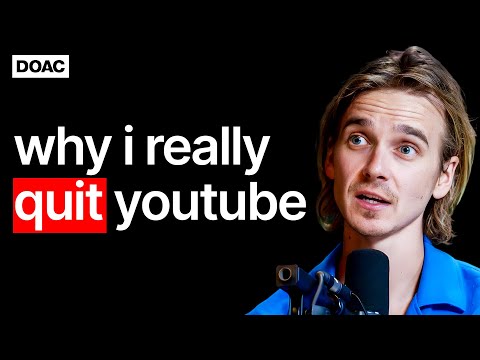
Growing A 10+ Million Youtube Following At The Age of 22: Joe Sugg | E172
Joe Sugg (guest), Steven Bartlett (host)
In this episode of The Diary of a CEO, featuring Joe Sugg and Steven Bartlett, Growing A 10+ Million Youtube Following At The Age of 22: Joe Sugg | E172 explores from Thatching Roofs To YouTube Fame: Joe Sugg’s Turbulent Journey Joe Sugg recounts his transformation from a shy, creative kid and apprentice roof thatcher into one of YouTube’s earliest mega-creators, amassing millions of followers by age 22. He explains the psychological costs of sudden fame: anxiety, burnout, imposter syndrome, overthinking, and the pressure of constantly chasing the next “big wave” of success.
From Thatching Roofs To YouTube Fame: Joe Sugg’s Turbulent Journey
Joe Sugg recounts his transformation from a shy, creative kid and apprentice roof thatcher into one of YouTube’s earliest mega-creators, amassing millions of followers by age 22. He explains the psychological costs of sudden fame: anxiety, burnout, imposter syndrome, overthinking, and the pressure of constantly chasing the next “big wave” of success.
The conversation explores his tendency toward procrastination and perfectionism, his plate‑spinning creativity, and how shifting algorithms and a maturing audience changed his relationship with YouTube. Sugg also details how therapy, nature, and his book ‘Grow’ helped him rebalance life in a hyper-digital world.
He reflects candidly on starting a creator management company to protect younger influencers, his evolving identity beyond “YouTuber,” and the unexpected way Strictly Come Dancing led to his first serious relationship with Dianne Buswell. Overall, he concludes that despite the hardships, the YouTube path has ultimately made him happier and more fulfilled.
Key Takeaways
Balancing self-confidence with self-doubt can protect you from both arrogance and paralysis.
Sugg describes having a vivid imagination that lets him picture best-case scenarios, which fuels confidence, but also an inner “Mr. ...
Get the full analysis with uListen AI
Procrastination often masks fear and self-doubt, not ‘high standards’ or perfectionism.
He admits delaying creative projects because he fears the reality won’t match the perfect version in his head, leaving many “unfinished paintings. ...
Get the full analysis with uListen AI
Early explosive success can distort expectations and make later, normal outcomes feel like failure.
Coming from a period where “everything we went into turned to gold,” Sugg now struggles with wanting instant success in new ventures. ...
Get the full analysis with uListen AI
Having a real Plan B—and skills outside your main career—reduces fear and enables risk-taking.
Sugg’s apprenticeship in roof thatching gave him a tangible fallback. ...
Get the full analysis with uListen AI
Therapy and labeling patterns (like people-pleasing and catastrophizing) can dramatically reduce anxiety.
Through therapy, Sugg discovered he is a strong people-pleaser, terrified of upsetting others or seeming rude, which fuels overthinking and panic in social situations. ...
Get the full analysis with uListen AI
Deliberately disconnecting from screens and reconnecting with nature can rebalance mental health.
During lockdown, he turned a small balcony into a garden and found that focusing on nurturing plants—something slow, physical, and offline—calmed his mind and reduced anxiety. ...
Get the full analysis with uListen AI
Fame amplifies imposter syndrome and public scrutiny, but mentorship can soften the landing for new creators.
Sugg still feels imposter syndrome, even sitting on Bartlett’s podcast, and worried he didn’t ‘deserve’ roles like his West End part in ‘Waitress’—especially when critics said he’d taken opportunities from trained actors. ...
Get the full analysis with uListen AI
Notable Quotes
“I see YouTube like catching a wave. I caught a record-breaking wave, and now I’m back out on my board paddling, waiting for the next one.”
— Joe Sugg
“It’s almost like I punish myself by putting the things I truly love doing to one side, and focusing on the things I’m less passionate about because I’m chasing instant success.”
— Joe Sugg
“Success can be a curse because of the way it messes with our expectations of ourselves and of the world.”
— Steven Bartlett
“The worst thing that’s going to happen to you is overthinking—worrying about how other people perceive you. It’ll cost you sleepless nights, anxiety, and a lot of self-doubt.”
— Joe Sugg
“Hand on heart, I’m more happy with the route I’ve gone down. Even with the struggles, I don’t regret YouTube.”
— Joe Sugg
Questions Answered in This Episode
You described feeling like everything you touched used to turn to gold; what specific metrics or moments finally convinced you that era was over, and how did you emotionally recalibrate your definition of success after that realization?
Joe Sugg recounts his transformation from a shy, creative kid and apprentice roof thatcher into one of YouTube’s earliest mega-creators, amassing millions of followers by age 22. ...
Get the full analysis with uListen AI
When you mentor younger creators through your management company, what is one concrete boundary or policy you enforce that you wish had existed during your own rapid rise on YouTube?
The conversation explores his tendency toward procrastination and perfectionism, his plate‑spinning creativity, and how shifting algorithms and a maturing audience changed his relationship with YouTube. ...
Get the full analysis with uListen AI
You spoke about punishing yourself by sidelining the activities you genuinely love, like painting and sculpting; what would a week look like if you deliberately reversed that pattern and made those ‘joy activities’ non-negotiable priorities?
He reflects candidly on starting a creator management company to protect younger influencers, his evolving identity beyond “YouTuber,” and the unexpected way Strictly Come Dancing led to his first serious relationship with Dianne Buswell. ...
Get the full analysis with uListen AI
In hindsight, do you think your West End backlash was more about genuine industry gatekeeping or about social media audiences resenting crossovers, and how should future ‘influencer-to-stage’ transitions be handled to be fair to both trained performers and digital talent?
Get the full analysis with uListen AI
If YouTube’s algorithm and audience tastes had never shifted and your numbers had stayed at their peak, do you think you would have ever written ‘Grow’ or gone to therapy, or would you have stayed on the wave until an even bigger crash later on?
Get the full analysis with uListen AI
Transcript Preview
I started to feel anxious. We were getting followed by, uh, a guy. Like, my mind is panicking. I actually can't concentrate on driving 'cause I know this person is just trying to follow us.
A Strictly finalist, written a book, the West End.
An internet sensation. Joe Sugg.
You started at 19, 20 years old. By '22, you had about six million subscribers.
Yeah.
That's fucking nuts.
It was so uncertain about where that was gonna go. The rise, but also the fall, can happen so quick. That imposter syndrome that I already had got amplified. Anxiety, self-doubt, the whole thing just didn't feel real.
Dianne, you met her on Strictly.
First real proper girlfriend, yeah. The further you go in that competition, the higher the pressure is and the stress gets. We saw the best and the worst of each other. I always thought it would be a very private thing. It's actually ended up being the complete opposite.
Hand on heart, do you think if you had never started YouTube you'd be happier overall?
Good question. Um...
So without further ado, I'm Steven Bartlett, and this is the Diary of a CEO. I hope nobody's listening, but if you are, then please keep this to yourself. (gentle music) Joe.
Hello.
Tell me, what are the most important things that I need to know about you from your early years in order to understand you?
Um...
In order to understand the man that you are today.
The man I am today. I was quite a loud child. I was a loud, annoying child growing up. When we look back through, like, family videos, um, it's, it's quite embarrassing to watch. Particularly me because, um, I, I'm this, I was the sort of boy that would be like, "Mummy, watch this, watch this." Like, repeating myself over and over again. And we're watching it back like, "Oh, shut up." Like, "You were an annoying child." But then, um, at some point, I flipped and I don't know when that was, but at some point I flipped and became a very, sort of timid, quite shy child. Um, always very creative, even from an early, early age, um, I was, uh, a good drawer. I used to draw, illustrate and draw a lot of pictures at school. Um, which definitely came from, passed down from my parents. Mum and dad both very creative in their own, in their own sense. I went to a very, very small primary school, um, in rural Wiltshire. Uh, I think there's 52 pupils in our, in our whole school. Going from there to secondary school was a big change for me 'cause that was going from 52 pupils in the whole school to over 1,000. So that was a big... Which probably could have a, a, a reason why I went from being sort of quite a loud, annoying child to being a lot more, sort of, "Oh, I'm at my depth here." Um, now a small fish in a big pond.
Install uListen to search the full transcript and get AI-powered insights
Get Full TranscriptGet more from every podcast
AI summaries, searchable transcripts, and fact-checking. Free forever.
Add to Chrome