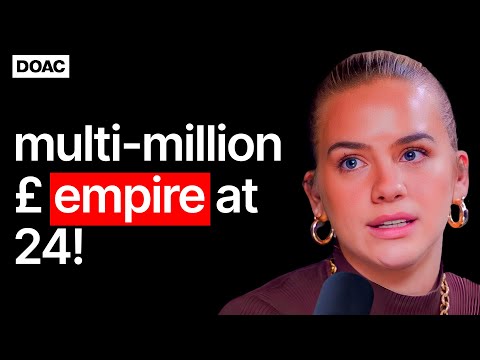
Grace Beverley: How To Build A Multi-Million Pound Empire At 24 | E69
Grace Beverley (guest), Steven Bartlett (host), Narrator, Narrator, Narrator
In this episode of The Diary of a CEO, featuring Grace Beverley and Steven Bartlett, Grace Beverley: How To Build A Multi-Million Pound Empire At 24 | E69 explores grace Beverley Redefines Hustle, Burnout, and Gen Z Entrepreneurship Expectations Grace Beverley, founder of two multi-million-pound brands (Shreddy and Tala), discusses building businesses while at Oxford, stepping back from social media, and confronting the personal costs of extreme ambition. She dismantles the myth of overnight success, explaining how her companies grew from small, scrappy experiments into serious ventures that now require real leadership, hiring, and delegation.
Grace Beverley Redefines Hustle, Burnout, and Gen Z Entrepreneurship Expectations
Grace Beverley, founder of two multi-million-pound brands (Shreddy and Tala), discusses building businesses while at Oxford, stepping back from social media, and confronting the personal costs of extreme ambition. She dismantles the myth of overnight success, explaining how her companies grew from small, scrappy experiments into serious ventures that now require real leadership, hiring, and delegation.
A major throughline is her critique of hustle culture and the glorification of being constantly busy; she admits to having embodied and promoted that mindset, only to hit severe burnout and PTSD-induced seizures that forced her to reconsider her relationship with work, validation, and mental health. She now frames productivity as sustainable, boundary-led effort rather than permanent overdrive.
Grace also explores gendered challenges in business, the double standards facing successful women online, and the tension between being visible enough to inspire while avoiding the perfection traps of cancel culture and social-media binary thinking. Personally, she’s consciously deprioritizing relationships for now, protecting her friendships, and redefining what balance looks like in her early 20s.
Throughout, she is candid about her insecurities, ego, and need for validation, while still owning what she’s uniquely good at—brand and product—and emphasizing the importance of hiring people better than herself to scale sustainably.
Key Takeaways
Successful businesses often grow from small, incremental experiments—not a single big idea.
Grace’s first venture started as monetizing free fitness content via simple e-books while she was interning at IBM. ...
Get the full analysis with uListen AI
Hustle culture can feel validating while quietly destroying your health and effectiveness.
Her ‘most praised’ period—launching Tala a month before Oxford finals while writing 40,000 words and sitting multiple exams—was, in her words, “the worst decision I’ve ever made. ...
Get the full analysis with uListen AI
Mental health issues demand the same seriousness as physical symptoms—often more, because they precede them.
Grace ignored mounting psychological distress from a traumatic event until it manifested as seizures and hospitalization due to PTSD. ...
Get the full analysis with uListen AI
Working hard is non-negotiable for big success, but boundaries are too.
She pushes back against both extremes: glamorizing 24/7 grind and pretending success can be achieved through ‘face masks and self-care’ alone. ...
Get the full analysis with uListen AI
Founders must let go of ego, hire people better than themselves, and stop bottlenecking growth.
Initially fearful and validating herself by “being involved in everything,” Grace learned that insisting on touching every process (including finance she barely understood) capped the scale of the business at one person—her. ...
Get the full analysis with uListen AI
Being a visible young woman in business comes with unique, often gendered, scrutiny.
Grace notes she’s white, privately educated, and Oxford-educated—privileges she openly contextualizes—but still faces people refusing to accept her authority, assuming she’s only a ‘face,’ or stereotyping successful women as either superhuman, secretly personally unfulfilled, or ‘a bitch. ...
Get the full analysis with uListen AI
Stepping back from social media can be a strategic career move, not a defeat.
Grace consciously pivoted from being a full-time influencer to being a founder whose primary work is off-camera, even though that meant sacrificing short-term income and the dopamine of constant validation. ...
Get the full analysis with uListen AI
Notable Quotes
“If something can manifest so physically that you’re having a fucking seizure, then you probably need to take this more seriously.”
— Grace Beverley
“This isn’t a competition for how many boxes you can tick within a small space of time. That is like a fast track towards burnout.”
— Grace Beverley
“Successful businesses that are founder-led are often the ones where the founder is product and brand.”
— Grace Beverley
“You’ve got to ask yourself: would you like the business to have the glory or would you like you to have the glory?”
— Grace Beverley
“The toughest thing I can do is to stand still and do it right.”
— Grace Beverley
Questions Answered in This Episode
You described that Tala launch during finals as your ‘worst decision’ but also incredibly validating—if you could relive that exact month with your current mindset, what would you concretely do differently day-to-day?
Grace Beverley, founder of two multi-million-pound brands (Shreddy and Tala), discusses building businesses while at Oxford, stepping back from social media, and confronting the personal costs of extreme ambition. ...
Get the full analysis with uListen AI
You openly contextualize your privilege as a white, privately educated Oxford grad; can you walk through one or two specific hiring, funding, or manufacturing decisions you’d do differently if you were designing your businesses to counteract those structural advantages?
A major throughline is her critique of hustle culture and the glorification of being constantly busy; she admits to having embodied and promoted that mindset, only to hit severe burnout and PTSD-induced seizures that forced her to reconsider her relationship with work, validation, and mental health. ...
Get the full analysis with uListen AI
When PTSD began showing up as seizures, what were the very first subtle warning signs—sleep changes, thought patterns, physical sensations—that, in hindsight, you wish you or someone close had taken seriously earlier?
Grace also explores gendered challenges in business, the double standards facing successful women online, and the tension between being visible enough to inspire while avoiding the perfection traps of cancel culture and social-media binary thinking. ...
Get the full analysis with uListen AI
You’ve said your unique value is brand and product: can you break down, step-by-step, how you personally shape a new Tala collection from initial insight to final campaign, and where you now deliberately stop yourself from getting involved?
Throughout, she is candid about her insecurities, ego, and need for validation, while still owning what she’s uniquely good at—brand and product—and emphasizing the importance of hiring people better than herself to scale sustainably.
Get the full analysis with uListen AI
You talked about leaving YouTube and shrinking your social presence as both a mental-health decision and a strategic business pivot; if the social media landscape shifted tomorrow (e.g., healthier algorithms, better nuance), under what conditions, if any, would you scale your public-facing content back up again?
Get the full analysis with uListen AI
Transcript Preview
One of the reasons I stepped back from social media was because I (dramatic music) ... if something can manifest so physically that you're having a fucking seizure-
Mm.
... then you probably need to take this more seriously. And that was, you know, like, that was, that was tough. (dramatic music) And that, for me, is my happiness.
(Instrumental music)
Grace Beverley, CEO and founder of two multi-million dollar companies. One's a fashion empire that's focused on sustainability, and one's a fitness empire comprising a mobile app, a supplements business, and gym equipment. She did all of that while studying and graduating from Oxford University, while growing her online channels to millions and millions of followers, while writing a book, and while dealing with all of the things that every other Gen Z person has to deal with at the age of 23. 23. And on the surface, it's easy to understand while looking in, someone might love to have Grace's life. But as you start to peel back the layers as we do in this conversation, you begin to understand her obsessive attention to detail, the weight of her workload, and the personal cost of her accomplishments. And you see the impact that those things have had on all parts of her life, and it makes you reconsider. Despite all of this, she's persisted. She's stayed true to her values. She's doubled down on the things she loves the most, and she's cut out some of the things that no longer serve her. She's learnt. She's learnt lessons that most of us would take a lifetime to learn, and she's 23. It blows my mind. Without further ado, I'm Steven Bartlett, and this is the Diary of a CEO. I hope nobody's listening, but if you are, then please keep this to yourself.
(Instrumental music)
Grace, I started my business at 18 years old as well. You, um, you faced a different set of challenges. Not only have you started your business at an incredibly young age, or you, or at least you got into business at an incredibly young age, you faced a set of challenges that are even alien to me in the sense that you are a woman in business, um, you are taking on various industries that don't want to be taken on and that really are sort of incumbent monopolies in the space of fast fashion and, and fitness and those things. I guess my first question is, why did you choose business, and what gave you the, what gave you the confidence to pursue a career that's filled with so much uncertainty at such a, a young age?
I think, I think people often assume that the first part of it always has to be a kind of, "I'm gonna start this. I'm gonna do this," and I think that mine absolutely wasn't that at all. And I think that that's what often makes me kind of question, you know, the amount of things that have had to fall into place for this to happen. And, of course, you know, there's hard work in that, but there's also so many other things that have had to go right. Um, so for me, you know, as I kind of said, when I was 18 and working, doing an internship at IBM, that's kind of when I started, and I just started doing some, I essentially started monetizing something that should be monetized. So, it was content I was giving away for free, and then I was gonna do lots more of that, and so I decided to monetize it via an e-book. Um, and then, you know, the next year, I did more of that, and then that's, you know, then it started picking up momentum. I started doing different products, and I think that that's, I guess, often not seen in the way that business is represented. It's kind of seen as, like, a eureka moment, then you go and do it, then you put it into action, then you fail once or twice, and then you get it.
Install uListen to search the full transcript and get AI-powered insights
Get Full TranscriptGet more from every podcast
AI summaries, searchable transcripts, and fact-checking. Free forever.
Add to Chrome