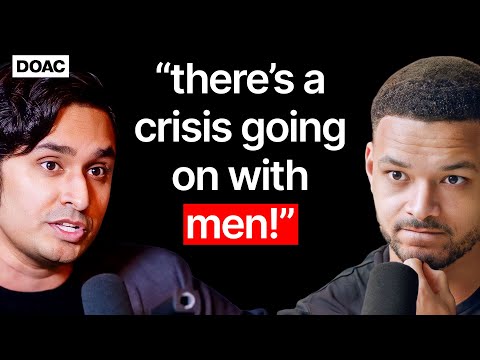
Dr K: "There Is A Crisis Going On With Men!", “We’ve Produced Millions Of Lonely, Addicted Males!”
Dr. Alok Kanojia (guest), Steven Bartlett (host)
In this episode of The Diary of a CEO, featuring Dr. Alok Kanojia and Steven Bartlett, Dr K: "There Is A Crisis Going On With Men!", “We’ve Produced Millions Of Lonely, Addicted Males!” explores harvard Monk-Psychiatrist Exposes Hidden Male Crisis, Offers Radical Inner Remedy Dr. Alok Kanojia (“Dr K”), a Harvard-trained psychiatrist and former monk, argues that we are facing a severe, long-ignored crisis among men marked by loneliness, addiction, suicidality and confusion about masculinity.
Harvard Monk-Psychiatrist Exposes Hidden Male Crisis, Offers Radical Inner Remedy
Dr. Alok Kanojia (“Dr K”), a Harvard-trained psychiatrist and former monk, argues that we are facing a severe, long-ignored crisis among men marked by loneliness, addiction, suicidality and confusion about masculinity.
He contends that modern technology and social media have externalized our attention, severing us from introspection and our internal signals, leaving young men especially vulnerable to toxic influencers who at least validate their pain.
Drawing on clinical experience across CEOs, incels, addicts and the homeless, he explains how thwarted belonging, shame and unprocessed trauma drive suicide and addiction more than classical mental illness.
His proposed remedies center on introspection, appropriate meditation techniques, genuine connection, and individual responsibility to listen non‑judgmentally and support struggling men (and increasingly women) rather than demonize or over‑rescue them.
Key Takeaways
Male suicidality is driven more by isolation and thwarted belonging than by classical mental illness.
Dr K cites research suggesting about 50% of men who die by suicide have no formal history of mental illness, which aligns with his clinical experience. ...
Get the full analysis with uListen AI
Constant external stimulation erodes self-knowledge and makes people dependent on outside scripts for identity and masculinity.
Modern life keeps our attention pointed outward—podcasts during workouts, content while cooking, phones in every “empty” moment. ...
Get the full analysis with uListen AI
Toxic masculine influencers thrive because they are the only ones openly validating men’s pain.
Dr K reframes the rise of figures like Andrew Tate as a failure of mainstream culture. ...
Get the full analysis with uListen AI
Addictions are both a source of pleasure and an antidote to pain; meditation strengthens the brain systems they exploit.
Across porn, gaming, substances, and phones, Dr K highlights a consistent pattern: dopamine surges plus suppression of negative emotion (amygdala/limbic deactivation). ...
Get the full analysis with uListen AI
Most people fail at meditation because they’re using the wrong technique, not because meditation “isn’t for them.”
He explains that there are many distinct meditation styles (he references 112 in yogic tradition), and each mind has a “cognitive fingerprint. ...
Get the full analysis with uListen AI
Over-helping struggling people can entrench helplessness; they must retain responsibility and initiative.
Using examples from rehab and a patient with HIV, Dr K argues that whenever others consistently “go the extra mile,” the person in trouble tends to do less. ...
Get the full analysis with uListen AI
Big, distant goals often undermine motivation; shrinking targets via the 25% rule makes change psychologically doable.
When someone with a huge target (e. ...
Get the full analysis with uListen AI
Notable Quotes
“For 100 years, men have been killing themselves. Eighty percent of suicides are men. The most dangerous thing for a man under 45 is themselves.”
— Dr K
“Most of the suicidal men that I work with, their mind isn’t malfunctioning. They genuinely have a life that is no longer worth living.”
— Dr K
“Someone needs to start offering these people safe haven no matter what they say… demonizing these people isn’t working.”
— Dr K
“Meditation is the process of plugging in your controller so that you start controlling the instrument of your life.”
— Dr K
“If you’ve tried meditation and it didn’t work for you, it’s not your problem. It’s that you had a crappy teacher.”
— Dr K
Questions Answered in This Episode
You argue that half of suicidal men aren’t mentally ill but trapped in objectively hopeless circumstances; what specific social or policy changes would most directly reduce that kind of ‘rational’ suicidality?
Dr. ...
Get the full analysis with uListen AI
If a young man is already deeply invested in toxic masculine influencers and feels they’re the only ones who ‘get’ him, what are the first three concrete steps you’d advise him to take in the next week to begin shifting toward healthier communities?
He contends that modern technology and social media have externalized our attention, severing us from introspection and our internal signals, leaving young men especially vulnerable to toxic influencers who at least validate their pain.
Get the full analysis with uListen AI
You describe anger as a protective, evolutionary emotion that men are both trained into and then punished for; how can couples practically renegotiate space for male anger without normalizing aggression or abuse?
Drawing on clinical experience across CEOs, incels, addicts and the homeless, he explains how thwarted belonging, shame and unprocessed trauma drive suicide and addiction more than classical mental illness.
Get the full analysis with uListen AI
Your techniques for ADHD meditation flip the usual script by asking the mind to speed up before it slows down; could you outline a 10-minute daily practice using that principle that a busy, skeptical listener could try for 30 days?
His proposed remedies center on introspection, appropriate meditation techniques, genuine connection, and individual responsibility to listen non‑judgmentally and support struggling men (and increasingly women) rather than demonize or over‑rescue them.
Get the full analysis with uListen AI
You’ve said over-helping fuels helplessness in addicts; for a parent whose child is at real risk (e.g., heavy drug use or severe porn addiction), where exactly is the line between ‘letting them own it’ and abdicating a moral duty to intervene?
Get the full analysis with uListen AI
Transcript Preview
This is super scary. 50% of men who kill themselves have no history or evidence of mental illness. What causes people to kill themselves is they try to connect with others, and they get rejected. You know, it's, it's... I can feel the hurt. I can feel the loss. (instrumental music plays) Dr. Alok Panojia...
He's a psychiatrist, Harvard Medical School instructor...
Real-life monk... Who uses his own addictive past...
To help millions of people improve their own mental health.
Everyone is getting screwed, but there's a crisis with men. People telling us that being a man means that you're a ... That you're toxic, that there's a patriarchy, that your testosterone level makes you violent. So, men are struggling right now and the rest of the world says, "No, you're not. You're privileged." And these people have been literally killing themselves because no one has been listening to them. Except there is one group of people who says, "Your life sucks," and that's these toxic masculine people. And these guys say, "I will show you a way to make it better," and that's when things go bad. And this, by the way, is how people wind up with addiction. Because when you look at addiction, what happens is we use a substance or a technology as an antidote to pain. So, I've worked with people who have pornography addiction, for example, that will have work on one screen, and they will literally have pornography on the second screen.
You're joking.
No, very common. And this is where there's a big problem in the world today.
Now you've got this young generation of women as well that are exploding in their suicidality. Loneliness seems to be getting worse and worse. What is the remedy to this?
So, this is something that's very important to understand. Everyone who is listening to this podcast needs to s- (music stops)
It's absolutely crazy to me that so many of you have decided to watch our show, um, and so many of you have decided to subscribe to our show. We now have five million subscribers on YouTube, which is a number that I just can't comprehend, and it's a dream that I absolutely never could have had. We started the Diary of a CEO just over three years ago now, and in my wildest expectations, we might have had 100,000 subscribers by now. So, you can imagine how shocked I am that so many of you have chosen to tune into these conversations every week, um, and spend some time with us. So, thank you. And I made a deal with you. I made a deal that if you subscribe to this show, that we would continue to raise the bar. And in 2024, we're gonna raise the bar like never before. I've been working for the last nine months on a surprise for all of you that have subscribed to this show, and I'm very excited to deliver that for you. The production's gonna change. We're gonna go even further with our guests, and we're gonna tell even more global stories. So, as always, if you appreciate what we're doing here, the simple free favor I'll ask from you is to hit the subscribe button. Let's get on with the episode. (instrumental music plays) Dr. K?
Install uListen to search the full transcript and get AI-powered insights
Get Full TranscriptGet more from every podcast
AI summaries, searchable transcripts, and fact-checking. Free forever.
Add to Chrome