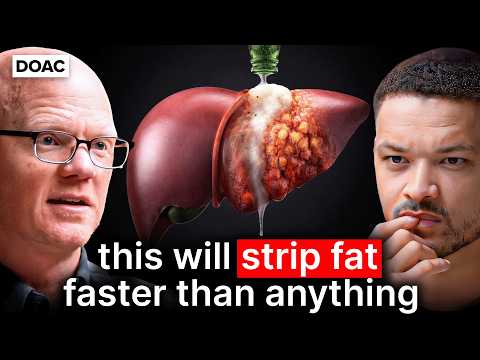
Insulin Expert: How To 'Drain' Your Liver of Fat (Do This!)
Dr. Benjamin Bikman (guest), Steven Bartlett (host)
In this episode of The Diary of a CEO, featuring Dr. Benjamin Bikman and Steven Bartlett, Insulin Expert: How To 'Drain' Your Liver of Fat (Do This!) explores insulin, ketones, and habits: a new blueprint for fat loss Dr. Benjamin Bikman argues that insulin control, not calorie counting, should be the central focus of sustainable fat loss and metabolic health. He explains how chronically high insulin drives fat storage, hunger, and brain fog, and why lowering carbohydrates can increase metabolic rate, satiety, and access to stored fat via ketones. The discussion covers ketogenic diets, exogenous ketones, GLP‑1 drugs like Ozempic, creatine, sleep, stress, and practical daily routines that fit real life. Throughout, Bikman stresses flexibility (keto isn’t the only path), the importance of preserving muscle, and using tools like CGMs, labs, and simple behavioral shifts to make 2026 a genuinely transformative health year.
Insulin, ketones, and habits: a new blueprint for fat loss
Dr. Benjamin Bikman argues that insulin control, not calorie counting, should be the central focus of sustainable fat loss and metabolic health. He explains how chronically high insulin drives fat storage, hunger, and brain fog, and why lowering carbohydrates can increase metabolic rate, satiety, and access to stored fat via ketones. The discussion covers ketogenic diets, exogenous ketones, GLP‑1 drugs like Ozempic, creatine, sleep, stress, and practical daily routines that fit real life. Throughout, Bikman stresses flexibility (keto isn’t the only path), the importance of preserving muscle, and using tools like CGMs, labs, and simple behavioral shifts to make 2026 a genuinely transformative health year.
Key Takeaways
Prioritize lowering insulin, not just cutting calories, to lose fat
Calorie restriction alone often leads to hunger and rebound weight gain; lowering insulin by reducing refined carbs lets you eat adequate protein and fat, access stored body fat, and feel less hungry while shrinking fat cells.
Get the full analysis with uListen AI
Use carb control and meal timing to stabilize energy and cravings
Minimize carbs at breakfast and lunch, eat a large protein‑ and fat‑rich lunch, and avoid late‑night snacking so you don’t go to bed hyperglycemic—this improves sleep, reduces evening cravings, and supports better metabolic health.
Get the full analysis with uListen AI
Leverage ketones for brain, heart, and appetite benefits
In low‑insulin states (fasting or low‑carb), the liver turns fat into ketones, which fuel the brain and heart efficiently, reduce anxiety and hunger, and may aid conditions like depression, migraines, epilepsy, and cognitive decline.
Get the full analysis with uListen AI
If you use GLP‑1 drugs, treat them as temporary training wheels
Bikman suggests low‑dose, time‑limited GLP‑1 use, paired with low‑carb coaching, to break carb cravings and establish new habits, rather than long‑term reliance that can erode muscle and eventually lose effectiveness.
Get the full analysis with uListen AI
Protect and build muscle with protein, resistance training, creatine, and omega‑3
During weight loss, you risk losing lean mass; lifting weights, eating sufficient protein, supplementing creatine and omega‑3s help preserve or build muscle, which is crucial for metabolism, longevity, and quality of life.
Get the full analysis with uListen AI
Improve sleep and manage stress to protect insulin sensitivity
Poor sleep and chronic stress rapidly worsen insulin resistance and drive cravings; tools like evening carb curfews, reduced alcohol, possible use of ashwagandha, and morning light/cold exposure can improve sleep and lower stress load.
Get the full analysis with uListen AI
Use simple tech and labs to personalize your plan
Continuous glucose monitors, finger‑stick ketone meters, and periodic lab tests for fasting insulin, HOMA‑IR, and (for men) testosterone provide feedback that helps you see how foods, routines, and supplements affect your body.
Get the full analysis with uListen AI
Notable Quotes
““Insulin, as a hormone, is the one metabolic hormone to rule them all.””
— Dr. Benjamin Bikman
““Don’t have your first step on your fat cell shrinking journey be low calorie, because hunger will win.””
— Dr. Benjamin Bikman
““You simply wipe out a person’s insulin, it is completely impossible for them to get fat.””
— Dr. Benjamin Bikman
““Every diet works until you stop doing it.””
— Dr. Benjamin Bikman
““If I could have one change in medicine, it would be: add insulin to every standard blood panel.””
— Dr. Benjamin Bikman
Questions Answered in This Episode
How low do my daily carbs realistically need to be to meaningfully lower insulin while still being sustainable for my lifestyle and preferences?
Dr. ...
Get the full analysis with uListen AI
If I’m considering a ketogenic approach, how should I phase into it to minimize side effects and avoid the ‘keto flu’ while maintaining my work and family responsibilities?
Get the full analysis with uListen AI
What’s the smartest way for me personally to use tools like CGMs, ketone meters, and lab tests (fasting insulin, HOMA‑IR, testosterone) without getting obsessive?
Get the full analysis with uListen AI
If I’m already on (or thinking about) a GLP‑1 drug like Ozempic, how can I design a time‑limited, muscle‑preserving plan that transitions me off it successfully?
Get the full analysis with uListen AI
Given my sex, age, and current stress/sleep situation, should I prioritize dietary changes, resistance training, sleep optimization, or stress management first to get the biggest initial return?
Get the full analysis with uListen AI
Transcript Preview
One of the problems with weight loss goals is saying-
(instrumental music)
... you need to cut calories in order to get there. Now, I'm not saying calories don't matter. They're relevant, but not the most relevant. And I'm gonna talk about evidence to support that.
If someone is listening at home now, and they have the goal of losing some weight, they want to be in a better physique, be more healthy, is this conversation going to help them accomplish those goals?
I'll make sure that they get what they need.
Dr. Benjamin Bikman is one of the world's leading metabolic and fat cell scientists. And now he's returned to expose some of the myths surrounding weight loss. And the surprising impact that one particular hormone has on our weight, brain and mental health.
As a metabolic scientist, I wouldn't want someone to think there is only one way to lose weight. However, I think this is the most practical and simplest strategy, a ketogenic diet. A huge reason is that when you cut carbs, insulin comes down, and insulin as a hormone is the one metabolic hormone to rule them all. Insulin will tell every single cell of the body what it needs to do with energy, and insulin is so determined to store energy that it is directing calories to be stored in tissues like fat or in the liver.
To make you fat?
Yeah. But there's more. Ketones are the brain's preferred fuel. It can control anxiety, improve depression. It can help with attention. In fact, the benefits of ketones are so extensive that companies are finding ways so you can drink ketones.
And I have a bunch of different exogenous ketone products here, a variety of different brands.
Yeah.
And a bunch of other things here on the table. So what the hell is this?
If someone is interested in a good, smart way of losing weight, try that.
Ugh. This is definitely a prop. It tastes like bleach. (laughs)
Oh, I'm so sorry. Oh my God.
So for 2026 to be the year where I finally get a grip of my health, and I asked you to make the perfect plan, what would you prescribe me?
So first of all...
I see messages all the time in the comments section that some of you didn't realize you didn't subscribe. So if you could do me a favor and double check if you're a subscriber to this channel, that would be tremendously appreciated. It's the simple, it's the free thing that anybody that watches this show frequently can do to help us here to keep everything going in this show, in the trajectory it's on. So please do double check if you've subscribed, and, uh, thank you so much, because in a strange way, you are, you're part of our history, and you're on this journey with us, and I appreciate you for that. So yeah, thank you. (instrumental music) Dr. Benjamin Bikman, at this time of year, the audience that are listening right now are thinking a lot about health and dietary changes that they can make to make 2026 the best year of their life, to finally be able to kick that habit. And one of the things that's front of mind, I think for all of my listeners is their relationship with sugar, with carbs.
Install uListen to search the full transcript and get AI-powered insights
Get Full TranscriptGet more from every podcast
AI summaries, searchable transcripts, and fact-checking. Free forever.
Add to Chrome