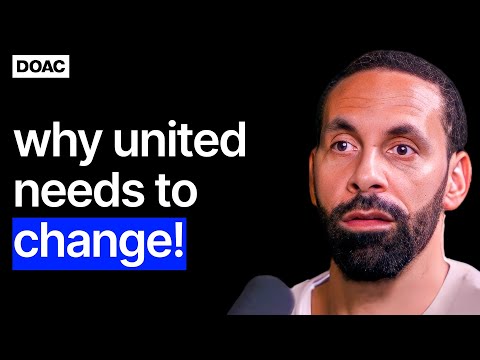
Rio Ferdinand's Reveals The Training Ground & Dressing Room Secrets That Made United Unbeatable!
Rio Ferdinand (guest), Steven Bartlett (host)
In this episode of The Diary of a CEO, featuring Rio Ferdinand and Steven Bartlett, Rio Ferdinand's Reveals The Training Ground & Dressing Room Secrets That Made United Unbeatable! explores rio Ferdinand Reveals Ruthless Culture And Vulnerability Behind United’s Dominance Rio Ferdinand reflects on the formative experiences, mentality, and culture that took him from a multi‑talented kid in Peckham to a Manchester United legend. He explains how Sir Alex Ferguson built an uncompromising, player‑led culture of standards, accountability, and loyalty that made United unbeatable for years. Beyond football, Rio talks about redefining his identity after retirement, embracing discomfort, learning business, and mentoring the next generation. He also opens up about grief, mental health, family, and the lifelong importance of health, communication, and curiosity.
Rio Ferdinand Reveals Ruthless Culture And Vulnerability Behind United’s Dominance
Rio Ferdinand reflects on the formative experiences, mentality, and culture that took him from a multi‑talented kid in Peckham to a Manchester United legend. He explains how Sir Alex Ferguson built an uncompromising, player‑led culture of standards, accountability, and loyalty that made United unbeatable for years. Beyond football, Rio talks about redefining his identity after retirement, embracing discomfort, learning business, and mentoring the next generation. He also opens up about grief, mental health, family, and the lifelong importance of health, communication, and curiosity.
Key Takeaways
Say yes widely when you’re rising, then get ruthlessly selective at the top.
As a kid, Rio said yes to everything – gymnastics, ballet, athletics, drama, football – encouraged by parents who pushed him to try and explore. ...
Get the full analysis with uListen AI
Real growth requires embracing vulnerability and looking stupid in new arenas.
Rio repeatedly puts himself into situations where he feels out of his depth – joining The Gym Group board, exploring boxing after football, entering media and business. ...
Get the full analysis with uListen AI
Elite culture is built on everyday habits, non‑negotiable standards, and enforced consequences.
At United, standards were embedded in punctuality, work ethic, intensity in training, and mutual respect. ...
Get the full analysis with uListen AI
Leadership is deeply personal: know your people, tailor your approach, and defend the group.
Sir Alex combined high standards with genuine personal care – knowing staff by name, sending flowers to Rio’s grandfather, understanding players’ families. ...
Get the full analysis with uListen AI
Hard work isn’t optional; it must become a lifestyle, not a phase.
Rio is blunt about the current ‘softness’ around hard work and the trend to demonize it via mental‑health rhetoric. ...
Get the full analysis with uListen AI
Unprocessed pain festers; healing starts when you unpack it and speak.
Rio admits that in his playing days, mental health was taboo and vulnerability equaled weakness; issues were compartmentalized rather than addressed. ...
Get the full analysis with uListen AI
Health, communication, and curiosity are the real long‑term performance multipliers.
After experiencing personal tragedy and a global pandemic, Rio now sees health as the foundational asset: without it, success is hollow. ...
Get the full analysis with uListen AI
Notable Quotes
“I don’t see barriers.”
— Rio Ferdinand
“My next phase of life… if in 10, 20 years they say, ‘That’s Rio who played for Man United,’ I ain’t really kicked on.”
— Rio Ferdinand
“If you fail, what? Get up and go again.”
— Rio Ferdinand
“Work hard, man. That should be just an absolute normal ask of any person.”
— Rio Ferdinand
“If you don’t fit the culture and you don’t adhere to the rules that are there, good night.”
— Rio Ferdinand
Questions Answered in This Episode
You described Sir Alex rarely entering the training‑ground dressing room because the culture was self‑policing—what specific behaviors or routines would you implement first if you were parachuted into a club today to rebuild that kind of player‑led culture from scratch?
Rio Ferdinand reflects on the formative experiences, mentality, and culture that took him from a multi‑talented kid in Peckham to a Manchester United legend. ...
Get the full analysis with uListen AI
Looking back at teammates like Louis Saha, if today’s understanding of mental health and support systems had existed then, what concrete interventions do you think would have extended or transformed his (or others’) careers?
Get the full analysis with uListen AI
You’ve been very critical of ‘softness’ around hard work but also deeply engaged with mental health—where, in your view, is the honest line between healthy relentless effort and genuinely destructive burnout, and how would you teach that line to your kids or academy players?
Get the full analysis with uListen AI
You talked about being willing to sack or sell even world‑class performers for culture reasons; can you recall a specific moment in your post‑football business life where you wished you’d been more ‘Fergie‑like’ and removed someone earlier to protect the standard?
Get the full analysis with uListen AI
Given your obsession with not being remembered only as a footballer, how will you personally decide that your post‑playing career has ‘kicked on’ enough—what measurable signs or milestones would convince you that you’ve truly escaped that single narrative?
Get the full analysis with uListen AI
Transcript Preview
I don't see barriers. (instrumental music plays) Hard work every day, the lifestyle, to be, like, a standard. Dedication, attention to detail. I just wanted to be the best. I was that obsessed with it. My kids lost, they lost their, their mum. I got to understand mental health for making a documentary. It's allowed me to kind of speak and, and show vulnerability that people probably were never used to. The great part of it is that you walk down the street, an old age lady or a man come up to you, you know, what... Throat's all croaky and... "I watched your program. F- I- I've never spoken before, really. You, you helped me." Like, my next phase in my life, when someone sees me in 10, 20 years, say "That's Rio Ferdinand." I haven't really done what I'm here to do, to set- setting out to do. (instrumental music plays)
Do I even need to introduce my next guest? Rio Ferdinand, former football player, one of the most decorated English footballers of all time, and as a Man United fan, probably one of my favorite players of all time, ever, and he's played alongside some of the greatest players ever, but he's also been managed by the best manager ever. I grew up as a Manchester United fan watching him, idolizing him, and now he's my mate. So this is gonna be a fairly interesting conversation. After retiring, he's become a sports commentator for BT Sport. He's become an author. He's become an entrepreneur. He's a, the founder of a charity, a foundation. He's a non-executive director, which we'll talk about today as well. And as you'll hear, he's also so much more, some things that you probably wouldn't expect. He's also a husband and a dad, one that's experienced tremendous, unthinkable tragedy, tragedy I pray that most of us will never know. Rio is a special guy, not least for what he's achieved on the field, but for who he is. And today you're gonna find out who he actually is, the philosophy to life that he swears by, and the culture required to win in an ambitious career, but also the culture required to win in your personal life. Without further ado, I'm Steven Bartlett, and this is the Diary of a CEO. I hope nobody's listening, but if you are, then please keep this to yourself. (instrumental music plays) I'm trying to find the right words to ask this question, because it's one that I've, I haven't seen been asked in p- previous interviews of you. But what are the, what are the key things that happened when you were very, very young that made you choose football as your future or enabled you to, to, to take that path? Because a lot of kids grow up in London, a lot of kids do a lot of things, they have a lot of passions. But for some reason, as I read through your story, football was this... Ballet as well, but football was the, the path that you chose to take above all other things.
Install uListen to search the full transcript and get AI-powered insights
Get Full TranscriptGet more from every podcast
AI summaries, searchable transcripts, and fact-checking. Free forever.
Add to Chrome