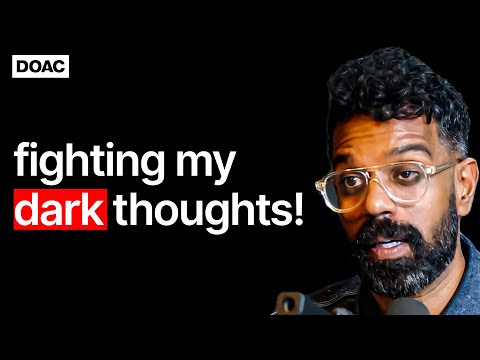
Romesh Ranganathan: There's A Dark Voice In My Head That I've Learnt To Control | E220
Romesh Ranganathan (guest), Steven Bartlett (host), Narrator
In this episode of The Diary of a CEO, featuring Romesh Ranganathan and Steven Bartlett, Romesh Ranganathan: There's A Dark Voice In My Head That I've Learnt To Control | E220 explores romesh Ranganathan On Darkness, Comedy, And Redefining Real Success Romesh Ranganathan recounts a childhood that flipped from comfort and privilege to chaos, poverty, and his father’s imprisonment, and how that upheaval shaped his worldview, ambition, and eventual comedy career.
Romesh Ranganathan On Darkness, Comedy, And Redefining Real Success
Romesh Ranganathan recounts a childhood that flipped from comfort and privilege to chaos, poverty, and his father’s imprisonment, and how that upheaval shaped his worldview, ambition, and eventual comedy career.
He speaks candidly about living with a brutal inner critic, periods of suicidal ideation, and the coping mechanisms he’s learned to keep a ‘dark voice’ in his head under control while functioning at the top of British comedy.
The conversation explores the impact of parental failure and sacrifice, immigrant expectations, shame, and class shifts, alongside the power of doing work you love, focusing on what you can control, and detaching from external markers of success.
Romesh also reflects on grief for his father, adoration for his mother, the role of luck and mentorship in his career, and how he defines happiness and meaning despite ongoing mental health struggles.
Key Takeaways
Early instability can wire a default expectation that life will go wrong – and that can fuel both self-sabotage and unconventional risk-taking.
Romesh’s life flipped in roughly 12–18 months from private school and financial comfort to repossession, council housing, his father’s affair and imprisonment, and living in a B&B. ...
Get the full analysis with uListen AI
Shame and secrecy around family collapse create a damaging double life that amplifies stress and low self-worth.
Through school, Romesh hid everything: his dad’s imprisonment, homelessness in a B&B, the lack of a house phone, and living in an uncarpeted council house. ...
Get the full analysis with uListen AI
A harsh internal voice can persist regardless of external success, so the battle is managing it, not waiting for circumstances to silence it.
Despite being one of the UK’s most visible comics, Romesh describes a ‘prick living in my head’ that tells him he’s a bad dad, bad husband, and fraud who will be found out. ...
Get the full analysis with uListen AI
Concrete coping mechanisms hinge on presence, physical habits, and naming what’s happening rather than trying to suppress it.
Romesh’s tools include: (1) radical presence – focusing only on doing the current gig, show, or conversation well instead of catastrophising about downstream consequences; (2) perspective-taking – mentally mocking his own ‘God complex’ belief that the universe is against him; (3) basic maintenance – sleep, hydration, exercise, meditation apps like Headspace; and (4) meta-awareness – telling himself, ‘I’ve gone dark’ and recognising the thoughts as irrational manifestations, not reality.
Get the full analysis with uListen AI
Career ‘breaks’ are usually built on long invisible grind, deliberate risk, and someone already inside the system betting on you.
He began stand-up as a ‘teacher with a hobby’, doing tiny pub gigs for years. ...
Get the full analysis with uListen AI
Parents can be deeply flawed and still be loved, admired, and formative – holding both truths is part of adult reconciliation.
Romesh’s father was a heavy drinker, womaniser, lost his job, did illegal import/export deals, went to prison, and abandoned the family emotionally and financially. ...
Get the full analysis with uListen AI
A healthier definition of success is loving the work and mastering what you control, not chasing external milestones like BAFTAs.
Romesh rejects rigid five‑year plans and goal-setting around awards or status because they depend on unpredictable external forces. ...
Get the full analysis with uListen AI
Notable Quotes
“I have a prick living in my head that talks to me all the time.”
— Romesh Ranganathan
“Happiness isn’t buzzing off your tits the whole time.”
— Romesh Ranganathan
“The honest truth is, I would have that voice regardless of what I did, so I might as well do something I really love.”
— Romesh Ranganathan
“Why would you give yourself a target that’s so outside of your control? What I can do is make something I’m proud of.”
— Romesh Ranganathan
“As soon as you flip the switch and go, ‘This isn’t happening to me,’ your ability to just chill out is miraculous.”
— Romesh Ranganathan
Questions Answered in This Episode
You described specific physical habits (sleep, hydration, exercise) that help keep your inner critic at bay. Have you ever systematically tracked which habits make the biggest difference, and what would your ‘minimum effective dose’ routine look like on a really bad week?
Romesh Ranganathan recounts a childhood that flipped from comfort and privilege to chaos, poverty, and his father’s imprisonment, and how that upheaval shaped his worldview, ambition, and eventual comedy career.
Get the full analysis with uListen AI
When you say there’s ‘always a cost’ to hiding your family situation as a teenager, what are one or two subtle ways that secrecy still shows up in your adult relationships or career decisions today?
He speaks candidly about living with a brutal inner critic, periods of suicidal ideation, and the coping mechanisms he’s learned to keep a ‘dark voice’ in his head under control while functioning at the top of British comedy.
Get the full analysis with uListen AI
You’ve said you’re okay if TV disappears as long as you can do stand-up. Is there any part of your ego or identity that you worry might actually struggle more with losing the public profile than you’re admitting now?
The conversation explores the impact of parental failure and sacrifice, immigrant expectations, shame, and class shifts, alongside the power of doing work you love, focusing on what you can control, and detaching from external markers of success.
Get the full analysis with uListen AI
Given your dad’s mix of brutal honesty and unwavering belief in your potential, how do you try to replicate or avoid that style when giving feedback to your own children about their dreams or talents?
Romesh also reflects on grief for his father, adoration for his mother, the role of luck and mentorship in his career, and how he defines happiness and meaning despite ongoing mental health struggles.
Get the full analysis with uListen AI
You’re sceptical of outcome-based goals like ‘win a BAFTA’ and prefer focusing on the work in front of you. If a young comic asked you how to balance that philosophy with the practical need to pay rent and build a career, what concrete steps would you advise them to take in their first five years?
Get the full analysis with uListen AI
Transcript Preview
Please welcome Romesh Ranganathan. (upbeat music)
He's one of the most popular stand-ups around.
I'm hosting this bitch. (upbeat music) I think that all comedians are wired slightly differently, and something happened to them that has made them an outsider in some way.
What is that for you?
We lived in a nice house. We had a nice car. All the stereotypical things that you mark success with. Then over the period of six months, it was a complete 180.
What was the catalyst for that 180?
Well- Shut up, mate. (energetic music) I'm addicted to doing stand-up, and it makes me better at everything. But I've got this inner voice that is horrific. It will say, "You're not a very good dad. You're not a very good husband." I'd done one of about six panel shows, and I was in a really bad place. And I turned up to each one of them with the steadfast belief that I was shit at this.
What happens when it does go horrifically on the stage?
It's horrible. (laughs)
(laughs)
Then silence. That never gets easier, man. But you learn more from those gigs. I just need to do the best I possibly can at this gig. I'm not in control of anything that happens after that. Don't think about this goal down the line that you're trying to get to. Do this thing brilliantly. If you love what you do and you do that, you are in a good camp.
This is such a, a right turn, but-
Oh, what an absolute stitch-up.
(laughs)
Are you joking?
(laughs)
We were having such a nice time.
(laughs) Hello, everybody. Thank you for tuning in to watch this episode. Honestly, an incredible episode, but I have to say thank you before we begin because we've hit a million subscribers on this channel now, and I... it's almost unthinkable. It's, I can't... you know, I'm speaking for our entire team here when I say it's genuinely, genuinely unthinkable. Biggest privilege of my life to get to do this. Means the world that you guys tune in every, every week, uh, to listen to these episodes. So I just wanted to say thank you. Thank you to all of our subscribers. Roughly 65% of you that watch this channel now subscribe to the channel, which is amazing. If you haven't yet subscribed, could you please do me a little bit of a favor? Um, I can't tell you how much it helps this channel and how much it's helped us to pull in amazing, amazing guests and to expand everything within our operations, and how it's also gonna help us enable the, the year that's to come and all the plans we have, some huge plans, which I'm gonna be bringing to you very shortly. But if you can just do me the one favor and hit that subscribe button, it will be tremendously appreciated by myself and all of our team here. Really, really hope you enjoy this episode. Thank you for being here. Thank you for helping us reach this huge milestone of a million subscribers. Let's get on with it. (upbeat music) I'm so fascinated by comedians because I find it to be an art form that is both genius and terrifying.
Install uListen to search the full transcript and get AI-powered insights
Get Full TranscriptGet more from every podcast
AI summaries, searchable transcripts, and fact-checking. Free forever.
Add to Chrome