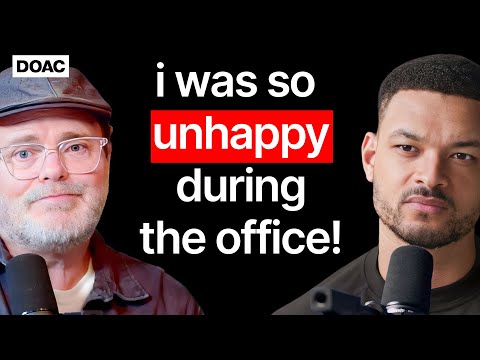
Rainn Wilson: "I was so unhappy during The Office!" (Dwight Schrute)
Rainn Wilson (guest), Narrator, Steven Bartlett (host), Steven Bartlett (host)
In this episode of The Diary of a CEO, featuring Rainn Wilson and Narrator, Rainn Wilson: "I was so unhappy during The Office!" (Dwight Schrute) explores rainn Wilson Confronts Trauma, Spirituality, Ego And Office-Era Unhappiness Rainn Wilson discusses how childhood abandonment, religious hypocrisy, and family dysfunction created deep anxiety, depression, and addiction—but also fueled his comedy, acting career, and spiritual search.
Rainn Wilson Confronts Trauma, Spirituality, Ego And Office-Era Unhappiness
Rainn Wilson discusses how childhood abandonment, religious hypocrisy, and family dysfunction created deep anxiety, depression, and addiction—but also fueled his comedy, acting career, and spiritual search.
He explains how pain drove him toward acting, a spiritual reawakening, and eventually to explore big questions about death, the soul, and the meaning of life in his book Soul Boom.
Wilson reflects candidly on being profoundly unhappy and ego-driven during The Office, despite massive success, and how gratitude, spirituality, and service reframed his ambitions.
He shares practical insights on trauma, parenting, meditation, the 12 Steps, ego and shadow work, and the power of surrender, love, and community in healing and change.
Key Takeaways
Childhood trauma can both wound and form the foundation of later strengths.
Wilson links his lifelong anxiety, depression, and addiction directly to early abandonment by his mother, an emotionally barren home, and religious gaslighting. ...
Get the full analysis with uListen AI
Comedy and gratitude are powerful counterweights to pain and depression.
Referencing Arthur Brooks, he notes that gratitude shifts focus away from depressive rumination; comedy does something similar for trauma. ...
Get the full analysis with uListen AI
Spiritual perspective on death can radically change how we live.
Watching his father die on life support, Wilson had a visceral realization that the body is just a vessel and that his father’s true reality—his 'light'—had moved on. ...
Get the full analysis with uListen AI
Success does not resolve inner emptiness; ego-based goals are a moving target.
Wilson describes being on The Office—earning millions, playing a beloved character, winning recognition—and spending several years “mostly unhappy because it wasn’t enough. ...
Get the full analysis with uListen AI
Gratitude and presence are practical antidotes to chronic dissatisfaction.
Asked how to enjoy success in the moment, he says if you always locate happiness in the future, it will always stay there. ...
Get the full analysis with uListen AI
Surrender and community are central levers of real personal change.
Drawing from 12 Step programs, Wilson highlights the paradox that admitting powerlessness—surrendering control, ego, and self-sufficiency—creates strength. ...
Get the full analysis with uListen AI
You can’t eradicate your shadow; you have to befriend and manage it.
Influenced by Jung, Wilson says everyone carries a shadow—addictive, narcissistic, entitled parts of the self. ...
Get the full analysis with uListen AI
Notable Quotes
“Here’s your choice: you can kill yourself or do comedy.”
— Rainn Wilson
“If I had had a happy, well-balanced childhood, I don’t know what my career would have been, but it certainly wouldn’t have been a successful actor.”
— Rainn Wilson
“We are not human beings having a spiritual experience; we are spiritual beings having a human experience.”
— Rainn Wilson, quoting Teilhard de Chardin and applying it to his father’s death
“When I was in The Office, I spent several years mostly unhappy because it wasn’t enough.”
— Rainn Wilson
“As long as we want to promote the self and the self‑will and ego satisfaction, we’ll never be happy.”
— Rainn Wilson
Questions Answered in This Episode
You describe being 'mostly unhappy' during The Office despite having everything you thought you wanted. If you could relive those years with your current spiritual tools, what specific daily practices would you implement on set to experience them differently?
Rainn Wilson discusses how childhood abandonment, religious hypocrisy, and family dysfunction created deep anxiety, depression, and addiction—but also fueled his comedy, acting career, and spiritual search.
Get the full analysis with uListen AI
When you realized at your father’s deathbed that 'this isn’t him, this is the vessel,' did anything in your Bahá’í upbringing conflict with that experience—or did it reshape how you interpret Bahá’í teachings about the soul and the afterlife?
He explains how pain drove him toward acting, a spiritual reawakening, and eventually to explore big questions about death, the soul, and the meaning of life in his book Soul Boom.
Get the full analysis with uListen AI
You’re candid that your shadow is narcissistic and entitled, yet you also need a public persona to create and promote work like Soul Boom. How do you practically distinguish between healthy self-promotion in service of a message and ego-driven grasping for attention?
Wilson reflects candidly on being profoundly unhappy and ego-driven during The Office, despite massive success, and how gratitude, spirituality, and service reframed his ambitions.
Get the full analysis with uListen AI
You said comedy is often a choice between 'kill yourself or do comedy.' For a young person in pain who doesn’t feel funny or artistic, what non-artistic equivalents to 'comedy' do you think can serve as that same life-raft and perspective shift?
He shares practical insights on trauma, parenting, meditation, the 12 Steps, ego and shadow work, and the power of surrender, love, and community in healing and change.
Get the full analysis with uListen AI
You and Stephen both talk about partners who are naturally loving, emotionally fluent, and spiritually open. For people who don’t have such a model at home, what concrete steps can they take to 'learn love' the way you did—without simply copying surface behaviors?
Get the full analysis with uListen AI
Transcript Preview
We're gonna talk about The Office, I promise.
(laughs)
Stick around, folks. (bell ringing) Rainn Wilson! Actor, writer, producer, you know as- Dwight Schrute, assistant regional manager. One of the most iconic characters- In TV history. Hold on, Michael, I am coming. (dramatic music) I experienced a lot of pain in my life. Neglect, abuse, abandoned. And then with anxiety and depression and addiction, I remember getting these anxiety attacks that would leave me shaking on the floor and sweating, and I thought I was dying. Waking up at 3:00 in the morning going, "Why should I keep living?" But this is the curious thing. I'm grateful for it. There's a reason why so many comedians come from painful backgrounds, because comedy shifts your perspective away from pain and trauma. Here's your choice, you can kill yourself or do comedy, and that was my path. It's my greatest dream come true.
You said, "When I was in The Office, I spent several years mostly unhappy because it wasn't enough."
I wanted more opportunities, I wanted more money. And as long as we wanna promote the ego satisfaction, we'll never be happy. We all have a shadow, and it's always there. And it's self-important and righteous and entitled, but I'm not going to get rid of those aspects of myself by keeping that shadow at arm's length. You need to embrace and accept and love one's shadow. Sit the shadow on the lap almost like a ventriloquist dummy. Hello. Speaker 2 You, diary of a CEO. Get a new T-shirt, idiot.
(laughs)
That's a wrap. (dramatic music)
I think this is fascinating. I looked at the back end of our YouTube channel, and it says that since this channel started, 69.9% of you that watch it frequently haven't yet hit the subscribe button. So, I have a favor to ask you. If you've ever watched this channel and enjoyed the content, if you're enjoying this episode right now, please can I ask a small favor? Please hit the subscribe button. Helps this channel more than I can explain. And I promise, if you do that, to return the favor, we will make this show better and better and better and better and better. That's a promise I'm willing to make you if you hit the subscribe button. Do we have a deal? (upbeat music) Let's start with your context. Um, I always think the, the earliest years are the most important. So, could you take me back to your earliest context and give me the factors that I need to understand to understand you?
Sure. Uh, couple of key pieces in my background that have made me who I am and, uh, led me to lead the life that I live, uh, are, my mom, uh, took off when I was a year and a half, uh, lived with my, with my dad. And we were members of the Bahá'í Faith, uh, which, in a nutshell, is the newest of the world's religions. Uh, there's about six million Bahá'ís around the globe. It's the second most widespread religion, so wherever you go in the world, there's gonna be Bahá'ís. You know, you go to Mongolia or Thailand or, you know, Botswana or whatever, there's gonna be Bahá'í communities. And after my dad had been kind of essentially abandoned or felt abandoned, they got divorced, uh, we moved to the jungles of Nicaragua when I was three years old. Here was this abandoned kind of toddler kid living in the, literally the jungle. Uh, and my dad was an abstract painter and science fiction writer, and Bahá'í, and, uh, that's, that's how I grew up. And then, when it was kinda around kindergarten time, first grade time, we moved back to Washington State. And, um, those are some key pieces. Yeah.
Install uListen to search the full transcript and get AI-powered insights
Get Full TranscriptGet more from every podcast
AI summaries, searchable transcripts, and fact-checking. Free forever.
Add to Chrome