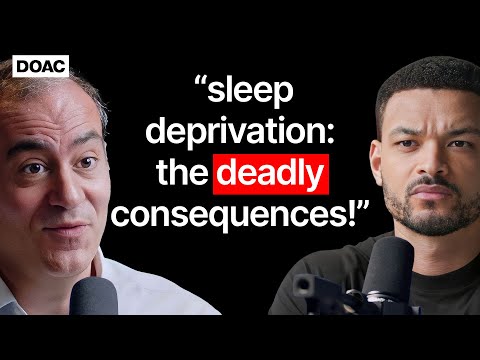
The Extreme Sleep Scientist: The Painful Trick To Fix Insomnia And Poor Sleep!
Dr. Guy Leschziner (guest), Steven Bartlett (host), Narrator
In this episode of The Diary of a CEO, featuring Dr. Guy Leschziner and Steven Bartlett, The Extreme Sleep Scientist: The Painful Trick To Fix Insomnia And Poor Sleep! explores extreme Sleep Secrets: Neuroscientist Reveals Counterintuitive Cure For Insomnia Neurologist and sleep physician Dr. Guy Leschziner explains why sleep is fundamental to nearly every bodily system, yet still deeply misunderstood and often mishandled in modern life. Drawing on more than 25,000 sleep studies and 100,000 patients, he outlines the true scale of sleep problems—from insomnia and sleep apnea to rare disorders like narcolepsy, extreme sleepwalking and Kleine–Levin syndrome.
Extreme Sleep Secrets: Neuroscientist Reveals Counterintuitive Cure For Insomnia
Neurologist and sleep physician Dr. Guy Leschziner explains why sleep is fundamental to nearly every bodily system, yet still deeply misunderstood and often mishandled in modern life. Drawing on more than 25,000 sleep studies and 100,000 patients, he outlines the true scale of sleep problems—from insomnia and sleep apnea to rare disorders like narcolepsy, extreme sleepwalking and Kleine–Levin syndrome.
He argues that culture, technology and anxiety around sleep itself are major drivers of insomnia, and that non-drug treatments, especially Cognitive Behavioral Therapy for Insomnia (CBT‑I), can significantly improve sleep in around 80% of chronic insomniacs. He warns that over‑focusing on sleep trackers, sleep “rules,” and pills can worsen problems, while explaining how circadian rhythms, light, hormones and genetics shape when and how much we should sleep.
The conversation also explores dramatic neurological cases—people who commit crimes while sleepwalking, never feel pain, taste words, or hallucinate music—to show how the brain constructs reality and behavior, including moral behavior. Leschziner closes by emphasizing that while many severe sleep and neurological disorders aren’t curable, most are highly manageable, and that for insomniacs in particular the odds of improvement are much better than they think.
Key Takeaways
Most chronic insomnia is highly treatable without drugs, primarily through CBT‑I.
Around 30% of adults will experience insomnia in a given year and ~10% develop chronic insomnia. ...
Get the full analysis with uListen AI
Trying harder to sleep and obsessing over “perfect sleep” often backfires.
Sleep naturally fluctuates and there is no single “perfect” template; genetics, age, and life context matter. ...
Get the full analysis with uListen AI
A third of your life spent asleep is evolutionarily expensive—and therefore crucial.
Sleep switches us off from the environment and makes us vulnerable, yet it has been conserved across species; some animals even evolved to sleep with half their brain at a time just to keep doing it. ...
Get the full analysis with uListen AI
Modern lifestyles and light exposure are misaligning our circadian clocks.
Every cell carries a roughly 24‑hour clock coordinated by a master clock in the hypothalamus, strongly influenced by light, especially blue light via specialized retinal cells. ...
Get the full analysis with uListen AI
Sleep deprivation powerfully drives overeating, metabolic dysfunction, and emotional instability.
Even a single night of sleep loss can dramatically increase calorie intake, alter appetite/satiety hormones, and bias people toward higher‑sugar, more energy‑dense foods. ...
Get the full analysis with uListen AI
Bed and bedroom behaviors can either condition good sleep or lock in insomnia.
Working in bed, scrolling at 1 a. ...
Get the full analysis with uListen AI
Extreme sleep and sensory disorders reveal how much behavior and reality are brain‑constructed.
Cases of sleepwalking homicide and sexual assault, people driving miles or cooking while asleep, the man who never feels pain, and individuals who taste words or see music all show how profoundly the brain’s wiring and chemistry shape perception and behavior. ...
Get the full analysis with uListen AI
Notable Quotes
“If sleep wasn’t important, it would be a very stupid thing for evolution to create in us.”
— Dr. Guy Leschziner
“The danger is that if you overemphasize the importance of getting eight hours every night, you actually risk exacerbating insomnia.”
— Dr. Guy Leschziner
“We are really, really poor witnesses to our own sleep.”
— Dr. Guy Leschziner
“For the majority of individuals, we can make sleep better. The odds are in your favour.”
— Dr. Guy Leschziner
“If we are all essentially machines doing the bidding of our brains, how much free will do all of us have?”
— Dr. Guy Leschziner
Questions Answered in This Episode
For someone currently in the grip of chronic insomnia, how would you practically implement sleep restriction at home without access to a sleep lab, and what early signs should tell them it’s working versus making things worse?
Neurologist and sleep physician Dr. ...
Get the full analysis with uListen AI
You mentioned that long sleep might be a prodromal sign of diseases like Parkinson’s or Alzheimer’s; what specific sleep pattern changes should clinicians and individuals watch for as potential early warning signs?
He argues that culture, technology and anxiety around sleep itself are major drivers of insomnia, and that non-drug treatments, especially Cognitive Behavioral Therapy for Insomnia (CBT‑I), can significantly improve sleep in around 80% of chronic insomniacs. ...
Get the full analysis with uListen AI
In cases like Kenneth Parks or your patient who attacked someone while sleepwalking, what additional clinical or technological markers (EEG patterns, genetic markers, comorbid conditions) might help courts distinguish genuine parasomnia from convenient legal defence?
The conversation also explores dramatic neurological cases—people who commit crimes while sleepwalking, never feel pain, taste words, or hallucinate music—to show how the brain constructs reality and behavior, including moral behavior. ...
Get the full analysis with uListen AI
Given your reservations about sleep trackers for anxious sleepers, how would you design an ideal consumer sleep‑feedback tool that helps behaviour change without fuelling obsession or misinterpretation?
Get the full analysis with uListen AI
Your cases of drug‑induced aggression and tumour‑driven personality change suggest behaviour can be strongly biologically driven; where do you personally draw the line between medical explanation and moral responsibility when advising courts or families?
Get the full analysis with uListen AI
Transcript Preview
I've seen patients cooking a meal in their sleep-
Whoa.
... who've driven in their sleep, committed crimes in their sleep.
So what is the story of Kenneth Parks?
He drove several miles to his in-laws' house, bludgeoned his mother-in-law to death, and then tried to kill his father-in-law. But it was deemed he was sleepwalking, and he was actually acquitted.
That's crazy. Dr. Guy Leschziner is a leading neurologist and sleep physician at one of Europe's largest sleep clinics.
And with over 25,000 studies of over 100,000 patients, his pioneering research in sleep medicine has provided the answers we need to improve our sleep.
So many people are chronically sleep-deprived. 30% will experience insomnia, and 80% of people in the UK don't know that they've got sleep apnea. This is the problem. But the majority can be helped.
So let's get into that. Is there such a thing as healthy sleep?
Somewhere between seven and eight and a half hours a night. Now, what's difficult to explain is why your all-cause mortality goes up if you're sleeping more than eight and a half hours.
Is there a link between sleep deprivation and weight gain increases?
So even a single night of sleep deprivation can result in a dramatic increase in calorie intake, and that's because ..........................
What hope would you offer insomniacs?
There are very effective treatments for insomnia. For example, if you ... we know that helps about 80% of individuals.
Are you a fan of sleep tablets?
As a general rule, no, because there are many non-drug-based techniques.
What are these techniques to improve our sleep?
The gold standard treatment now is ...
Guy, why do we dream?
That's a really important question. The honest answer is ...
We've just hit six million subscribers on the Diary of a CEO, um, so me and my team would like to do something we've never done before as a little thank you, and we're calling it the Diary of a CEO Subscriber Raffle, and here is how it works. Every episode this month, we're going to pick three current subscribers at random, and we'll send one of you a 1,000 pound voucher, one of you tickets to come and watch the Diary of a CEO behind the scenes live with our team, and one of you will have a 10-minute phone call with me to discuss whatever you want to talk about. If you're a subscriber, you're in the raffle. Thank you from the bottom of my heart for allowing me to do something that me and my team love doing so much. It is the greatest honor of my lifetime, and I hope it, I hope it continues, uh, off into the future. Let's get to the episode. (instrumental music) Guy, or should I say Dr. Guy, what is it that is at the very sort of heart of your personal curiosity? Because as I look at your work and how, what you've committed your career to, there seems to be a bit of a through line as to sort of the subject matters that have captured you.
Install uListen to search the full transcript and get AI-powered insights
Get Full TranscriptGet more from every podcast
AI summaries, searchable transcripts, and fact-checking. Free forever.
Add to Chrome