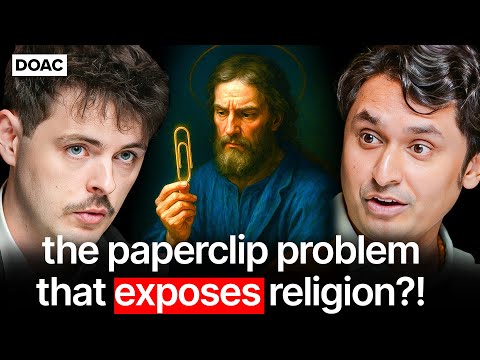
Atheist vs Christian vs Spiritual Thinker: Is Not Believing In God Causing More Harm Than Good?!
Steven Bartlett (host), Greg Koukl (guest), Alex O’Connor (guest), Dr. K (Alok Kanojia) (guest), Narrator, Steven Bartlett (host), Dr. K (Alok Kanojia) (guest), Narrator, Narrator, Narrator
In this episode of The Diary of a CEO, featuring Steven Bartlett and Greg Koukl, Atheist vs Christian vs Spiritual Thinker: Is Not Believing In God Causing More Harm Than Good?! explores atheist, Christian, Spiritualist Clash Over Purpose, Suffering, and God This long-form discussion brings together Christian apologist Greg Koukl, atheist-leaning agnostic philosopher Alex O’Connor, and spiritual psychiatrist Dr. Alok Kanojia (Dr. K) to dissect the modern ‘meaning crisis’ amid rising religiosity and worsening mental health stats. They debate whether purpose is objective or self-created, and how far science, spirituality, and religion can each go in resolving existential emptiness and suffering.
Atheist, Christian, Spiritualist Clash Over Purpose, Suffering, and God
This long-form discussion brings together Christian apologist Greg Koukl, atheist-leaning agnostic philosopher Alex O’Connor, and spiritual psychiatrist Dr. Alok Kanojia (Dr. K) to dissect the modern ‘meaning crisis’ amid rising religiosity and worsening mental health stats. They debate whether purpose is objective or self-created, and how far science, spirituality, and religion can each go in resolving existential emptiness and suffering.
Greg argues Christianity best explains our moral intuitions, consciousness, and desire for meaning, framing life as a ‘broken’ world in need of divine restoration. Alex challenges this with evolutionary and philosophical accounts of meaning, suffering, and consciousness, insisting that psychological comfort is not evidence for religious truth and pressing hard on the problem of evil, especially children’s cancer.
Dr. K largely brackets metaphysical truth and focuses on mechanisms: how purpose operates psychologically and neurologically, how trauma and tech disrupt it, and which concrete practices measurably increase one’s subjective sense of purpose. The conversation converges on the idea that ultimate meaning, if it exists, can’t be simply handed down but must be experientially discovered, while differing sharply on whether that discovery points to God, Brahman, or a purely naturalistic universe.
Key Takeaways
Purpose has a measurable, psychological component that can be increased by specific behaviors.
Dr. ...
Get the full analysis with uListen AI
Technology and constant exposure to competing worldviews may be intensifying the meaning crisis.
Alex argues the crisis is not just about secularization; it’s about our nervous systems being bombarded by social media’s ‘infinite scroll’ of alternative lives and beliefs. ...
Get the full analysis with uListen AI
Religious experience can be psychologically transformative, but that doesn’t by itself prove religious truth.
Greg sees life-transforming conversion (like Stephen’s friend in Dubai who became Christian and found purpose) as evidential for Christianity’s truth. ...
Get the full analysis with uListen AI
The problem of suffering is a major stress-test for theistic accounts of meaning.
Greg invokes the Fall (Adam and Eve’s disobedience) and a ‘broken world’ to explain suffering, including cancer in children, while admitting he can’t detail all mechanisms (e. ...
Get the full analysis with uListen AI
Ego dissolution and ‘zooming out’ from the self are recurring ingredients in deep experiences of meaning.
Dr. ...
Get the full analysis with uListen AI
You can live a relatively meaningful life without explicit belief in God, but the panel disagrees on whether that’s ‘ultimate’.
Greg holds that nonbelievers can still flourish if their lives accidentally align with the objective purposes God designed humans for (e. ...
Get the full analysis with uListen AI
Concrete first steps for the ‘lost’ involve turning inward, taking agency, and experimenting with practices, not waiting for a guru.
All three emphasize that no two-hour panel or single teacher can hand you capital-P Purpose. ...
Get the full analysis with uListen AI
Notable Quotes
“If your worldview does not have a way of making sense of our moral intuitions about suffering, it’s not an adequate worldview.”
— Greg Koukl
“If you want religion to provide existential comfort for people who are suffering, you have to do more in the face of children dying of cancer than some reference to mythical human beings.”
— Alex O’Connor
“Purpose is not binary, it’s quantifiable. If you stick with the program for about 20 weeks, your sense of purpose increases by 68%.”
— Dr. Alok Kanojia
“Big questions and big changes don’t always need big effort or big answers.”
— Dr. Alok Kanojia
“Anybody who says to you with a straight face, ‘I know what the meaning in life is,’ is either lying or will instantly tell you that they’re not going to be able to convey that information.”
— Alex O’Connor
Questions Answered in This Episode
To Greg: If Eve could sin before eating from the Tree of the Knowledge of Good and Evil, how exactly does the Fall explain humanity’s proclivity to sin, rather than merely presupposing it?
This long-form discussion brings together Christian apologist Greg Koukl, atheist-leaning agnostic philosopher Alex O’Connor, and spiritual psychiatrist Dr. ...
Get the full analysis with uListen AI
To Dr. K: In your clinical work, have you observed cases where spiritual practices backfire—deepening delusion, grandiosity, or dependency—and how do you distinguish between a ‘meaningful’ mystical experience and a psychologically harmful one?
Greg argues Christianity best explains our moral intuitions, consciousness, and desire for meaning, framing life as a ‘broken’ world in need of divine restoration. ...
Get the full analysis with uListen AI
To Alex: If panpsychism or a consciousness-first ontology turns out to be the best explanation of mind, what, if anything, would still separate your view from a non-dual spiritual or even theistic worldview?
Dr. ...
Get the full analysis with uListen AI
To all three: If five people each convert to different religions (or to staunch atheism) and all report dramatic, lasting increases in purpose and mental health, what—if anything—should we conclude about the relationship between psychological transformation and metaphysical truth?
Get the full analysis with uListen AI
To Stephen: You describe waking up genuinely excited for life while still agnostic about ultimate purpose; what specific practices, habits, or constraints do you think are non-negotiable for maintaining that level of day-to-day meaning in a hyper-distracting, hyper-free world?
Get the full analysis with uListen AI
Transcript Preview
Nine in ten young people in the UK believe that their life is lacking purpose, and a lot of people are turning back to religion. There is something going on.
This is about the most important thing that anyone could ever find out about their life, and God has made us for a purpose, and the purpose flows from that meaning.
I kind of reject that 'cause this is a perfect example of a solution being provided without explaining exactly why it provides a solution, and that's what people are doing in religious traditions.
I hard disagree. For me, finding meaning and purpose is, like, a very practical thing.
And that's what I wanna talk about today.
We are joined by an atheist, Christian, and spiritual thinker...
... to find an answer to the purpose crisis millions are facing today.
One of the reasons that I'm a Christian is because it's the best explanation for the way things are.
But if Christianity were true, we would not expect the kind of suffering that is present in the world.
So, I'm very curious, what if I died f- from cancer at one years old?
So, someone violated God's commands and that had an impact on the world.
So, children get cancer because a few million years ago-
Yeah, well-
... someone ate a fruit. If you want religion to provide existential comfort for people who are suffering, you have to do more in the face of children dying of cancer than some reference to mythical human beings.
But if your worldview does not have a way of making sense or our moral intuitions about suffering, it's not an adequate worldview.
What I would say that science and spirituality can really add is it's effective in terms of reducing suicidality, improving resilience, giving them a reason to wake up in the morning, and we'll get into that.
And Alok, if someone's listening now and they feel lost in their life, is there any advice that you could give them?
So, as an atheist, I'm offering a psychological explanation, so I would recommend that they (censored) .
You're spot on, Alex. So, the first thing to understand is it is an internal feeling. We found in our study that if you (censored) , your sense of purpose increases by 68%.
Alok, Greg, Alex. The reason I wanted to speak to all three of you today is to discuss meaning and purpose, and there's some stats that I wanted to share that kind of frame the discussion. Three in five young Americans believe that their life lacks purpose. Nine in ten young people in the UK believe that their life is lacking purpose. And when I look across other stats as it relates to things like mental health, 59% of Brits said they lived a meaningful life compared to just 25% who said they did not. In an October 21 survey, 34% of men in the UK said life had no meaning compared to 18% of women, and 50% of the same group who said that their lives lack purpose and meaning said that their poor mental health was linked to not knowing what to do with their life.
Install uListen to search the full transcript and get AI-powered insights
Get Full TranscriptGet more from every podcast
AI summaries, searchable transcripts, and fact-checking. Free forever.
Add to Chrome