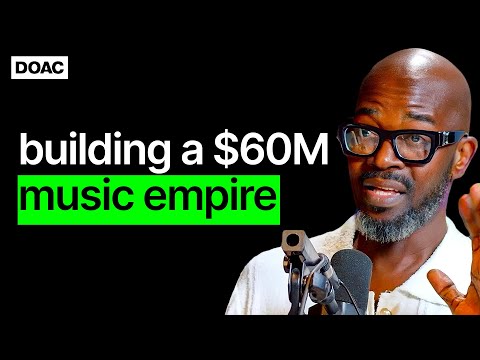
How I Became The Worlds Best DJ With Only One Arm: Black Coffee | E183
Black Coffee (guest), Narrator, Steven Bartlett (host)
In this episode of The Diary of a CEO, featuring Black Coffee and Narrator, How I Became The Worlds Best DJ With Only One Arm: Black Coffee | E183 explores from One-Armed Teen Survivor To Global DJ Icon: Black Coffee South African DJ Black Coffee (Nkosinathi Maphumulo) recounts his journey from a harsh, work-filled childhood and near‑fatal accident to becoming one of the world’s most respected DJs and producers.
From One-Armed Teen Survivor To Global DJ Icon: Black Coffee
South African DJ Black Coffee (Nkosinathi Maphumulo) recounts his journey from a harsh, work-filled childhood and near‑fatal accident to becoming one of the world’s most respected DJs and producers.
Raised by a strict, industrious grandmother, he developed an intense work ethic and self-reliance, but also emotional distance and a tendency toward isolation that still shapes his relationships.
At 14, a politically motivated car attack left his arm severely nerve-damaged, forcing him to rebuild his identity, accept his disability, and invent a unique one‑handed DJ style through obsessive practice.
Throughout, he explains how music functioned as escape, therapy, and vocation; how he navigates industry pressures, fame, and ego; and why he now prioritizes authenticity, legacy, therapy, and emotional openness with his family.
Key Takeaways
Adversity can build a powerful work ethic, but it also carries emotional costs that must be addressed later.
Growing up with a strict grandmother, milking cows twice a day from age 11 and having “no childhood,” taught Black Coffee discipline and self-reliance. ...
Get the full analysis with uListen AI
Radical acceptance of a life-changing injury can unlock focus on what’s still possible.
After his brachial plexus injury at 14, he endured years of pain, false hope, mean comments, and physiotherapy that showed no visible progress. ...
Get the full analysis with uListen AI
Obsession, preparation, and self-defined standards matter more than external validation.
Before he had gigs, he DJed alone for two hours a day simply “to be ready” for the moment someone asked if he was a real DJ. ...
Get the full analysis with uListen AI
Ownership and clear boundaries with labels preserve artistic identity and career longevity.
From his first album, he used licensing deals so labels received finished work instead of dictating track lists and sound. ...
Get the full analysis with uListen AI
Separating your public persona from your private self helps manage fame, ego, and relationships.
He distinguishes between Natty (the kid from a township) and Black Coffee (the global star with access and privileges). ...
Get the full analysis with uListen AI
Therapy is critical when transitioning from survival mode to a sustainable, grounded life.
He describes the psychological whiplash of returning to his old community in a Lamborghini and suddenly being idolized by people who once overlooked him. ...
Get the full analysis with uListen AI
Music can be both personal healing and a way to heal others.
As a child, music was his only escape from relentless work and poverty: imagining Michael Jackson’s world, getting lost at Coca‑Cola trucks that played loud music, and DJing weddings on cassette decks. ...
Get the full analysis with uListen AI
Notable Quotes
“I hardly had a childhood. I was always working.”
— Black Coffee
“This thing was trying to rob me of the one thing that I really, really love, and I will not allow it.”
— Black Coffee
“I didn’t want a pity party. I just wanted to be understood and heard like everyone else.”
— Black Coffee
“It’s a very thin line between seeing yourself as a king over everyone else, or knowing you are and still respecting everyone else.”
— Black Coffee
“Happiness is not a destination. It’s a series of different things where boxes are ticked.”
— Black Coffee
Questions Answered in This Episode
When you first realized your arm might never fully recover, was there a specific moment or decision that marked the shift from hoping for the old life back to fully committing to building a new one?
South African DJ Black Coffee (Nkosinathi Maphumulo) recounts his journey from a harsh, work-filled childhood and near‑fatal accident to becoming one of the world’s most respected DJs and producers.
Get the full analysis with uListen AI
You’ve said chasing a ‘song of the year’ scares you—have you ever been tempted by a specific commercial opportunity or collaboration that you turned down because it felt like it would pull you into that trap?
Raised by a strict, industrious grandmother, he developed an intense work ethic and self-reliance, but also emotional distance and a tendency toward isolation that still shapes his relationships.
Get the full analysis with uListen AI
How do you practically balance being a present father with doing over 150 shows a year—are there concrete routines, agreements, or boundaries you’ve put in place with your children?
At 14, a politically motivated car attack left his arm severely nerve-damaged, forcing him to rebuild his identity, accept his disability, and invent a unique one‑handed DJ style through obsessive practice.
Get the full analysis with uListen AI
You described separating African and global releases to avoid being boxed into ‘world music.’ If you were in charge of the Grammys, how would you redesign categories so African electronic and dance music is fairly recognized?
Throughout, he explains how music functioned as escape, therapy, and vocation; how he navigates industry pressures, fame, and ego; and why he now prioritizes authenticity, legacy, therapy, and emotional openness with his family.
Get the full analysis with uListen AI
Now that you’ve built a literal “Black Coffee house” as a future legacy space, what do you most hope your kids—and young African artists who might visit one day—feel or learn when they walk through it?
Get the full analysis with uListen AI
Transcript Preview
We just heard this sound, and it was a car, just rammed through the crowd. And I just blacked out.
Make some noise for Black Coffee! (audience cheering)
I hardly had a childhood. I was always working, and I used to hate it growing up, because I just felt like, "Well, when, when am I gonna become a child, you know, and play like other kids?"
The 10th of February, tell me about that day.
(exhales sharply) Man, that was a scary thing for me. When I went to the hospital, no one knew what to do. I would literally close my eyes. I wouldn't know whether it's here or here or here or ...
So, it was paralyzed at that point?
Yeah. I stayed for three months in the hospital, you know, and that depressed me even more. Music helped me so much. It brought me peace. This is why I share it. It's my way of healing people the same way it healed me. My childhood, where I come from, those things scare me.
Why do those things scare you?
'Cause it's a story that ... It was, for years, hard for me to share. So what happened is I ...
(Music) Before this conversation starts, I've got a favor to ask from you. 74% of people that watch this podcast frequently haven't yet hit the subscribe button, and 9% of people haven't yet hit the bell to turn notifications on. The bigger this platform gets, the bigger the guests get. So if you could do me one favor, if you've ever enjoyed this podcast, please hit the subscribe button and turn notifications on. Without further ado, I'm Steven Bartlett, and this is the Diary of a CEO. I hope nobody's listening, but if you are, then please keep this to yourself. (music) So the question that I always start this podcast with, because I, I, I ch- ... I studied childhood psychology for a little while, and it was illuminating to me how much of our early years end up defining and shaping us-
Of course.
... how m- who we become.
Of course.
So that early context before 12 years old, what, what did that look like for you?
(inhales deeply) Um, when I was born, my, my parents were, were married. My mom was super young. I was the first one. Um, (clicks tongue) two other siblings at the time. Uh, my mom married very extremely young, probably like 22, 23 already. With three kids, divorcing. Um, (clicks tongue) we were moved to live with our grandmother from the maternal side, and she's the one who raised us. And she used to work in a general hospital in the sewing room, but I saw her w- working extremely hard to go for everything she wanted. You know, like, I look back, (clicks tongue) and try to imagine how much money she was earning, and look at the achievements, like changing her mud house into a, a big designed, respectable house. And she did this bit by bit by bit. And as a kid, I was there, and I saw it. Whatever little money she would have, she would buy the bricks, they would wait. She buy sand, it waits. She buy gravel, it waits. Everything, (clicks tongue) slowly. So that's what I learned from her, like, to be assertive. You, you wake up. You go work. Also, the strongest thing that I learned from her is that she had cows, and she was the only woman in the area, you know, who had cows, you know, and she was single woman. And (clicks tongue) my job was to, every morning, go milk the cows before I go to school, every afternoon after school. So I hardly had a childhood. I had, like, um, time to play as a child. I was always working, 5:00, 5:30 from 11 years old, every single day. And, um, that was my environment, you know, where I'm like, "Okay, whatever you need, you just ... You have to work. There's no other way." And so, for the few years, (clicks tongue) she would make sure I'm up. She would make sure, you know, I'm on time, and eventually it was my thing. She didn't have to wake me up. She didn't have to tell me when to go. She didn't have to ... If there was a problem with the, the cows, I knew what was wrong. If I needed to get medication from the pharmacy, you know, I, I understood everything eventually. It became my thing, you know. Um, (clicks tongue) that's, that's my childhood.
Install uListen to search the full transcript and get AI-powered insights
Get Full TranscriptGet more from every podcast
AI summaries, searchable transcripts, and fact-checking. Free forever.
Add to Chrome