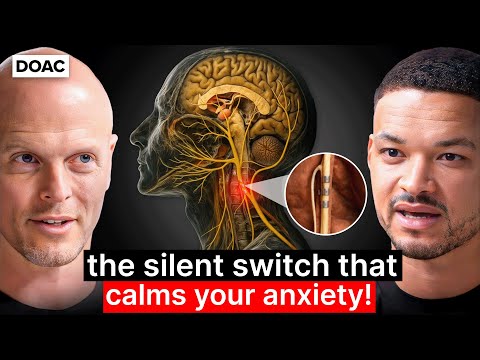
Tim Ferriss: The Hidden Nerve That Controls Trauma, Mood & Emotional Pain!
Tim Ferriss (guest), Steven Bartlett (host)
In this episode of The Diary of a CEO, featuring Tim Ferriss and Steven Bartlett, Tim Ferriss: The Hidden Nerve That Controls Trauma, Mood & Emotional Pain! explores tim Ferriss Reveals Science-Backed Tools To Heal Trauma And Depression Tim Ferriss joins The Diary of a CEO to unpack how he simplifies complex subjects, learns new skills rapidly, and applies systems thinking to life, work, and healing. He introduces his DSSS framework for accelerated learning and his relationship-and-skills-based way of choosing projects instead of rigid long-term plans.
Tim Ferriss Reveals Science-Backed Tools To Heal Trauma And Depression
Tim Ferriss joins The Diary of a CEO to unpack how he simplifies complex subjects, learns new skills rapidly, and applies systems thinking to life, work, and healing. He introduces his DSSS framework for accelerated learning and his relationship-and-skills-based way of choosing projects instead of rigid long-term plans.
The conversation turns deeply personal as Tim shares his childhood sexual abuse, his near-suicide in college, and how trauma shaped his mental health, relationships, and hyper-competence. He explains how addressing the root cause of trauma, rather than patching symptoms, radically transformed the frequency and severity of his depressive episodes.
Ferriss then explores emerging frontiers in mental health: accelerated TMS, metabolic psychiatry and ketogenic interventions, psychedelic-assisted therapies, and promising but often-misunderstood vagus nerve stimulation. He emphasizes the non-negotiable role of analog human connection and awe in psychological well-being.
In the final chapters, Tim reflects on purpose, dating apps and the paradox of choice, his shift toward prioritizing family and deep relationships, and concrete practices like annual reunions and four-week “mini-retirements” to architect a meaningful life.
Key Takeaways
Use DSSS To Learn Any Skill Faster
Tim’s meta-learning framework DSSS—Deconstruction, Selection, Sequencing, Stakes—lets you turn any vague goal (“learn to swim,” “learn Japanese”) into a concrete, efficient plan. ...
Get the full analysis with uListen AI
Pick Projects For Relationships And Skills, Not Fixed Career Plans
Rather than five- or ten-year plans, Tim runs his life as a series of 6–12 month projects packed with 2–4 week experiments. ...
Get the full analysis with uListen AI
Trauma Often Sits Beneath Multiple ‘Separate’ Mental Health Problems
Tim once believed he had “seven independent psycho-emotional challenges,” but when he finally revisited his childhood sexual abuse, he realized most were downstream of that single lead domino. ...
Get the full analysis with uListen AI
There Are Powerful, Underused Tools For Depression And Anxiety
Tim highlights accelerated TMS (10 short sessions per day for 5 days) as a highly promising, low-risk intervention for treatment-resistant depression and anxiety, citing dramatic turnarounds (e. ...
Get the full analysis with uListen AI
Social Connection And Awe Are Non-Negotiable For Mental Health
Ferriss argues humans are not designed to be lone wolves; analog, in-person interaction is often the single intervention that quietly fixes multiple issues (loneliness, anxiety, meaninglessness) that otherwise show up as separate diagnoses. ...
Get the full analysis with uListen AI
Bioelectric Medicine And Vagus Nerve Stimulation Could Reshape Psychiatry
Tim predicts the next decade will overturn core psychiatric assumptions as we better understand the ‘body electric’ and neural-immune communication. ...
Get the full analysis with uListen AI
Architect Life Around Deep Relationships And Periodic Disconnection
In this season of life, Tim is guided less by business upside and more by relationships, family, and long-term connection. ...
Get the full analysis with uListen AI
Notable Quotes
“If more information were the answer, we’d all be billionaires with six-pack abs.”
— Tim Ferriss
“Take the pain and make it part of your medicine.”
— Tim Ferriss quoting his psychotherapist
“Psychiatry is still in the Dark Ages. It’s where surgery was 300 years ago.”
— Tim Ferriss
“Independence, lone wolf is not in our programming. It just is not.”
— Tim Ferriss
“Another startup’s not gonna make any difference to my life.”
— Tim Ferriss
Questions Answered in This Episode
You described going from multiple long depressive episodes each year to one every few years—if you had to rank the top three interventions (therapy type, TMS, metabolic changes, psychedelics, connection, etc.) that contributed most to that shift, what would they be and in what order?
Tim Ferriss joins The Diary of a CEO to unpack how he simplifies complex subjects, learns new skills rapidly, and applies systems thinking to life, work, and healing. ...
Get the full analysis with uListen AI
For someone who suspects early trauma is the ‘lead domino’ behind their mental health struggles but feels terrified to revisit it, how would you practically sequence first steps so they don’t get overwhelmed or destabilized?
The conversation turns deeply personal as Tim shares his childhood sexual abuse, his near-suicide in college, and how trauma shaped his mental health, relationships, and hyper-competence. ...
Get the full analysis with uListen AI
Accelerated TMS, ketogenic psychiatry, psychedelics, and vagus nerve stimulation are all powerful but not widely accessible; what systemic barriers (regulation, training, economics, stigma) most worry you about scaling these tools responsibly rather than having them become the next overhyped fad?
Ferriss then explores emerging frontiers in mental health: accelerated TMS, metabolic psychiatry and ketogenic interventions, psychedelic-assisted therapies, and promising but often-misunderstood vagus nerve stimulation. ...
Get the full analysis with uListen AI
You argue dating apps are designed like casinos that exploit the paradox of choice; if you were forced to design a ‘healthy’ dating product aligned with long-term commitment instead of engagement metrics, what constraints or rules would you build in?
In the final chapters, Tim reflects on purpose, dating apps and the paradox of choice, his shift toward prioritizing family and deep relationships, and concrete practices like annual reunions and four-week “mini-retirements” to architect a meaningful life.
Get the full analysis with uListen AI
You’ve built your life as a series of 6–12 month projects optimized for relationships and skills—what trade-offs or regrets, if any, have emerged from not having a fixed long-term career plan, especially now that you’re prioritizing partner, family, and stability?
Get the full analysis with uListen AI
Transcript Preview
Every mental health complication or diagnosis is increasing, and I've worked with different scientists and done a lot of experimentation on myself, having grown up with multiple depressive episodes every year, to see if there are root causes that we can address. And so I'll just throw out a few things that have been very, very helpful. First, there's brain stimulation. When I did this, I had months of no anxiety. Then there's something called vagus nerve stimulation, and one of the most heavily cited scientists of the last 30 years has seen a wild collection of benefits.
So let's talk about that. Tim Ferriss has become a performance hacking expert after speaking with over 800 influential voices on his podcast. Now he's taking the most valuable frameworks and techniques to help you-
... optimize productivity, health, and performance.
Tim, the variety of things that you write about, talk about, is so wide. So what is the question that most people should ask you?
How do you break down complicated subjects and accelerate your ability to learn? Because time is one of our most valuable non-renewable resources, and so I have a framework that you can apply to any subject matter which consists of the 80/20 principle, which is picking the 20% to focus on that will give you 80% of what you want. For instance, there's hundreds of thousands of words you could learn in Spanish, but with the most frequently used 1,500, you can get to reasonable conversational fluency in almost any language in eight to 12 weeks, and if you figure that out, you're ahead of 99.9% of the world.
And what do you think is the question most people want to ask you?
So there's a lot of questions around mental health, and I feel like I have a moral obligation to help people because I was, uh, sexually abused by a babysitter's son on a weekly basis. I was this close to killing myself, and it can have a lot of effects, but these are things that you can slowly chip away at, and instead of feeling like you're held captive by them, feel like you can take the pain and make it part of your medicine.
How?
So...
I see messages all the time in the comments section that some of you didn't realize you didn't subscribe, so if you could do me a favor and double-check if you're a subscriber to this channel, that would be tremendously appreciated. It's the simple, it's the free thing that anybody that watches this show frequently can do to help us here to keep everything going in this show in the trajectory it's on, so please do double-check if you've subscribed and, uh, thank you so much, because in a strange way, you are, you're part of our history, and you're on this journey with us, and I appreciate you for that. So yeah, thank you. Tim, you are a remarkably interesting individual in part because the variety of things that you write about, talk about, clearly have deep curiosity in is so wide that you're, you're hard to, to put into any particular box. So I... My first question to you is how do you think about the work you do and how do you sort of like self-define, if you do at all, who you are and what your mission is?
Install uListen to search the full transcript and get AI-powered insights
Get Full TranscriptGet more from every podcast
AI summaries, searchable transcripts, and fact-checking. Free forever.
Add to Chrome