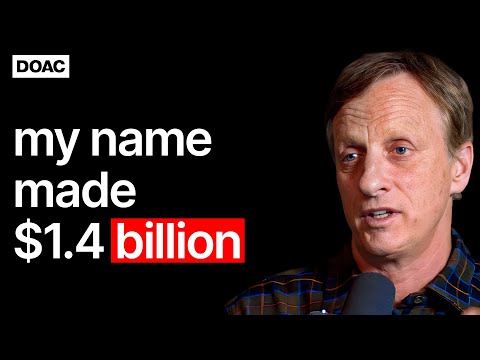
Tony Hawk: The Man With The $1.4 Billion Name! Burnout, Obsession & Regrets
Tony Hawk (guest), Steven Bartlett (host), Narrator
In this episode of The Diary of a CEO, featuring Tony Hawk and Steven Bartlett, Tony Hawk: The Man With The $1.4 Billion Name! Burnout, Obsession & Regrets explores tony Hawk on Obsession, Burnout, Fame, Regret, and Reinvention Tony Hawk traces his journey from an outcast kid obsessed with skateboarding to becoming the sport’s global ambassador and the face of a billion‑dollar video game franchise. He explains how hyper‑focus and risk‑taking fueled his rise, but also led to burnout, emotional disconnection, and strained relationships. As fame and money arrived through the X Games and Tony Hawk’s Pro Skater, he grappled with identity, imposter syndrome, and the emptiness of celebrity culture. Now in his 50s, he’s rebalanced his priorities toward family, emotional intimacy, philanthropy, and a more sustainable relationship with both skating and success.
Tony Hawk on Obsession, Burnout, Fame, Regret, and Reinvention
Tony Hawk traces his journey from an outcast kid obsessed with skateboarding to becoming the sport’s global ambassador and the face of a billion‑dollar video game franchise. He explains how hyper‑focus and risk‑taking fueled his rise, but also led to burnout, emotional disconnection, and strained relationships. As fame and money arrived through the X Games and Tony Hawk’s Pro Skater, he grappled with identity, imposter syndrome, and the emptiness of celebrity culture. Now in his 50s, he’s rebalanced his priorities toward family, emotional intimacy, philanthropy, and a more sustainable relationship with both skating and success.
Key Takeaways
Deep obsession plus deliberate risk‑taking can outcompete conventional “talent.”
Hawk emphasizes that his edge wasn’t raw talent but obsession, willingness to leave his comfort zone, and an unusually high tolerance for getting hurt. ...
Get the full analysis with uListen AI
Burnout can happen even when you’re doing what you love.
At the height of his competitive dominance, Hawk began dreading contests and feeling like a “machine” performing on demand. ...
Get the full analysis with uListen AI
Fame and money amplify existing issues; they don’t resolve them.
The success of the X Games and Tony Hawk’s Pro Skater catapulted him into mainstream celebrity, bringing talk shows, red carpets, and club culture. ...
Get the full analysis with uListen AI
Strategic risk in business can be as important as physical risk in sport.
Before the first game launched, Activision offered Hawk a $500,000 buyout of all future royalties—a life‑changing sum for someone who’d known lean years. ...
Get the full analysis with uListen AI
Emotional intimacy and vulnerability are learned skills, not fixed traits.
Growing up with older parents in a “functional, not warm” household, Hawk never heard “I love you” from his father and carried a fear of intimacy into adulthood. ...
Get the full analysis with uListen AI
Reinvention requires decoupling your identity from your peak performance era.
Hawk never expected to skate professionally beyond 20, yet he’s continued into his 50s by redefining what success looks like. ...
Get the full analysis with uListen AI
Mastery is iterative, often spanning years of failure before one breakthrough.
The 900 took Hawk roughly 12 years of sporadic attempts, broken ribs, and spatial confusion. ...
Get the full analysis with uListen AI
Notable Quotes
“I was so hyper‑fixated on my skating, I didn’t really work on my humanity.”
— Tony Hawk
“I wasn’t afraid to step out of my comfort zone, and I also wasn’t afraid to get hurt along the way.”
— Tony Hawk
“I was a machine. I’d go and do the event and win the trophy and go home.”
— Tony Hawk
“I got famous by accident. I just wanted to see skateboarding get more popular.”
— Tony Hawk
“The bravery actually means sharing your feelings.”
— Tony Hawk
Questions Answered in This Episode
You described walking away from contests despite sponsors warning it would end your career; was there a specific moment or conversation that finally convinced you to ignore that financial pressure and step back anyway?
Tony Hawk traces his journey from an outcast kid obsessed with skateboarding to becoming the sport’s global ambassador and the face of a billion‑dollar video game franchise. ...
Get the full analysis with uListen AI
When judges started scoring you against your own potential rather than the field, did you ever advocate for changes in judging criteria, and what reforms would you design now to protect top performers from that dynamic?
Get the full analysis with uListen AI
You’ve admitted that fame once distracted you from your kids—if one of your children came to you today with sudden viral success, what concrete guardrails would you insist they put in place to avoid repeating your mistakes?
Get the full analysis with uListen AI
Looking back, which failed business venture taught you the most useful lesson, and what exactly would you do differently if you had to evaluate that same opportunity again today?
Get the full analysis with uListen AI
You said fear of intimacy and a cold childhood home shaped your adult relationships; what are one or two very specific behaviors you use now with your kids or wife to deliberately ‘break the cycle’ you grew up in?
Get the full analysis with uListen AI
Transcript Preview
I'm either gonna make this or get taken away on a stretcher. (dramatic music) It changed my life completely. Tony, Tony, Tony!
Whoa, whoa, Tony!
Tony, hold on.
Were you prepared for that?
How could you prepare for anything like that? (bell rings)
Tony Hawk began riding a skateboard when he was nine years old. And when he turned 16, he was the best skateboarder in the whole wide world.
Yeah! Are you kidding me? Being the outcast and the outcast activity, I got picked on, I got bullied. Even when I turned pro, I would leave high school for a big skate event, I'm signing autographs, and then I would come back and be a ghost in the hallways again. Yeah, I just wanted to see skateboarding get more popular. But I got famous by accident. Suddenly, I was this chosen ambassador. I was making income, I owned a house in my last year of high school. So, I was doing talk shows and I was doing big appearances. My video game was a big hit.
How much revenue?
A billion dollars.
Wow.
The trajectory just seemed like it was never gonna end, and then it dropped very quickly. (image whooshes) I was so hyper-fixated on my skating, I didn't really work on my humanity. I was a machine, and I'd go and do the event and win the trophy and go home. It didn't allow me to be myself very much.
Did you lose people?
Yeah. Made them feel like they weren't the priority. And a lot of it was just being afraid of intimacy, and I regret that. (image whooshes) I started getting burned out on competition. Ahh!
The term burnout is used a lot these days. What did that experience teach you about what causes burnout?
It taught me that... (image whooshes)
Before we get into this episode, just wanted to say thank you, first and foremost, for being part of this community. Um, the team here at the Diary of a CEO is now almost 30 people, and that's literally because you watch and you subscribe and you, um, leave comments and you like the videos that th- this show's been able to grow. And it's the greatest honor of my life to sit here with these incredible people and just selfishly ask them questions that I'm pondering over or worrying about in my life. But this is just the beginning for the Diary of a CEO. We've got big, big plans to scale this show, um, to every corner of the world and to, to, to diversify our guest selection. And that's enabled by you, by a simple thing that you guys do, which is to watch. So, if there's one thing you could do to help this show and to help us continue to do what we do, it's just to hit the subscribe button. If you like this show, if you like what we do here, if you watch these episodes, please just hit that subscribe button. It means the world. Let's get on with it. (lo-fi music) Tony, not sure if you've ever listened to this podcast before, but I'm quite predictable with how I start these conversations, and I'll, I'll be transparent f- in terms of my rationale. Um, when I read about a story like yours, and I read about how much of an anomaly you were in many respects of your life, I always ask the question, "Why and how? Where did that begin? Where did that start?" And having, you know, read right back into your, your, your parents' history and your history, I saw signs of, of that. But seeing as you're here-
Install uListen to search the full transcript and get AI-powered insights
Get Full TranscriptGet more from every podcast
AI summaries, searchable transcripts, and fact-checking. Free forever.
Add to Chrome