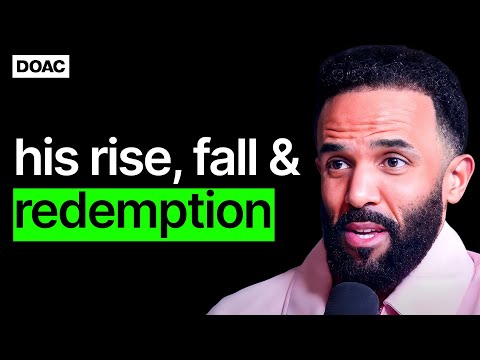
Craig David Opens Up About His Painful Rise, Fall & Redemption | E135
Steven Bartlett (host), Craig David (guest), Narrator
In this episode of The Diary of a CEO, featuring Steven Bartlett and Craig David, Craig David Opens Up About His Painful Rise, Fall & Redemption | E135 explores craig David on bullying, fame, burnout, depression and spiritual rebirth Craig David traces his journey from an overweight, bullied kid on a Southampton council estate to global superstardom, explaining how childhood shame, family dynamics and early heartbreak wired his beliefs about love, success and self‑worth.
Craig David on bullying, fame, burnout, depression and spiritual rebirth
Craig David traces his journey from an overweight, bullied kid on a Southampton council estate to global superstardom, explaining how childhood shame, family dynamics and early heartbreak wired his beliefs about love, success and self‑worth.
He details the explosive rise of his debut album, the industry pressures that pulled him out of alignment, and the Miami years where partying, overtraining and injury culminated in deep depression and dark thoughts.
Craig describes how returning to the UK, rebuilding through his TS5 parties, and reconnecting with the ‘kid’ who loved music for its own sake led to a creative and emotional rebirth and his album ‘22’.
Throughout, he speaks candidly about men’s mental health, abandoning and then reclaiming himself, and learning to live and create from intuition, heart, and authenticity rather than expectation and ego.
Key Takeaways
Childhood shame often becomes adult drive—if you unpack it consciously
Craig connects being overweight, bullied and feeling second best at school with his later obsession with fitness and success. ...
Get the full analysis with uListen AI
Early mastery came from ‘nerdy’ obsession, not from chasing fame
Between ages 11 and 14 he spent countless hours with a basic Studio 100 setup, dubbing vocals between cassette tapes, copying melodies from R&B acts, and building his own mini “factory” of mixtapes. ...
Get the full analysis with uListen AI
Unchecked success plus industry expectations will pull you out of alignment
After ‘Born To Do It’ sold ~7 million and his label started expecting 10+ million from the follow‑up, Craig says he absorbed a new story: 3. ...
Get the full analysis with uListen AI
Depression can follow physical breakdown and lifestyle misalignment
In Miami, music slid behind partying, status symbols and extreme training. ...
Get the full analysis with uListen AI
Men’s ‘man up’ culture is dangerous; vulnerability is a survival tool
Craig calls ‘man up’ “the most amount of nonsense”, linking it directly to high male suicide rates. ...
Get the full analysis with uListen AI
Reinvention came from going back to the kid who loved music
TS5 began as small house parties in his Miami apartment, just Craig DJing, MCing and (initially) not even playing his own songs. ...
Get the full analysis with uListen AI
Living and creating from the heart beats chasing metrics and gas pedals
He now rejects his own old language about keeping his ‘foot on the gas’, noting that rest, stillness and intuition often do more than manic striving. ...
Get the full analysis with uListen AI
Notable Quotes
“When I started to abandon myself and I started to do things that just weren't in alignment, it was a point where I had dark thoughts. I was just like, 'I can't live my life like this.'”
— Craig David
“That 'man up' thing is the most amount of nonsense that I've ever heard. It's what's caused the crazy suicide rates that we see, especially in men.”
— Craig David
“I felt like I was starting to make music to tick boxes.”
— Craig David
“What people enjoyed from me was music… it never had changed, and I realized that from when I came back to London.”
— Craig David
“It feels like it has all the feels of my first album, ‘Born To Do It’. I feel like the kid again.”
— Craig David
Questions Answered in This Episode
Looking back now, is there a specific moment in the ‘Trust Me’ or Motown covers era where you knew in your gut, before the sales came in, that you were no longer making music from your true self?
Craig David traces his journey from an overweight, bullied kid on a Southampton council estate to global superstardom, explaining how childhood shame, family dynamics and early heartbreak wired his beliefs about love, success and self‑worth.
Get the full analysis with uListen AI
You described that back injury and nerve pain as the first time you couldn’t ‘reframe’ an experience positively—what, concretely, were the first two or three steps you took when you realized mindset alone wasn’t going to save you?
He details the explosive rise of his debut album, the industry pressures that pulled him out of alignment, and the Miami years where partying, overtraining and injury culminated in deep depression and dark thoughts.
Get the full analysis with uListen AI
When you first brought TS5 from your Miami living room to UK venues, what did you change (or refuse to change) to keep it feeling like a genuine house party rather than a branded show?
Craig describes how returning to the UK, rebuilding through his TS5 parties, and reconnecting with the ‘kid’ who loved music for its own sake led to a creative and emotional rebirth and his album ‘22’.
Get the full analysis with uListen AI
You’ve owned up to objectifying women and keeping your heart closed during your peak fame years; if a 19‑year‑old artist on the brink of a similar breakout asked you how to avoid repeating your mistakes, what very specific boundaries or practices would you tell him to implement immediately?
Throughout, he speaks candidly about men’s mental health, abandoning and then reclaiming himself, and learning to live and create from intuition, heart, and authenticity rather than expectation and ego.
Get the full analysis with uListen AI
On ‘22’, how did you decide which parts of your story to put into lyrics versus leave between the lines—and is there a song on that album you feel might only fully resonate with listeners who know about your depression and Miami period?
Get the full analysis with uListen AI
Transcript Preview
Could you do me a quick favor if you're listening to this? Please hit the follow or subscribe button. It helps more than you know. And we invite subscribers in every month to watch the show in person.
Making moves, yeah, on the dance floor. Re-ewind. When the crowd say who? Craig David. This means so, so much to me. Everything I touched was turning to gold. Everyone wanted a piece of me and...
How does an 18, 19-year-old deal with that?
The height of success when it is like, whoa, there's so much of the, the human part that's being unmet. I felt like I was starting to make music to tick boxes. When I started to do Abandon Myself and I started to do things that just weren't in alignment, it was a point where I had dark thoughts. I was just like, "I can't live my life like this." What people enjoyed from me was music, and I realized that from when I came back to London. I feel like the kid again. And trust me, the crowd are gonna go off when they hear something soon, okay?
So 22 years later, if you could whisper in the ear of your 14-year-old self, what would you whisper?
Listen, Craig.
Without further ado, I'm Steven Bartlett, and this is the Diary of a CEO. I hope nobody's listening, but if you are, then please keep this to yourself. Craig, I've got some lyrics that I wanted to recite to you, okay?
Okay.
It's another day at school. And he's just walking out the door. Got his rucksack on his back and his feet dragging on the floor. Always late. But when he's questioned, he can't think of what to say. Hides the bruises from the teachers, hoping that they'd go away. Even though his mum and dad, they've both got problems of their own, caught in a catch-22, but he'd still rather be at home. Cries himself to sleep and prays when he wakes up things might have changed, but everything's the same. That's from your record Johnny from 2006.
Yeah. That was a, that was a, that was a song that I had to... It was the first time I think kinda opening up and, and expressing a experience that I felt that I had maybe on a lesser degree to a lot of other people in my school. I think at school, like, in my, my secondary school, I've had a, a very... I had a beautiful upbringing. I, I enjoyed life. I was a playful kid and I loved music. Um, but secondary school, all-boys school. Went to Bellmore in Southampton. And for the majority of it, it was, it was great times, but when you come in in your early years and you've got the older, the older boys in there and they're like, "Yo, you got two pound on you," "No, I haven't got two pound," and push you up against the wall, "You got two pound on you." Like, and then it's not a case of, like, have you got the money, it's like, "Let me check in your pockets, let me try and pull out the pockets." So, as a less degree of the bullying, I was like, I was experiencing it physically in the corridors. So I kinda... So when I was starting to write that song, I was drawing from... I had to go to how did it feel when that was happening? And it only happened with one, one, one guy in, in, at one period in the school. So I understood what bullying was. I mean, that was... I was, I was felt helpless, I couldn't... He was two years older, stronger, could rough me up if he really wanted to. But then also I was seeing other people who were getting the, a real... I was getting the psychological element, but there was a deeper side of that psychology of when they say, "Tell the teacher. They'll, they'll deal with it." This is the thing with bullying, is that I agree with... It, it needs to be spoken to someone you can confide in. But sometimes that kind of very rush in, you've told the teacher, they rush in, they... It's all out in the open. I was seeing kids who would then have a kid waiting outside of school for them. Or it might be that they, they're, they're being bullied by someone from a different school, even. So they'd be coming out to the school gates, thinking, "Okay, well, I'm on my way home." No, it's about to start when you get on the bus to go home.
Install uListen to search the full transcript and get AI-powered insights
Get Full TranscriptGet more from every podcast
AI summaries, searchable transcripts, and fact-checking. Free forever.
Add to Chrome