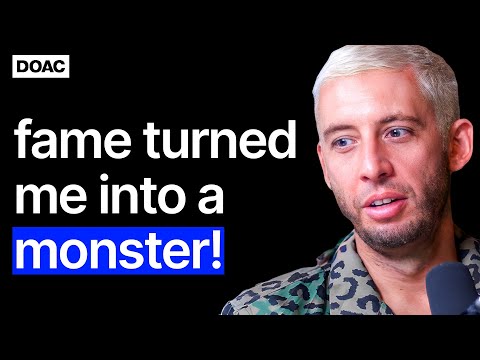
Example: The Dark Side Of Money & Fame | E152
Example (Elliot Gleave) (guest), Steven Bartlett (host)
In this episode of The Diary of a CEO, featuring Example (Elliot Gleave) and Steven Bartlett, Example: The Dark Side Of Money & Fame | E152 explores from Fame And Chaos To Fatherhood And Clarity: Example’s Awakening Musician Example (Elliot Gleave) traces his journey from a loving but intense childhood and early bullying through the brutal realities of the music industry, sudden fame, and self-destructive behavior with drugs, alcohol, and infidelity.
From Fame And Chaos To Fatherhood And Clarity: Example’s Awakening
Musician Example (Elliot Gleave) traces his journey from a loving but intense childhood and early bullying through the brutal realities of the music industry, sudden fame, and self-destructive behavior with drugs, alcohol, and infidelity.
He describes the emotional and physical costs of success—burnout, loneliness, interventions from his family, and a profound sense of disconnection despite chart-topping hits and constant touring.
Meeting his wife Erin, becoming a father, and adopting practices like running, yoga, and breathwork catalyzed a major shift toward honesty, spirituality, and a more grounded definition of success.
Now approaching his eighth album, he reflects on changing metrics of musical success, the frustrations of being perceived as ‘retired,’ and what truly matters for a good life: family, health, integrity, and meaningful work.
Key Takeaways
Thick skin built in childhood can be an asset in brutal industries.
Example grew up seeing his working-class parents’ relentless work ethic and received strong emotional support at home, even while being bullied at school for his appearance (≈420–720s). ...
Get the full analysis with uListen AI
Neurodivergent traits can be ‘weird’ advantages when consciously channeled.
Diagnosed young with Asperger’s (≈1260s), he had hyperactivity, tics, and an extreme photographic memory, memorizing Trivial Pursuit cards for fun. ...
Get the full analysis with uListen AI
The music industry structurally pushes artists toward unhealthy pressure and identity distortion.
He describes label-era life as a constant treadmill of playlist meetings, chart expectations, and promotional obligations (≈1710–2100s). ...
Get the full analysis with uListen AI
Sudden access to money, status, and sex is morally destabilizing without guidance.
He didn’t try class-A drugs until 23, then fame and money hit and he “went off the rails” with drugs, alcohol, and chronic infidelity (≈2100–2430s). ...
Get the full analysis with uListen AI
Loneliness often hides beneath success and hedonism, and connection is the real antidote.
At his apparent peak—constant festivals, TV, and tours—he was living in a run-down house with his 93-year-old step-grandad, exhausted and emotionally adrift (≈2880–3390s). ...
Get the full analysis with uListen AI
Physical practices and nature can be powerful, accessible mental health tools.
Influenced by his father, who coped with extreme stress and alopecia by marathon training (≈3510–3690s), Example uses running without music, swimming, yoga, and river-side routes as active meditation. ...
Get the full analysis with uListen AI
Love, parenting, and spirituality fundamentally reshaped his values and identity.
Meeting Erin at the right time allowed him to ‘reset’ and return to the honest, faithful person his parents raised (≈4170–4410s). ...
Get the full analysis with uListen AI
Notable Quotes
“Money and fame can show you who you are.”
— Stephen Bartlett
“The person I was when I was 27 was a fucking monster compared to the person I was when I was 21.”
— Example (Elliot Gleave)
“There’s no one signs a record deal and has a manager come up to them and go, ‘There’s a good chance you’re gonna be really successful and famous… here’s a pamphlet on how to not be a C‑U‑N‑T.’”
— Example (Elliot Gleave)
“I look back as it being one of the worst weeks ever.”
— Example (Elliot Gleave)
“Right now I love being on stage, but if someone was like, ‘You’ve got another year now, you’re not gonna write one song or do another gig,’ I’d be totally happy with that, as long as I had all the other things.”
— Example (Elliot Gleave)
Questions Answered in This Episode
If you could design the ‘pamphlet on how not to be a cunt’ that every newly signed artist gets, what three specific lessons—drawn from your own worst mistakes—would it absolutely have to include?
Musician Example (Elliot Gleave) traces his journey from a loving but intense childhood and early bullying through the brutal realities of the music industry, sudden fame, and self-destructive behavior with drugs, alcohol, and infidelity.
Get the full analysis with uListen AI
You spoke about craving cuddles and safety more than sex during your most hedonistic period; looking back, what concrete signs do you now recognize that could have alerted you much earlier to that hidden loneliness?
He describes the emotional and physical costs of success—burnout, loneliness, interventions from his family, and a profound sense of disconnection despite chart-topping hits and constant touring.
Get the full analysis with uListen AI
Given your skepticism about rigid diagnoses but lived experience of Asperger’s traits, how would you advise parents and schools to balance support, medication, and freedom for kids who are ‘weird’ in the way you were?
Meeting his wife Erin, becoming a father, and adopting practices like running, yoga, and breathwork catalyzed a major shift toward honesty, spirituality, and a more grounded definition of success.
Get the full analysis with uListen AI
When promoters and radio programmers dismiss you because you’re not currently playlisted, how do you practically stop that external rejection from warping the music you make next or dragging you back into old validation loops?
Now approaching his eighth album, he reflects on changing metrics of musical success, the frustrations of being perceived as ‘retired,’ and what truly matters for a good life: family, health, integrity, and meaningful work.
Get the full analysis with uListen AI
You’ve talked about spirituality emerging from both science and parenting—if you distilled your current ‘personal philosophy of the universe’ into a few guiding principles for your sons when they’re teenagers, what would those be and why?
Get the full analysis with uListen AI
Transcript Preview
No one signs a record deal and has a manager come up to them and go, "There's a good chance you're gonna be really famous. Here's a pamphlet on how to not be a (beep) ."
Put your hands together for Example! (upbeat music plays) Money and fame can show you who you are. And one of the things you said is the person I was when I was 27 was a fucking monster.
When I became famous, I just went a bit off the rails with drugs and alcohol. I think there was just this, this one weekend at Glastonbury where I just kind of disappeared for 48 hours. I was in an absolute state.
What was the cost?
Well, it's just not nice to see your parents cry, you know?
Wow.
I look back as it being one of the worst weeks ever. And then I met Erin. Just watching someone grow a baby and give birth is like one of the most sobering experiences ever.
You tragically had a miscarriage on your second.
I remember I was invited onto Lorraine, and I was meant to go on and talk about a single and a tour. Just before I went on, they went, "We just found out you lost a second baby. Do you wanna make the whole interview about that?" I got so many messages from guys afterwards just going, "That's amazing you went on and spoke about that." I've realized there's been the first times I've spoken about things that I should have probably spoken about with friends or family a long time ago.
If you were advising a younger Elliot-
(laughs)
... what would you say in terms of the components that make for a good life?
I've often thought about this.
So without further ado, I'm Steven Bartlett, and this is The Diary of a CEO. I hope nobody's listening, but if you are, then please keep this to yourself. (electronic music plays) One of the things I always try and do, again, because I, I tend to believe that we are all a product of our like, of typically our significant childhood events, whatever they might be. When I look at your story, I was hazarding a guess as well. I was saying, "Well, this was obviously quite a key moment. This is the key moment." But in your own words, what were those catalyst key moments from your childhood that ultimately shaped you to become who you are today?
Oh, wow. Um, I think in terms of work ethic, um, it's definitely from my mum and dad. I was very aware as a kid, um, you know, even, uh, like, even before as a teenager how much time and effort my mum and dad put into, well, like, they're both working class and they both came from very humble beginnings. But I think the main thing I was aware of is that my dad was always away working as a kid. I was also aware that a lot of my friends' parents weren't together. You know, they were, a lot of them were raised by just their single mums. Um, but then I also saw how much effort my mum put in. She was... She didn't have a day job, but I could see how hard my mum worked, especially with my dad being away. So I think the work ethic thing has helped me a great deal in terms of where I've got to. Um, par- not so much anymore, but partly trying to impress them or, you know, feeling like I, uh, lived up to their standards, maybe in my early 20s, mid-20s. Apart from, you know, like my parents' influence as a kid, I think mainly I'd say the, the, you know, the culture at school in terms of music culture. London, I grew up in Fulham. I went to school in Wandsworth, and even though it was a really nice school in terms of it was a modern school, it was a technology college. It was a, I'd say the majority of kids I went to school with all lived on council estates, and I didn't, but I spent a lot of time down there. So I think that was really good in helping me not only understand, um, the different cultures and therefore, as a result, where the music cultures came from. Just like how other people live and how other pe- You know, what people have to go, go through. You know, like some of my best friends, their mums would have five jobs.
Install uListen to search the full transcript and get AI-powered insights
Get Full TranscriptGet more from every podcast
AI summaries, searchable transcripts, and fact-checking. Free forever.
Add to Chrome