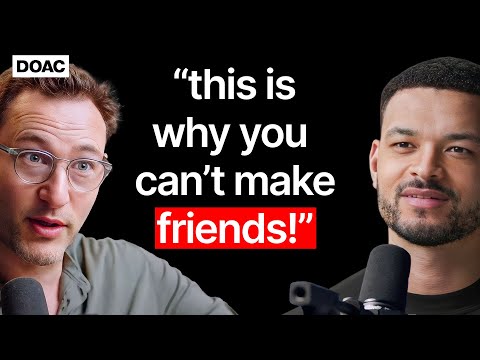
Simon Sinek: "Strong Thigh Muscles = More friends", This Is Why You Can't Make Friends!
Simon Sinek (guest), Steven Bartlett (host), Narrator, Narrator, Narrator, Narrator, Narrator
In this episode of The Diary of a CEO, featuring Simon Sinek and Steven Bartlett, Simon Sinek: "Strong Thigh Muscles = More friends", This Is Why You Can't Make Friends! explores friendship, Service, And Strong Thighs: Simon Sinek Redefines Connection Simon Sinek argues that most modern crises—loneliness, addiction, anxiety, extremism, and shallow masculinity—are downstream of a society that has forgotten friendship, service, and genuine human connection.
Friendship, Service, And Strong Thighs: Simon Sinek Redefines Connection
Simon Sinek argues that most modern crises—loneliness, addiction, anxiety, extremism, and shallow masculinity—are downstream of a society that has forgotten friendship, service, and genuine human connection.
He contends that close friendships are the most powerful "biohack" for mental and physical health, yet we neither prioritize nor learn the skills of being a good friend, listener, or servant leader.
Throughout the conversation, Sinek connects macro issues (leaderless politics, remote work, declining religion, toxic influencers) to micro behaviors: how we schedule friends, how we talk to partners, how we show up at work, and whether we give more than we take.
He offers concrete practices—from redefining friendship and making service your default, to eye-contact techniques in public speaking and rules for hard conversations—arguing that these human skills, taught especially at work, could transform both individual lives and society.
Key Takeaways
Deep friendship is a superior "biohack" for health and resilience.
Sinek cites research and metaphors like Rat Park: social rats exposed to morphine-laced water self‑regulate and avoid addiction, whereas isolated rats drink to death. ...
Get the full analysis with uListen AI
Friendship is fundamentally service—and most of us don’t know how to serve.
Sinek argues the core lost skill is service: we’ve over‑indexed on taking and individual success. ...
Get the full analysis with uListen AI
We’ve architected our lives for loneliness by deprioritizing people for work and convenience.
Remote work, mass transport, apps, and social media optimize comfort but strip away friction points that used to create connection (walking to see friends, bumping into colleagues, going to church). ...
Get the full analysis with uListen AI
Redefine what a ‘friend’ is: it’s who you can call in joy and in pain.
Sinek distinguishes between fair‑weather friends (only there in good times), foul‑weather friends (only there when you’re suffering), and true friends: the very few you can call both when things fall apart and when you win. ...
Get the full analysis with uListen AI
Service and love create the strongest teams—from special forces units to offices.
Drawing on Navy SEALs and combat units, Sinek shows that world‑class performance comes from extreme mutual care: operators fear letting each other down more than death itself. ...
Get the full analysis with uListen AI
Human skills—listening, hard conversations, emotional expression—are teachable and should be taught at work.
Sinek insists we’re badly trained at being human: active listening, giving/receiving tough feedback, resolving conflict, talking about race or feelings. ...
Get the full analysis with uListen AI
Speak and sell as a giver, not a taker: stories + service beat self‑promotion and data.
On communication, Sinek emphasizes two core practices: (1) always walk on stage or into a pitch telling yourself, "I’m here to give," not to "get" applause, sales, or validation; audiences are highly attuned to takers. ...
Get the full analysis with uListen AI
Notable Quotes
“Friendship is the thing that actually protects us.”
— Simon Sinek
“You can’t make a friend until you learn how to serve, because friendship is fundamentally service.”
— Simon Sinek
“We are social animals who’ve over‑indexed on rugged individualism. You wanna know why we’re lonely? Because we’ve architected our lives to be lonely.”
— Simon Sinek
“People with close friendships are healthier, they live longer, they better deal with stress, less likely to become addicted.”
— Simon Sinek
“I don’t own a car just to buy petrol. I own a car to go places. Money is the fuel, not the purpose.”
— Simon Sinek
Questions Answered in This Episode
You argue that friendship is the ultimate biohack against addiction and mental health issues. How would you redesign a typical week—hour by hour—to structurally prioritize friendships for someone currently stuck in a work‑first routine?
Simon Sinek argues that most modern crises—loneliness, addiction, anxiety, extremism, and shallow masculinity—are downstream of a society that has forgotten friendship, service, and genuine human connection.
Get the full analysis with uListen AI
When you tell a lonely young man, "Find someone else who struggles to make a friend and help them," what are three concrete, low‑risk actions he could take tomorrow that don’t feel socially overwhelming or fake?
He contends that close friendships are the most powerful "biohack" for mental and physical health, yet we neither prioritize nor learn the skills of being a good friend, listener, or servant leader.
Get the full analysis with uListen AI
You draw a sharp line between fair‑weather, foul‑weather, and true friends. How should someone gracefully downgrade or step back from a long‑time foul‑weather friend without creating unnecessary drama or guilt?
Throughout the conversation, Sinek connects macro issues (leaderless politics, remote work, declining religion, toxic influencers) to micro behaviors: how we schedule friends, how we talk to partners, how we show up at work, and whether we give more than we take.
Get the full analysis with uListen AI
If national service is so powerful for teaching responsibility and connection, what would your ideal, non‑military service program look like for 18–25‑year‑olds today—and how would you sell it to a generation skeptical of institutions?
He offers concrete practices—from redefining friendship and making service your default, to eye-contact techniques in public speaking and rules for hard conversations—arguing that these human skills, taught especially at work, could transform both individual lives and society.
Get the full analysis with uListen AI
You’ve shown how toxic influencers hook disaffected young men by validating their victimhood and then offering a path out. How could educators, parents, or platforms ethically use that same emotional pattern—without manipulation—to steer those same men toward service, friendship, and healthy masculinity instead?
Get the full analysis with uListen AI
Transcript Preview
You wanna know why we're lonely? 'Cause we have architected our lives to be lonely. We are social animals. Of course it's hurting us. And so the question is, is what can you do? And this is the one thing that I learned that was the greatest lesson I ever learned in my life. The true skill that we've lost, and everybody's guilty of this, is-
Simon Sinek.
The best-selling author, sought-after speaker, and unshakeable optimist is back with one solution that aims to solve some of the biggest issues we face today.
Everyone's looking for a biohack for all the problems that we're facing today, rising suicide, rising anxiety, depression, addiction, mental health, and there's one biohack that's better than all of the things that we're trying, which is friendship. But we are not good at making friends and we're not good at looking after friends. There's an entire industry to help people become better leaders, to help us maintain better relationships, and there's no industry to teach us how to be a better friend. And yet people with close friendships are healthier, they live longer, they better deal with stress, less likely to become addicted. Friendship is the thing that actually protects us. So why aren't we prioritizing our friendships? It's because we actually don't know how to do it. Mass transportation, technology, social media, all of these things, they've interrupted our ability to make friends. Or sometimes we have old friends where the only bond is time. But is it a friend simply because you've known somebody for a long time? They give you no joy, give you no inspiration. And if you have good friendship, you will not feel lonely. So yes, friends are allowed to change, and it's never too late to make a friend.
So how do I make friends?
I guarantee you will make friends by learning how to .......................... That's all it takes.
We've just hit six million subscribers on The Diary of a CEO. Um, so me and my team would like to do something we've never done before as a little thank you, and we're calling it The Diary of a CEO Subscriber Raffle, and here is how it works. Every episode this month, we're going to pick three current subscribers at random, and we'll send one of you a 1,000-pound voucher, one of you tickets to come and watch The Diary of a CEO behind the scenes live with our team, and one of you will have a 10-minute phone call with me to discuss whatever you want to talk about. If you're a subscriber, you're in the raffle. Thank you from the bottom of my heart for allowing me to do something that me and my team love doing so much. It is the greatest honor of my lifetime and I hope it, I hope it continues, uh, off into the future. Let's get to the episode. Simon.
Hi, Stephen. Good to see you again.
Install uListen to search the full transcript and get AI-powered insights
Get Full TranscriptGet more from every podcast
AI summaries, searchable transcripts, and fact-checking. Free forever.
Add to Chrome