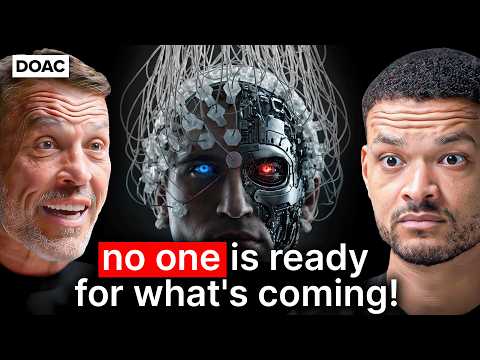
Tony Robbins: No One Is Ready For What's Coming (The truth about AI).
Steven Bartlett (host), Steven Bartlett (host)
In this episode of The Diary of a CEO, featuring Steven Bartlett and Steven Bartlett, Tony Robbins: No One Is Ready For What's Coming (The truth about AI). explores tony Robbins on AI disruption, meaning, stress mastery, and wealth principles Robbins frames the next decade as a high-speed transition where AI and related technologies could displace jobs faster than societies can psychologically adapt, risking loss of meaning, identity, and a rise in unrest.
Tony Robbins on AI disruption, meaning, stress mastery, and wealth principles
Robbins frames the next decade as a high-speed transition where AI and related technologies could displace jobs faster than societies can psychologically adapt, risking loss of meaning, identity, and a rise in unrest.
He argues most people suffer because they ‘manage’ life rather than ‘create’ it, and that obsession with self-care and individualism can weaken resilience by narrowing focus to the self.
Across personal development, entrepreneurship, and investing, he emphasizes pattern recognition/utilization/creation, peak-state conditioning, and shifting needs toward love, growth, and contribution for lasting fulfillment.
He also shares wealth-building patterns from elite investors (risk management, asymmetrical bets, diversification, uncorrelated assets) and founder traits (mission, leadership talent, hunger, and continual pruning).
Key Takeaways
You experience the life you focus on.
Robbins’ core model: in every moment you choose what to focus on, decide what it means, then decide what to do. ...
Get the full analysis with uListen AI
‘Self-care’ can become self-obsession that weakens resilience.
He argues the mind will always find something wrong when attention is trapped on the self; serving something bigger creates relief from rumination and builds ‘pull’ motivation that outlasts willpower.
Get the full analysis with uListen AI
AI disruption will be as much a mental-health crisis as an economic one.
Robbins warns jobs provide identity, dignity, and agency; abrupt displacement (drivers, coders, white-collar roles) can trigger grief, anger, and social unrest if societies don’t retool skills and psychology.
Get the full analysis with uListen AI
The winning edge will be learning speed, not static expertise.
He highlights three meta-skills: pattern recognition (reduce fear), pattern utilization (act on what you see), and pattern creation (invent new approaches). ...
Get the full analysis with uListen AI
State comes before strategy for real change.
Robbins’ ‘strategy, story, state’ framework: most people start with ‘how’ and fail because their story (“nothing works”) and emotional state (uncertainty) override action. ...
Get the full analysis with uListen AI
Lasting change requires leverage and conditioning, not discussion.
He defines change as a ‘must’ created by strong reasons (pain/pleasure). ...
Get the full analysis with uListen AI
Wealthy investors optimize survival first, then upside.
From his interviews: focus on not losing money, use asset allocation, seek asymmetrical risk-reward (small downside, large upside), and diversify—ideally across 8–12 uncorrelated investments to reduce risk while keeping returns.
Get the full analysis with uListen AI
Notable Quotes
“You don’t experience life. You experience the life you focus on.”
— Tony Robbins
“Jobs are not just money, jobs are meaning.”
— Tony Robbins
“I don’t believe most people will be replaced by an AI. They’ll be replaced by somebody who knows how to use AI.”
— Tony Robbins
“Most people are trying to figure out what to do… it’s the wrong sequence. Strategy, story, state.”
— Tony Robbins
“The biggest drug on earth is not cocaine… it’s problems.”
— Tony Robbins
Questions Answered in This Episode
On AI: What specific ‘retooling’ plan would you implement first—skills training, UBI, community service programs, or identity/mental-health support—and why?
Robbins frames the next decade as a high-speed transition where AI and related technologies could displace jobs faster than societies can psychologically adapt, risking loss of meaning, identity, and a rise in unrest.
Get the full analysis with uListen AI
You predict violence from displacement. What are the earliest warning signals (economic, psychological, online) leaders should watch for in the next 3–10 years?
He argues most people suffer because they ‘manage’ life rather than ‘create’ it, and that obsession with self-care and individualism can weaken resilience by narrowing focus to the self.
Get the full analysis with uListen AI
Your ‘self-care makes you weaker’ claim is controversial—where’s the line between necessary recovery and self-absorption that erodes resilience?
Across personal development, entrepreneurship, and investing, he emphasizes pattern recognition/utilization/creation, peak-state conditioning, and shifting needs toward love, growth, and contribution for lasting fulfillment.
Get the full analysis with uListen AI
In a post-work or reduced-work world, what alternative sources of meaning should cultures intentionally build (tribe, service, craft, faith, civic roles)?
He also shares wealth-building patterns from elite investors (risk management, asymmetrical bets, diversification, uncorrelated assets) and founder traits (mission, leadership talent, hunger, and continual pruning).
Get the full analysis with uListen AI
For pattern recognition: what daily/weekly exercises would you prescribe (journaling prompts, after-action reviews, trigger tracking) to improve it measurably?
Get the full analysis with uListen AI
Transcript Preview
I'm trying not to cry. [chuckles] I'm just like, um, I hate suffering. I've suffered myself, and so I hate to see anybody suffer. And so, um, this is my mission. This is what I'm made for, and, um, I'm just one guy, I can't do everything, but I can do a lot. [gentle music] Um, I always try to help people say, "How can you turn your worst day into your best day?"
Please help me welcome to the stage, Tony Robbins! [upbeat music]
He's the nation's number one life and business strategist.
He's worked with royalty, elite athletes, Oscar winners, scientists, and everyone in between-
To overcome their limitations and accelerate change.
Can you take us back to the environment that shaped you into the man that you are?
So I grew up in a tough environment. I had four different fathers. My mom, she drank alcohol and took prescription drugs, and we had no money, no food. And then the thing that changed my whole life was a knock on the door on Thanksgiving. There was this tall guy standing there with two bags of groceries and an uncooked frozen turkey in a pan. My dad saw this man, he said, "We don't take charity," and he went and slammed the door on the guy. But it became a very useful in distinction for me about how he and I processed that day differently, because there's three decisions you make every moment of your life, and the real problem is the story you have. For example, that day, my dad's focus was the fact he not fed his family and he was worthless. However, I took that as strangers care. And so the story is the belief you've told yourself over and over, 'cause belief is the invisible force that controls everything in your life. And then there's the third decision: What am I gonna do? And so what I decided to do is someday I'm gonna do this for others and end suffering where I can. And so I'm gonna show you how to get clear on what you really want, figure out what's been stopping you, put the plan in place, and teach you the most important thing that's made me successful.
And I don't think people fully realize the significance of how many of the most influential people on planet Earth you have worked with and continue to work with. What is the pattern that you noticed in those people?
So I found four things with them, and the first thing is-
Listen, my, my team gave me a script that they asked me to read, but I'm just gonna ask you, um, in the nicest way I possibly can. Thank you first and foremost for choosing to subscribe to this channel. It is, um... It's been one of the most incredible, crazy years of my life. I never could have imagined. I had so many dreams in my life, but this was not one of them. And the very fact that these conversations have resonated with you and you've given me so much feedback is something I will always be appreciative of, and I almost carry a weight, a sort of burden of, uh, responsibility to pay you back. And the favor I would like to ask from you today is to subscribe to the channel, if you, um, would be so obliged. It's completely free to do that. Roughly about forty-seven percent of you that listen to this channel frequently currently don't subscribe to this channel. So if you're one of those people, please come and join us. Hit the subscribe button. It's the single free thing you can do to make this channel better, and every subscriber sort of pays into this show and allows us to do things bigger and better and to push ourselves even more. And I will not let you down if you hit the subscribe button, I promise you, and if I do, please do unsubscribe, but I promise I won't. Thank you. [upbeat music] Tony, I was, I was shocked. It was so surprising to me that you had the childhood you had based on the outcomes that you've accomplished in your life. And as someone that has followed you for a very long time, I imagine that there's many other people that have followed you for a very long time that have no idea about the early context. For those people-
Install uListen to search the full transcript and get AI-powered insights
Get Full TranscriptGet more from every podcast
AI summaries, searchable transcripts, and fact-checking. Free forever.
Add to Chrome