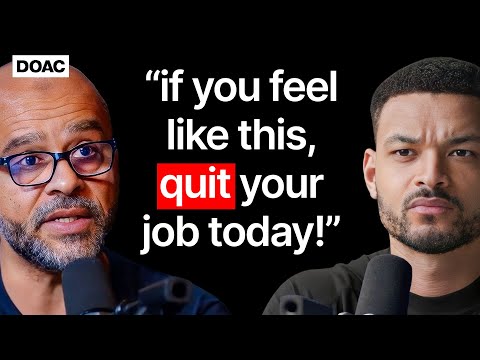
Mo Gawdat: A WARNING about Stress & Anxiety! This Is Causing 70% Of Heart Attacks In Young People!
Mo Gawdat (guest), Mo Gawdat (guest), Narrator, Steven Bartlett (host), Narrator, Narrator
In this episode of The Diary of a CEO, featuring Mo Gawdat and Mo Gawdat, Mo Gawdat: A WARNING about Stress & Anxiety! This Is Causing 70% Of Heart Attacks In Young People! explores mo Gawdat Exposes Stress Addiction Sabotaging Health, Work, Relationships, Future Mo Gawdat argues that stress has become the real global pandemic, driving 70–80% of doctor visits and silently pushing people toward burnout, anxiety, and physical illness. He explains that stress itself isn’t the problem—our addiction to it, our beliefs about success, and our failure to set limits are. Using his TONN framework (Trauma, Obsessions, Nuisances, Noise) and the ‘three Ls’ (Limit, Learn, Listen), he shows how most damaging stress comes from controllable micro-stressors and anticipatory fear, not rare traumatic events.
Mo Gawdat Exposes Stress Addiction Sabotaging Health, Work, Relationships, Future
Mo Gawdat argues that stress has become the real global pandemic, driving 70–80% of doctor visits and silently pushing people toward burnout, anxiety, and physical illness. He explains that stress itself isn’t the problem—our addiction to it, our beliefs about success, and our failure to set limits are. Using his TONN framework (Trauma, Obsessions, Nuisances, Noise) and the ‘three Ls’ (Limit, Learn, Listen), he shows how most damaging stress comes from controllable micro-stressors and anticipatory fear, not rare traumatic events.
Against the backdrop of accelerating change—AI, economics, geopolitics, and climate—Gawdat insists we must make well-being our top priority and deliberately reconfigure our lives, work, and relationships. He challenges hustle culture, showing that 80% of work is performative and that true productivity and creativity require more space, not more hours. The conversation becomes deeply personal as he confronts Stephen Bartlett’s own stress addiction, linking overwork to unresolved scripts from childhood, status, and fear.
Gawdat also explores love and relationships as powerful buffers against stress, sharing how doing the inner work allowed him to recognize a compatible partner quickly and reframe love as an ‘internal job’ rather than a quest to find someone to fix us. He warns that AI and economic systems driven by ego and scarcity will make the world more stressful, but maintains that individuals can become ‘unstressable’ by building skills in the four stress modalities—mental, emotional, physical, and spiritual—so the same external world affects them far less.
Key Takeaways
Most stress damage comes from burnout and anticipation, not single traumas.
Gawdat explains that there are only three ways stress truly breaks us: trauma, burnout, and anticipation of stress (fear, worry, anxiety, panic). ...
Get the full analysis with uListen AI
Burnout is mathematically predictable and can be prevented by reducing micro‑stressors.
He frames burnout as: total stress load = number of stressors × intensity × duration × frequency. ...
Get the full analysis with uListen AI
Stress is an addiction and status symbol—‘I’m busy’ has become a badge of honor.
Gawdat describes modern stress as having all the hallmarks of addiction: we use busyness to avoid being alone with our thoughts, to numb psychological discomfort, and to feel important. ...
Get the full analysis with uListen AI
Setting hard limits and clear ceilings is essential to protect well-being and true productivity.
Central to Gawdat’s ‘Unstressable’ philosophy is Limit: choosing what you allow into your life. ...
Get the full analysis with uListen AI
Internal scripts from childhood silently drive overwork, stress, and relationship patterns.
Drawing on his wife Hanna’s therapy background, Gawdat explains that we run on scripts formed early: ‘I’m not enough’, ‘relationships are prison’, ‘love is conditional’, ‘I must survive’. ...
Get the full analysis with uListen AI
Building skills in four stress modalities makes you far more ‘unstressable’.
Gawdat distinguishes four ‘languages’ of stress: mental (racing thoughts, 4 a. ...
Get the full analysis with uListen AI
Connection and love are powerful buffers against stress and mortality risk.
He cites research showing that people who experience major stressors but also frequently help others or have strong support networks eliminate the increased risk of death seen in those without such connections. ...
Get the full analysis with uListen AI
Notable Quotes
“Stress is very good for you, until it kills you.”
— Mo Gawdat
“Eighty percent of the stuff you do at work is just to prove you’re alive.”
— Mo Gawdat
“It’s not the events of your life that stress you, it’s the way you deal with them that does.”
— Mo Gawdat
“We spend most of life planning to live it, instead of living it.”
— Mo Gawdat
“The whole endless cycle of growth and progress is a big lie.”
— Mo Gawdat
Questions Answered in This Episode
Your burnout equation treats all stressors mathematically—how would you practically help someone quantify and then redesign their weekly ‘nuisance load’ without becoming obsessively analytical about their own life?
Mo Gawdat argues that stress has become the real global pandemic, driving 70–80% of doctor visits and silently pushing people toward burnout, anxiety, and physical illness. ...
Get the full analysis with uListen AI
You challenged Stephen to be ‘unstressed’ by year-end; if he asked you for a concrete 90‑day plan, what specific boundaries, routines, and relationship changes would you demand he make first?
Against the backdrop of accelerating change—AI, economics, geopolitics, and climate—Gawdat insists we must make well-being our top priority and deliberately reconfigure our lives, work, and relationships. ...
Get the full analysis with uListen AI
You say 80% of work is performative—what would it actually look like inside a large company if the CEO took that seriously and redesigned work around the 20% that truly moves the needle?
Gawdat also explores love and relationships as powerful buffers against stress, sharing how doing the inner work allowed him to recognize a compatible partner quickly and reframe love as an ‘internal job’ rather than a quest to find someone to fix us. ...
Get the full analysis with uListen AI
You admitted you’d stop AI development if you could, but also celebrated its potential to reduce suffering; under what ethical or governance conditions, if any, would you support continued AI progress?
Get the full analysis with uListen AI
Your story about proposing on day three rests on years of inner work and clear criteria—how should someone who hasn’t done that level of work approach dating differently to avoid both ‘junk relationships’ and paralysing perfectionism?
Get the full analysis with uListen AI
Transcript Preview
There are only three ways where stress will break you, but the majority of how stress kills us is because of ... But this is completely within your control.
Mo Gawdat is back.
And this time, he's on a mission to help millions of people manage their stress.
No matter what their circumstances.
Stress is very good for you, until it kills you. And what most people don't understand is that it's an addiction. Stress is a badge of honor. It means that I'm wanted, I'm needed. And the reality is that 80% of the stuff you do at work is just to prove you're alive. But we tell ourselves we're too busy. That's a lie. But the truth is that we are getting to the point where this turning into burnout, anxiety, panic attacks. We're all suffering. Now, I think the most interesting part of stress is to understand that what breaks us is the long application of obsessions and nuisances. Nuisances are stressors that are triggered every day, and there are so many of them. The first 10 minutes of your day, you get 10, 15 stressors. And then obsessions create a lot of stress as a result of the lies that you told yourself. This is quite serious.
What do we do about it though?
So, you get stressed in four modalities: mentally, emotionally, physically, or spiritually. And each of those is a different language. So your mental stress speaks to you in a language that is different than your emotional stress. But if you learn that language, then you can easily deal with that stress when it happens. And it's simple techniques, so we should cover as many of them as we can. So, first of all ...
Congratulations, Diary of a CEO gang. We've made some progress. 63% of you that listen to this podcast regularly don't subscribe, which is down from 69%. Our goal is 50%. So if you've ever liked any of the videos we've posted, if you like this channel, can you do me a quick favor and hit the subscribe button? It helps this channel more than you know. And the bigger the channel gets, as you've seen, the bigger the guests get. Thank you, and enjoy this episode. (upbeat music) Mo, how are you doing?
Uh, I'm here again. Love it.
(laughs)
Uh, it's always a pleasure to be with you, Steve. I, I'm doing, um, I am somewhere between the best time of my life and, uh, and the most interestingly inviting for change time of my life.
What do you mean?
I think the, I think I'm, I'm, thanks to you, of course, by the way, and, and many others, I've, I've, I think my message is getting to a lot of people. I think that's, uh, really, really, really ... it feels such an honor to be actually making progress on my mission on what I stand for. Uh, but I have to say, I think the world is changing in so many ways that doing what we've always done may not deliver the same results. So I feel that I have to revisit very deeply, uh, how I can continue to help. I h- how I can continue to explain what I think will be probably the most needed in the, in the times to come. But, uh, but also not, um ... I think most people don't realize how different the world is going to be in the next five years.
Install uListen to search the full transcript and get AI-powered insights
Get Full TranscriptGet more from every podcast
AI summaries, searchable transcripts, and fact-checking. Free forever.
Add to Chrome