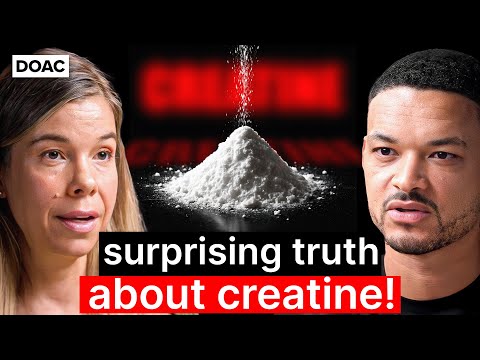
Anti-Aging Expert: Missing This Vitamin Is As Bad As Smoking! The Truth About Creatine!
Dr Rhonda Patrick (guest), Steven Bartlett (host)
In this episode of The Diary of a CEO, featuring Dr Rhonda Patrick and Steven Bartlett, Anti-Aging Expert: Missing This Vitamin Is As Bad As Smoking! The Truth About Creatine! explores lifestyle, Not Genes: Simple Habits That Radically Slow Your Aging Dr. Rhonda Patrick explains that around 70% of how we age is driven by lifestyle, not genetics, and outlines practical strategies to extend both lifespan and healthspan. She highlights the profound effects of exercise, especially vigorous cardio and saunas, on brain and heart aging, showing they can reverse structural aging markers by decades.
Lifestyle, Not Genes: Simple Habits That Radically Slow Your Aging
Dr. Rhonda Patrick explains that around 70% of how we age is driven by lifestyle, not genetics, and outlines practical strategies to extend both lifespan and healthspan. She highlights the profound effects of exercise, especially vigorous cardio and saunas, on brain and heart aging, showing they can reverse structural aging markers by decades.
Nutrient status emerges as another major lever: deficiencies in vitamin D, magnesium, and omega‑3s, as well as low choline in pregnancy, are linked with higher risks of dementia, cancer, depression, and poorer cognitive outcomes. Patrick also reframes familiar 'gym' molecules like creatine and ketones as powerful brain-support tools, particularly under stress and sleep deprivation.
She warns about modern environmental risks—microplastics, pesticides, late-night eating—and emphasizes simple countermeasures such as fiber, water filtration, and earlier eating windows. Throughout, she argues that small, consistent interventions can dramatically alter how sharp, mobile, and disease‑free we remain into old age.
Key Takeaways
Vigorous Exercise Is One of the Most Powerful Anti‑Aging Tools
Cardiorespiratory fitness (VO2 max) is a stronger predictor of early mortality than smoking, type 2 diabetes, or cardiovascular disease. ...
Get the full analysis with uListen AI
Exercise Literally Reverses Structural Aging in the Heart and Brain
A two‑year progressive program including 1–2 weekly Norwegian 4×4 sessions in previously sedentary 50‑year‑olds made their hearts look structurally like those of 30‑year‑olds—larger and less stiff, reversing ~20 years of aging. ...
Get the full analysis with uListen AI
Vitamin D, Magnesium, and Omega‑3 Deficiencies Quietly Drive Disease Risk
About 70% of people have insufficient vitamin D, and deficiency is associated with an ~80% increased risk of dementia; supplementation with vitamin D3 can reduce dementia risk by ~40% and improve cognition in those already impaired. ...
Get the full analysis with uListen AI
Creatine Is a Brain‑Support Compound, Not Just a Gym Supplement
The liver and brain make limited creatine, but muscles hoard it; 5 g/day enhances strength and training volume only when combined with resistance training. ...
Get the full analysis with uListen AI
Ketones and Ketogenic Strategies Offer Powerful Brain Protection
Endogenous ketones (especially beta‑hydroxybutyrate, BHB), generated via ketogenic diets, fasting, or prolonged intense exercise, provide an efficient fuel for neurons, free up glucose to produce the antioxidant glutathione, and act as a signaling molecule that boosts BDNF and neuroplasticity. ...
Get the full analysis with uListen AI
Simple Daily Choices Strongly Influence Dementia and Alzheimer’s Risk
Major modifiable contributors to dementia include chronic sleep loss (impaired glymphatic clearance of amyloid‑beta), high refined sugar intake and insulin resistance (disrupted brain glucose metabolism), sedentarism (low VO2 max), alcohol, smoking, and nutrient deficiencies (especially vitamin D and omega‑3s). ...
Get the full analysis with uListen AI
Modern Exposures Matter: Microplastics, BPA, and Pesticides Are Not Trivial
Hot liquids in lined paper cups, plastic bottles, canned foods, and plastic tea bags can massively increase intake of microplastics and endocrine‑disrupting chemicals like BPA/BPS (up to ~55‑fold leaching when plastic is heated). ...
Get the full analysis with uListen AI
Notable Quotes
“Three weeks of bed rest was worse on their cardiorespiratory fitness than 30 years of aging.”
— Dr. Rhonda Patrick
“If you could pill up what exercise does, it would blow Ozempic out of the water.”
— Dr. Rhonda Patrick
“Not getting enough omega‑3 from your diet is like smoking in terms of mortality risk.”
— Dr. Rhonda Patrick
“Being deficient or insufficient in vitamin D can increase dementia risk by 80%.”
— Dr. Rhonda Patrick
“I could take a 15‑day‑old worm and double its lifespan just by dialing down insulin signaling. Lifestyle matters that much.”
— Dr. Rhonda Patrick
Questions Answered in This Episode
You mentioned that vigorous exercise outperforms moderate exercise for improving VO2 max and brain health. For someone with joint issues or low baseline fitness, what specific, low‑impact HIIT protocols would you design to safely achieve those benefits?
Dr. ...
Get the full analysis with uListen AI
The omega‑3 index study equated low omega‑3 status with smoking in terms of mortality risk. In practice, how would you prioritize omega‑3 supplementation versus quitting borderline habits like occasional alcohol or ultra‑processed foods for someone with limited bandwidth to change everything at once?
Nutrient status emerges as another major lever: deficiencies in vitamin D, magnesium, and omega‑3s, as well as low choline in pregnancy, are linked with higher risks of dementia, cancer, depression, and poorer cognitive outcomes. ...
Get the full analysis with uListen AI
Given the promising but early data on creatine for depression and Alzheimer’s, what kind of large‑scale, well‑controlled trial would you most like to see next, and what outcomes or biomarkers would convince you creatine should be part of standard psychiatric or geriatric care?
She warns about modern environmental risks—microplastics, pesticides, late-night eating—and emphasizes simple countermeasures such as fiber, water filtration, and earlier eating windows. ...
Get the full analysis with uListen AI
You spoke about exogenous ketones providing a short neurocognitive boost similar to being in ketosis. In your view, could frequent reliance on exogenous BHB backfire metabolically or blunt the body’s own adaptive responses compared to earning ketones via fasting or exercise?
Get the full analysis with uListen AI
The microplastics and pesticide data are alarming but still emerging. If we take a strict risk–benefit view, which three environmental changes (e.g., replacing certain containers, filtering water, changing certain foods) do you think will yield the largest reduction in long‑term neurodegenerative and cancer risk for the average person?
Get the full analysis with uListen AI
Transcript Preview
Why do people not know that vitamin D deficiency can increase dementia risk by 80%? Why do people not know that having a lack of this mineral is affecting their long-term risk of cancer? Why do people not know that having a low omega-3 index is as bad for you, in terms of mortality, as smoking? And as a scientist, I've seen firsthand that 70% of the way you're aging is actually due to your lifestyle. And all these things are so easy to do. So for example, as we age, certain areas of the brain which is involved in learning and memory starts to shrink by about 1 to 2% per year. The good news is studies show that people being part of an exercise protocol, not only did they not have their hippocampus shrink, it actually grew by 1 to 2%. And there's more. There are other things that don't even require as much effort as exercise, like supplements. And it's been shown study after study that if you take someone and you sleep deprive them for 21 hours and give them 25 to 30 grams of creatine, not only does it negate the cognitive deficits of sleep deprivation, it makes people function better than if they were well-rested. And then there's magnesium. There have been studies showing that people with the highest magnesium levels have a 40% lower all-cause mortality. And over 300 different enzymes in your body need it to help with short-term survival. And yet, 50% of the population in the United States does not have adequate levels of magnesium. And there's still more. There's saunas, red light therapy, ketogenic diets, blueberries, electrolytes, and we can talk about all of 'em.
Please.
Okay. So I've found when you go into the sauna, something happens that's incredible. So...
I see messages all the time in the comment section that some of you didn't realize you didn't subscribe. So if you could do me a favor and double-check if you're a subscriber to this channel, that would be tremendously appreciated. It's the simple, it's the free thing that anybody that watches this show frequently can do to help us here to keep everything going in this show and the trajectory it's on. So, please do double-check if you've subscribed and, uh, thank you so much. Because in a strange way, you are- you're part of our history and you're on this journey with us and I appreciate you for that. So, yeah, thank you. Dr. Rhonda Patrick, you strike me as a fairly obsessed person. What is it you're obsessed about and why are you obsessed about it? Because I can see from speaking to you previously how passionate you are about the subjects we're gonna talk t- about today. And so I was- I was, um, I was wondering what it is about these subjects that is driving you and what- what you're trying to accomplish?
I've learned through my experience, so I have a PhD in biomedical science, I've done research on aging, on cancer, on metabolism, nutrition, neuroscience, a lot of different fields, very cross-disciplinary. And I've realized over, you know, the decades of doing research that there are many different small changes that can be made that have a really big impact on our health, what's called our health span. So this is essentially being disease-free, uh, throughout our life, being healthy, feeling good. And I'm sort of obsessed with trying to optimize that and find a protocol to optimize it and then share that information with the world. And it's funny because, you know, we live in a time now where we've got access to so much information, overwhelming amount of information, but the reality is is that simple important tools that people can do in their life right now to drastically improve the way they age are still not known to the general population. And so my mission is to get that knowledge to people so that they can make these simple changes and live healthier and feel better.
Install uListen to search the full transcript and get AI-powered insights
Get Full TranscriptGet more from every podcast
AI summaries, searchable transcripts, and fact-checking. Free forever.
Add to Chrome