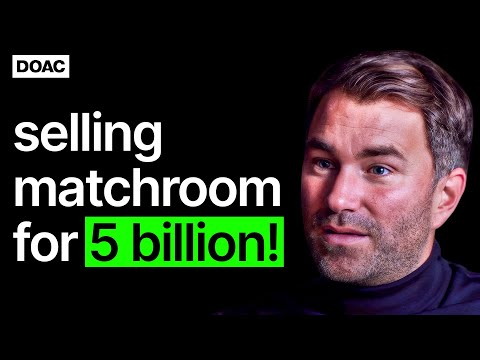
Eddie Hearn on Selling Matchroom For 5 Billion | E58
Steven Bartlett (host), Eddie Hearn (guest), Narrator
In this episode of The Diary of a CEO, featuring Steven Bartlett and Eddie Hearn, Eddie Hearn on Selling Matchroom For 5 Billion | E58 explores eddie Hearn: Obsessed Promoter Chasing Legacy, Not Money, In Boxing Eddie Hearn unpacks the roots of his relentless ambition, tracing it back to a childhood defined by winning at all costs and living in the shadow of his self‑made father, Barry Hearn.
Eddie Hearn: Obsessed Promoter Chasing Legacy, Not Money, In Boxing
Eddie Hearn unpacks the roots of his relentless ambition, tracing it back to a childhood defined by winning at all costs and living in the shadow of his self‑made father, Barry Hearn.
He talks candidly about the personal costs of obsession: compromised family time, strained relationships, and the inability to ever feel content, even at the peak of success.
Hearn explores his complicated relationship with money, legacy, and the idea of selling Matchroom for billions, admitting that the real driver is competition, validation, and proving what he and his father can build from nothing.
Throughout, he reflects on mental health, social media toxicity, and the importance of short‑term focus, simplicity, and self‑awareness in surviving high‑pressure, high‑profile careers.
Key Takeaways
Winning as an identity can create lifelong obsession and insecurity.
Hearn’s upbringing revolved around performance and results: his dad and mum dismissed ‘taking part’ and only praised winning. ...
Get the full analysis with uListen AI
High achievement requires sacrifice, especially in family life, and you must be honest about that.
Hearn openly admits you “have to be incredibly selfish” to operate at his level. ...
Get the full analysis with uListen AI
Success is a ‘drug’ that can make contentment almost impossible.
Whether it’s AJ winning a world title or staging Joshua–Klitschko at Wembley, Hearn says the highs are intense but fleeting; by the next morning, he’s already onto the next goal. ...
Get the full analysis with uListen AI
Short‑term, controllable goals are a powerful tool against anxiety and overwhelm.
On feeling low or mentally off‑balance, Hearn writes down small, practical tasks—like walking the dog, finalising a contract, going to the gym—and ticks them off. ...
Get the full analysis with uListen AI
Relentless ambition often isn’t about money; it’s about the ‘game’ and proving a point.
Hearn says additional wealth from a potential £4–5 billion valuation wouldn’t change his lifestyle; the appeal is the story and the competition—emulating or surpassing the UFC, proving he and his dad built something monumental. ...
Get the full analysis with uListen AI
Being comfortable with yourself is a turning point for effectiveness and resilience.
In his twenties, Hearn cared deeply about how he looked and what people thought. ...
Get the full analysis with uListen AI
Repetition in high‑pressure situations builds calm and competence.
Hearn recalls his first press conference, secretly shaking and hiding his hands, contrasted with speaking for hours without notes today. ...
Get the full analysis with uListen AI
Notable Quotes
“There is no way you can be the perfect husband or the perfect father and run a successful business or be a relentless operator. It’s impossible.”
— Eddie Hearn
“Success is a drug. But you gotta be careful that it doesn’t turn you into an asshole at the same time.”
— Eddie Hearn
“I’m not doing this because I need the money. I could’ve bought the Lamborghini at 21. I’m doing it because I love to win.”
— Eddie Hearn
“We were never supposed to be this business. I was never supposed to be this kid.”
— Eddie Hearn
“You can talk about mindset and mentality for hours. Just keep it simple. Don’t overthink things. If things get tough, wake up an hour earlier and go to bed an hour later.”
— Eddie Hearn
Questions Answered in This Episode
You say selling Matchroom for UFC‑level money wouldn’t change your lifestyle—if the money isn’t the point, what specific achievement or recognition would finally make you feel ‘enough’?
Eddie Hearn unpacks the roots of his relentless ambition, tracing it back to a childhood defined by winning at all costs and living in the shadow of his self‑made father, Barry Hearn.
Get the full analysis with uListen AI
You’re very open about sacrificing family time for work; what, if anything, would have to happen for you to reverse that priority for a season and put family first?
He talks candidly about the personal costs of obsession: compromised family time, strained relationships, and the inability to ever feel content, even at the peak of success.
Get the full analysis with uListen AI
If you had the power to redesign boxing’s fragmented structure tomorrow to match your ‘one sport, one promoter, one belt’ vision, what concrete steps would you take and who would resist you the hardest?
Hearn explores his complicated relationship with money, legacy, and the idea of selling Matchroom for billions, admitting that the real driver is competition, validation, and proving what he and his father can build from nothing.
Get the full analysis with uListen AI
You’ve called your work pattern an ‘illness’—how do you distinguish between healthy obsession that drives excellence and unhealthy compulsion that damages your life, and where do you think you are on that line right now?
Throughout, he reflects on mental health, social media toxicity, and the importance of short‑term focus, simplicity, and self‑awareness in surviving high‑pressure, high‑profile careers.
Get the full analysis with uListen AI
Given your worries about social media’s impact on your children, what specific rules or guidance are you planning (or already using) to let them participate online without being consumed by it?
Get the full analysis with uListen AI
Transcript Preview
Oh, my God. Eddie Hearn. What a guy. There's very few people... No. I'm gonna change that. I've never met someone as neurotically obsessed with success, and with winning, and with accomplishing things, and with living a life in constant forward motion as my next guest, Eddie Hearn. And it's remarkable because when you unpack the reasons for that obsession and that dedication to being more and achieving more, there's quite a fragile, vulnerable, insecure story. That's something I've noticed with a lot of my guests, and it often makes me think that the most successful amongst us aren't necessarily choosing to be. Something's happened to them that's left them with no choice. Eddie Hearn is one of the most notorious sports promoters in the world. He's the king of boxing in this country. He is known for his No Contacts Hand Twitter page, which I'm sure a lot of you have seen. But what I wanted to do when I sat down with Eddie Hearn was to get underneath, to get underneath the external sort of braggadocious, loud promoter side of him, and to find out even in the case of someone like Eddie who is loud, who is successful, who is ambitious, who is a promoter, are the same things true for him that are true for you? The insecurities, the vulnerabilities, the mental health issues. And how much does he really understand himself? My conversation with Eddie was incredibly enlightening. But it also wasn't that surprising. So without further ado, I'm Steven Bartlett, and this is the Diary of a CEO. I hope nobody is listening, but if you are, then please keep this to yourself. (instrumental music plays) You've done a ton of interviews, especially over the last couple of weeks, and there's this really consistent theme that I felt in all of the interviews I watched. I watched you at Cambridge, the High Performance Podcast, loads of them. And, um, and then before we came, uh, started filming today, I had a chat with Frank, and he fully grassed on you. No.
(laughs)
What he said to me, which I, I, which was also consistent with these interviews, is that you are relentless. And he was telling me he's b- he's had some, um... I probably shouldn't say this, but he was telling me, he goes, "I've, I've started having this, uh..." Is it night owl or-
Night nurse.
... night nurse stuff.
Yeah, yeah, yeah, yeah, yeah.
'Cause Eddie will text me in the middle of the night.
Mm-hmm.
And he went, "I'll tell you one thing about Eddie. He is relentless."
Mm-hmm.
You're what? 40?
41.
41 years old. What's made you that relentless at 41 years old to the point where you're, you're, uh, pestering your colleagues at 3:00 AM in the morning?
I don't know really. Um, I think when I, when I did the book, it was like, it was quite a good, um, sort of counseling session-
Install uListen to search the full transcript and get AI-powered insights
Get Full TranscriptGet more from every podcast
AI summaries, searchable transcripts, and fact-checking. Free forever.
Add to Chrome