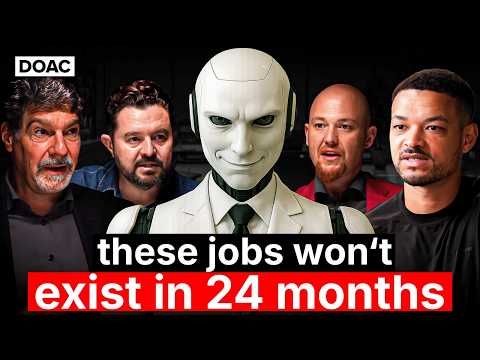
AI AGENTS DEBATE: These Jobs Won't Exist In 24 Months!
Amjad Masad (guest), Bret Weinstein (guest), Steven Bartlett (host), Daniel Priestley (guest), Narrator, Narrator, Narrator, Narrator
In this episode of The Diary of a CEO, featuring Amjad Masad and Bret Weinstein, AI AGENTS DEBATE: These Jobs Won't Exist In 24 Months! explores aI Agents, Jobs, And Humanity: Opportunity, Upheaval, And Existential Risk This conversation brings together a founder building AI agent tools, an evolutionary biologist, and an entrepreneur to debate how AI—especially autonomous agents—will reshape work, wealth, meaning, and power. They demonstrate current capabilities, like ordering goods and building software end‑to‑end, then extrapolate to near‑term labor disruption and longer‑term systemic changes.
AI Agents, Jobs, And Humanity: Opportunity, Upheaval, And Existential Risk
This conversation brings together a founder building AI agent tools, an evolutionary biologist, and an entrepreneur to debate how AI—especially autonomous agents—will reshape work, wealth, meaning, and power. They demonstrate current capabilities, like ordering goods and building software end‑to‑end, then extrapolate to near‑term labor disruption and longer‑term systemic changes.
Amjad (Replit) argues AI agents will massively democratize entrepreneurship and supercharge individual productivity, while Dan emphasizes the unprecedented leverage for small teams and creators. Bret counters with complex-systems warnings: AI as a new evolving species, runaway misuse, deepfakes, autonomous weapons, and a social order that could regress into extreme inequality and control.
They explore concrete examples of job automation, new forms of work, UBI, education reform, mental health, declining birth rates, and the risk of AI‑enabled surveillance states. Despite deep concerns, all three see major upside in healthcare, education, and the chance to redesign work around meaning instead of drudgery.
The episode ends with personal prescriptions: become a high‑agency generalist, learn to wield AI directly, focus on creation over consumption, and push for systems that spread AI’s dividend instead of concentrating it among a tiny elite.
Key Takeaways
AI agents move beyond chatbots to perform autonomous, multi‑step digital labor.
Unlike ChatGPT’s request–response mode, AI agents accept a goal and keep working—sometimes for 30+ minutes—until they either achieve it or fail and ask for help. ...
Get the full analysis with uListen AI
Routine, digital, and text‑based roles are at highest risk in the next few years.
Any job that is “as routine as it comes”—QA, data entry, many customer support roles, basic accounting and legal drafting, parts of radiology and medical imaging, and other text‑in/text‑out or repeatable click‑work—is directly exposed. ...
Get the full analysis with uListen AI
New opportunities concentrate around high‑agency individuals who can orchestrate AI ‘swarms’.
The panelists frame the future as favoring “high‑agency generalists” who can spot opportunities, design systems, and coordinate many AI agents rather than do routine execution. ...
Get the full analysis with uListen AI
Wealth and power may concentrate dramatically even as access to tools becomes more equal.
AI democratizes capability—anyone with ideas and an internet connection can build—but variance in outcomes spikes. ...
Get the full analysis with uListen AI
AI will both enable and combat large‑scale abuse like scams, deepfakes, and cyberattacks.
Already, deepfake ads and voice clones are defrauding fans of the host and guests. ...
Get the full analysis with uListen AI
Education must shift from narrow skills to general thinking tools and lifelong adaptation.
Static skills are quickly automated. ...
Get the full analysis with uListen AI
Hyper‑novelty, meaning loss, and demographic decline are as central as job loss.
Even before AI, rapid change has outpaced our ability to adapt, feeding loneliness, mental illness, and falling birth rates. ...
Get the full analysis with uListen AI
Notable Quotes
“If your job is as routine as it comes, it's gone in the next couple years.”
— Amjad Masad
“We have created a new species and nobody on Earth can predict what's going to happen.”
— Bret Weinstein
“It's almost as if we've just invented a new continent of remote workers... they've all got a master's or a PhD, and they're 25 cents an hour.”
— Dan (entrepreneur)
“The idea that this AI disruption doesn't lead us to some very human catastrophe is overly optimistic.”
— Bret Weinstein
“AI has this superpower of making you a hyper consumer or a hyper creator.”
— Dan (entrepreneur)
Questions Answered in This Episode
For roles you singled out as ‘routine and at risk’—like QA, support, and basic accounting—what concrete steps should a 30‑ or 40‑year‑old in those jobs take this year to reposition themselves without having to become a programmer?
This conversation brings together a founder building AI agent tools, an evolutionary biologist, and an entrepreneur to debate how AI—especially autonomous agents—will reshape work, wealth, meaning, and power. ...
Get the full analysis with uListen AI
Bret argued that technologists underestimate emergent behavior in complex systems; Amjad argued current AIs are bounded by training data. Can you walk through a specific example where your predictions about AI capabilities meaningfully diverge over the next five years?
Amjad (Replit) argues AI agents will massively democratize entrepreneurship and supercharge individual productivity, while Dan emphasizes the unprecedented leverage for small teams and creators. ...
Get the full analysis with uListen AI
You all mentioned AI enabling ‘hyper‑consumers’ and ‘hyper‑creators.’ What practical criteria or daily habits can an ordinary person use to audit whether AI is currently tying their shoelaces together—or putting them in the Formula 1 car?
They explore concrete examples of job automation, new forms of work, UBI, education reform, mental health, declining birth rates, and the risk of AI‑enabled surveillance states. ...
Get the full analysis with uListen AI
On education, you praised one‑to‑one AI tutoring and hands‑on physical problem‑solving. How would you redesign a concrete school timetable for a 12‑year‑old today, blending AI tools with real‑world projects, without increasing total hours?
The episode ends with personal prescriptions: become a high‑agency generalist, learn to wield AI directly, focus on creation over consumption, and push for systems that spread AI’s dividend instead of concentrating it among a tiny elite.
Get the full analysis with uListen AI
The episode touched on AI‑enabled surveillance in Iran, Canada, and Western cities. Where would you each draw a hard red line on legitimate vs illegitimate uses of AI in law enforcement, and what technical or legal safeguards would you require to enforce that boundary?
Get the full analysis with uListen AI
Transcript Preview
I think a lot of people don't realize how massive the positive impact AI is gonna have on their life.
Well, I would argue that the idea that this AI disruption doesn't lead us to human catastrophe is optimistic. For example, people are gonna be unemployed in huge numbers.
You agree with that, don't you?
Yes. If your job is as routine as it comes, it's gone in the next couple years. But it's gonna create new opportunities for wealth creation.
Let me put it to you this way: we have created a new species and nobody on Earth can predict what's going to happen.
We are joined by three leading voices to debate the most disruptive shift in human history, the rise of AI.
And they're answering the questions you're most scared about.
This technology is gonna get so much more powerful. And yes, we're gonna go through a period of disruption, but at the other end, we're gonna create a fairer world. It's enabling people to run their businesses, make a lot of money.
And you can solve meaningful problems such as the breakthroughs in global healthcare and education will be phenomenal, and you can live an incredibly fulfilling existence.
Well, I would just say on that front, this has always been a fantasy of technologists, to do marvelous things with our spare time but we end up doomscrolling.
Loneliness epidemic.
Right, falling birth rates. So the potential for good here is infinite and the potential for bad is ten times. For example, there's war, undetectable deepfakes, and scams, so people don't understand how many different ways they are going to be robbed.
Look, I don't think blaming technology for all of it is the right thing. All these issues, they're already here.
We're all fathers here, so what are you saying to your children?
Well, first of all...
This has always blown my mind a little bit: 53% of you that listen to this show regularly haven't yet subscribed to this show. So could I ask you for a favor before we start? If you like this show and you like what we do here and you wanna support us, the free simple way that you can do just that is by hitting the subscribe button. And my commitment to you is if you do that, then I'll do everything in my power, me and my team, to make sure that this show is better for you every single week. We'll listen to your feedback, we'll find the guests that you want me to speak to, and we'll continue to do what we do. Thank you so much. The reason why I wanted to have this conversation with all of you is because the subject matter of AI, but more specifically AI agents, has occupied my free time for several weeks in a row. And actually, Amjad, when I started using Replit, for me, it was a paradigm shift.
Install uListen to search the full transcript and get AI-powered insights
Get Full TranscriptGet more from every podcast
AI summaries, searchable transcripts, and fact-checking. Free forever.
Add to Chrome