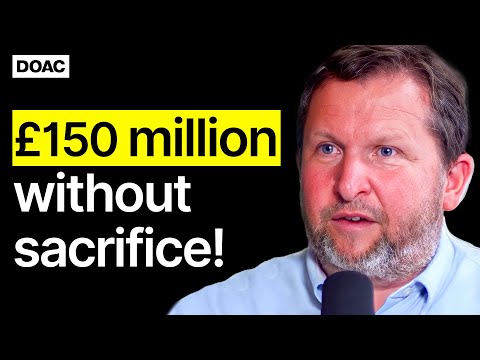
Moonpig Founder: How I Built A $150 Million Business WITHOUT Sacrifice: Nick Jenkins | E97
Nick Jenkins (guest), Steven Bartlett (host), Narrator
In this episode of The Diary of a CEO, featuring Nick Jenkins and Steven Bartlett, Moonpig Founder: How I Built A $150 Million Business WITHOUT Sacrifice: Nick Jenkins | E97 explores moonpig’s Nick Jenkins: Building Massive Wealth Without Losing Your Life Nick Jenkins, founder of Moonpig and former Dragon’s Den investor, explains how he built a £150M+ business (now worth ~$1.6B) without embracing the extreme ‘hustle’ culture often glorified in entrepreneurship.
Moonpig’s Nick Jenkins: Building Massive Wealth Without Losing Your Life
Nick Jenkins, founder of Moonpig and former Dragon’s Den investor, explains how he built a £150M+ business (now worth ~$1.6B) without embracing the extreme ‘hustle’ culture often glorified in entrepreneurship.
He argues that key entrepreneurial traits like decisiveness and risk tolerance are partly innate but can be refined, and that success comes more from product quality, data-driven experimentation, and focus than from 100-hour workweeks.
Jenkins details Moonpig’s difficult first five years, his near-total financial risk, and the statistical insight that kept him going when even his investors had given up.
Now financially free, he emphasizes redefining success as being a ‘successful human being’—valuing relationships, contribution, and learning over endless wealth accumulation.
Key Takeaways
Validate core business hypotheses with the smallest possible spend.
Jenkins used statistics to calculate the minimum marketing spend needed for a ‘statistically significant’ cost of customer acquisition, often spending £2,500 instead of £25,000 to test a channel. ...
Get the full analysis with uListen AI
You don’t need a unique idea; you need a better execution.
Moonpig entered a market where personalization and greeting cards already existed, and there were even direct competitors. ...
Get the full analysis with uListen AI
Product quality and repeat behavior matter more than ad spend.
Moonpig survived a year with zero marketing spend yet grew 30% because customers loved the product and it had a built-in viral loop (recipients saw ‘moonpig. ...
Get the full analysis with uListen AI
Focus on one venture; don’t split yourself across multiple startups.
As an investor, Jenkins refuses to back founders running multiple startups and even contractually restricts significant outside interests. ...
Get the full analysis with uListen AI
Work–life sacrifice is not a prerequisite for entrepreneurial success.
Contrary to ‘hustle porn’, Jenkins maintained a good social life and tried to run Moonpig largely within sensible working hours. ...
Get the full analysis with uListen AI
Decisiveness, tolerance for failure, and mild self‑delusion are assets.
Jenkins argues that entrepreneurs must make decisions without perfect information and be unafraid of ending up back at zero. ...
Get the full analysis with uListen AI
Redefine success beyond money to stay fulfilled post‑exit.
After selling Moonpig and already earning substantial dividends, Jenkins realized more money would bring diminishing returns. ...
Get the full analysis with uListen AI
Notable Quotes
“Like all overnight successes, it took 11 years.”
— Nick Jenkins
“If you’re frightened of ever making a mistake, then you won’t do it much.”
— Nick Jenkins
“You don’t have to be unique. You’ve just got to be better in some respect.”
— Nick Jenkins
“The most exciting times I ever had in my business were when my back was absolutely against the wall and I’m thinking, ‘This is going down.’”
— Nick Jenkins
“I’m reluctant to create this illusion that if you work incredibly hard, you can make a lot of money and that will make you successful. You have to be a successful human being.”
— Nick Jenkins
Questions Answered in This Episode
You mentioned that a small amount of self‑delusion helped you start Moonpig—how can a founder distinguish between healthy self‑belief and destructive denial when the numbers aren’t yet working?
Nick Jenkins, founder of Moonpig and former Dragon’s Den investor, explains how he built a £150M+ business (now worth ~$1. ...
Get the full analysis with uListen AI
Looking back at Moonpig’s first five years, is there a specific decision you’d *reverse* today if you had your current experience and data, and how do you think it would have changed the growth curve?
He argues that key entrepreneurial traits like decisiveness and risk tolerance are partly innate but can be refined, and that success comes more from product quality, data-driven experimentation, and focus than from 100-hour workweeks.
Get the full analysis with uListen AI
You argue that uniqueness is overrated and ‘better’ is enough: can you outline a practical framework a new founder can use to systematically identify where to be ‘better’ in a crowded market?
Jenkins details Moonpig’s difficult first five years, his near-total financial risk, and the statistical insight that kept him going when even his investors had given up.
Get the full analysis with uListen AI
You’ve seen founders living under their desks and others maintaining balance—have you noticed any reliable early signs that a team is tipping from necessary hard work into unhealthy, failure‑spiral overwork?
Now financially free, he emphasizes redefining success as being a ‘successful human being’—valuing relationships, contribution, and learning over endless wealth accumulation.
Get the full analysis with uListen AI
Post‑exit, you deliberately moved into the charity sector: what are the biggest mistakes you see business people make when they try to ‘apply business thinking’ to social impact, and how can they avoid doing more harm than good?
Get the full analysis with uListen AI
Transcript Preview
So, you do something with greeting cards? Is that something you do from your spare room?
Nick Jenkins, former CEO and founder of Moonpig, a company now worth $1.6 billion.
My first proper business was Moonpig, which, although, um, it- it's been a success, of course, it went through various ups and downs. Like all overnight successes, it took 11 years. I- I got to confess, I probably slightly stumbled on it. I mean, I look at it now and think, "Wow, I- I- that accidentally was a really good business model." (laughs) Unfortunately, we, too often we measure the things that are easiest to measure, and the easiest thing to measure is how wealthy someone is. I'm reluctant to create this illusion that- that, you know, if you work incredibly hard, you can make a lot of money and that will make you successful. You have to be a successful human being. The most exciting times I ever had in my business were when my back was absolutely against the wall and think, "This is going down."
(laughs)
Bizarrely, I found that quite invigorating. I mean, at one point, my- my shareholders all said, "Look, Nick, this is never gonna work. It's never gonna make money." By the time I'd got to the end of it, I was pretty much down to zero.
(intro music) Nick Jenkins, former CEO and founder of Moonpig, a company now worth $1.6 billion. Nick's achievements are miraculous. He's incredibly inspiring, and he created a business that's touched many of our lives. But the thing that I found even more intriguing about Nick was he bucks most of the typical entrepreneurship and success narratives. I think we're all sold the belief and the story that in order to be successful in business or any discipline in life, you have to undergo tremendous sacrifice. You have to work yourself into the ground. Nick and his story and his philosophy disprove all of that. He's got another way of doing it. If listening to this episode does anything outside of just inspiring the hell out of you and giving you very practical business information, it will definitely prove, in my view, that there is no such thing as a born entrepreneur. And also, once you become an entrepreneur, the path to success isn't the same for everybody. A lot of what you've been told is a lie. Without further ado, I'm Steven Bartlett, and this is the Diary of a CEO. I hope nobody's listening, but if you are, then please keep this to yourself. Nick, super intrigued when I meet entrepreneurs, um, because there's a huge sort of narrative and I guess a debate that's happened in the entrepreneurial community about whether entrepreneurs are made, whether they're born, or whether it's something that can be taught. And, um, from listening to you describe your early years and your school years and your upbringing, um, I wondered what your opinion on that was, and also whether you think you were a born entrepreneur.
Install uListen to search the full transcript and get AI-powered insights
Get Full TranscriptGet more from every podcast
AI summaries, searchable transcripts, and fact-checking. Free forever.
Add to Chrome