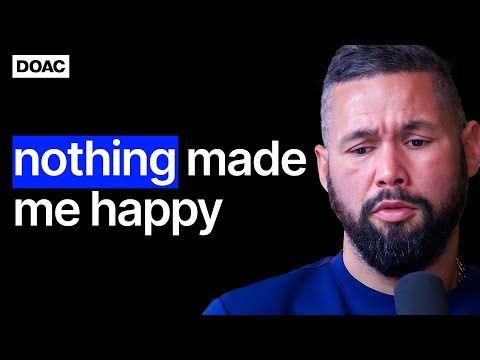
Tony Bellew: Nothing Made Me Happy Until I Found This | E156
Tony Bellew (guest), Steven Bartlett (host), Narrator
In this episode of The Diary of a CEO, featuring Tony Bellew and Steven Bartlett, Tony Bellew: Nothing Made Me Happy Until I Found This | E156 explores fighting, Grief, And Real Happiness: Tony Bellew’s True Battle Outside Tony Bellew traces his journey from a turbulent childhood in Liverpool to becoming a world champion boxer and financially secure family man, revealing that none of it brought lasting happiness on its own.
Fighting, Grief, And Real Happiness: Tony Bellew’s True Battle Outside
Tony Bellew traces his journey from a turbulent childhood in Liverpool to becoming a world champion boxer and financially secure family man, revealing that none of it brought lasting happiness on its own.
He explores how violence, racism, loyalty, and a deep need to impress his father shaped him, and how boxing gyms and key mentors literally saved lives in his community.
Bellew details the harsh economics and physical toll of boxing, the life‑altering grief of losing his brother‑in‑law Ashley, and the breakdown he only recognised on SAS: Who Dares Wins.
Now retired, he wrestles with purpose, money, and masculinity, arguing that what truly matters is the wellbeing within his four walls and the ongoing, imperfect search for genuine happiness.
Key Takeaways
Environment powerfully shapes behaviour, but doesn’t have to define your destiny.
Bellew describes growing up in Wavertree surrounded by infidelity, violence, and street crime, where the only people with 'nice things' were drug dealers. ...
Get the full analysis with uListen AI
A strong father figure can both wound and drive you.
His dad was a loving but deeply flawed role model—unfaithful, violent, twice jailed—yet Bellew adored him and built his entire boxing career around impressing and surpassing him. ...
Get the full analysis with uListen AI
Loyalty and integrity can be expensive in the short term but transformative long term.
Bellew turned down a £1. ...
Get the full analysis with uListen AI
Boxing is financially brutal and physically destructive for most fighters.
Despite being British, Commonwealth, European and world champion, Bellew wasn’t a millionaire until beating David Haye in 2017. ...
Get the full analysis with uListen AI
Grief can quietly evolve into depression, especially when you can’t fix others’ pain.
After Ashley’s sudden death in Mexico, Bellew went to camp for the Haye rematch, sobbing himself to sleep alone in a hotel for months. ...
Get the full analysis with uListen AI
Protective emotional walls that served you in chaos can sabotage you in peacetime.
As a kid he built a shield—fighting for his gay, Black brother, front‑footing his mixed‑race identity, suppressing emotion—to survive. ...
Get the full analysis with uListen AI
Money and fame don’t resolve inner emptiness; purpose and close relationships matter more.
When the box‑office money from the Haye fight hit his account, Bellew felt anti‑climax, not elation: 'Nothing’s changed. ...
Get the full analysis with uListen AI
Notable Quotes
“If you're in jail, you've failed. There's no winners in here, there's no great people in here. If you're in here, you've failed.”
— Tony Bellew (quoting his father)
“I'm just a fat kid from Liverpool who never gave in, who never gave up, and always believed in himself.”
— Tony Bellew
“When that box office money landed, I realised it wasn't about money. Nothing’s changed me as a person.”
— Tony Bellew
“Every night I’d cry myself to sleep. Like, nothing made me happy. Nothing.”
— Tony Bellew
“All that matters is what’s in the four walls of my house. Nothing else really matters.”
— Tony Bellew
Questions Answered in This Episode
You describe refusing to revisit certain painful parts of your past—do you ever worry that keeping those doors closed might quietly be affecting your marriage or your parenting?
Tony Bellew traces his journey from a turbulent childhood in Liverpool to becoming a world champion boxer and financially secure family man, revealing that none of it brought lasting happiness on its own.
Get the full analysis with uListen AI
When you turned down the £1.6 million BT offer for the Haye fight, what exact thought tipped you from 'I should take this for my kids' to 'I’m backing my handshake with Eddie'?
He explores how violence, racism, loyalty, and a deep need to impress his father shaped him, and how boxing gyms and key mentors literally saved lives in his community.
Get the full analysis with uListen AI
You’ve said boxing gyms literally save lives in places like Wavertree—if you had political power, how would you redesign youth sport and community funding based on what you’ve seen?
Bellew details the harsh economics and physical toll of boxing, the life‑altering grief of losing his brother‑in‑law Ashley, and the breakdown he only recognised on SAS: Who Dares Wins.
Get the full analysis with uListen AI
Looking back at the Haye rematch period, if Rachel had explicitly asked you not to fight, do you honestly think you would have cancelled the bout, or would 'the job' still have come first?
Now retired, he wrestles with purpose, money, and masculinity, arguing that what truly matters is the wellbeing within his four walls and the ongoing, imperfect search for genuine happiness.
Get the full analysis with uListen AI
You and Steven both felt a profound anti‑climax after becoming multimillionaires—what practical advice would you give a young fighter today so they don’t pin their whole identity on that bank‑balance moment?
Get the full analysis with uListen AI
Transcript Preview
Every night, I'd cry meself to sleep. Like, nothing made me happy. Nothing. (camera clicking)
(crowd cheering) Tony Bellew, what a fighter.
I believe I was put on this earth to fight. It was me father who taught me how to punch. And at 12, 13 years old, that's a powerful tool to show a kid.
Finding out that your brother was gay being a pivotal moment-
Mm-hmm.
Why?
In the mid-90s, it wasn't cool to be gay and Black. That's when, I'd say, the fighting took shape. I used to brutalize me body, cannibalize me own body. There's fight nights that I've had that I can't remember anything.
That shield you put up to help you to survive, I'm guessing it's not serving you.
No.
Bellew shots on his feet... Score! Bellew two, Hayne nil. One of the things I will never forget is the raw emotion that came out of you after you won that fight.
You know, people look at you and think you're the success story. They look at the money you've got, they look at the, the scenario and the setup you've got, but ultimately, are you happy?
Are you happy? So without further ado, I'm Steven Bartlett, and this is The Diary of a CEO. I hope nobody's listening, but if you are, then please keep this to yourself. (lively music) Tony, from reading your book and a lot of the things that you've said over the years, one of the things that really stood out to me, 'cause I think it's been front of mind, 'cause a few guests have said this to me over the last couple of weeks, is, "I was a product of my environment." And your early environment was Wavertree in Liverpool.
Yeah.
Take me back to that environment and tell me what it was about that environment that shaped who you went on to be and who you are today.
(sighs) I am a product of me environment and, and I, I say that, and, and the way I get to that is because the... it's no coincidence I'm a fighter. I was just... I believe I was put on this earth to fight. It's something that I enjoy. It's something that I like. It's something that I'm not afraid of. Like, fighting doesn't... it never scared me, it never bothered me, and I think that's a bit weird, to be honest, but it, it's just me. I can't change who I am, and, uh, the environment I was raised in definitely helped produce that. You know, from being a kid. At the age of 10, me, me old man leaves home. Uh, he's gone, and then at that age, me little brother at that age is about six or seven. Me two elder brothers, one had moved out, and the other one was on the verge of finishing school. So the elder one who finishes school then goes on to further education, he goes to university, so we keep moving on over a few years. And then once I hit 13, 14, it's quite apparent me younger brother's gay. Uh, and then that's when, I'd say, the fighting takes shape, and things take shape, so yeah.
Install uListen to search the full transcript and get AI-powered insights
Get Full TranscriptGet more from every podcast
AI summaries, searchable transcripts, and fact-checking. Free forever.
Add to Chrome