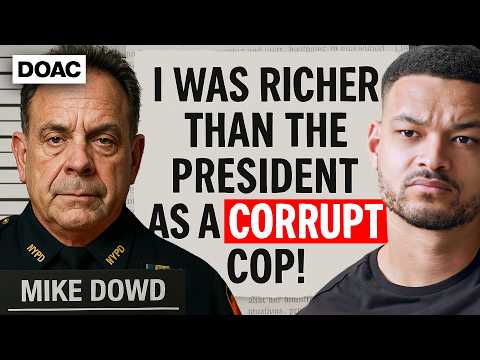
Corrupt Cop: I Had Sex With Girls In My Police Car, Arrested Drug Dealers, Then Sold Their Drugs!
Steven Bartlett (host), Mike Dowd (guest), Carol Dowd (guest), Mike Dowd's father (guest)
In this episode of The Diary of a CEO, featuring Steven Bartlett and Mike Dowd, Corrupt Cop: I Had Sex With Girls In My Police Car, Arrested Drug Dealers, Then Sold Their Drugs! explores america’s Dirtiest Cop Reveals How Power, Greed And Love Collided Former NYPD officer Michael Dowd recounts his descent from a young recruit seeking a paycheck into a central player in New York’s cocaine economy, earning more than the U.S. president while still wearing a badge.
America’s Dirtiest Cop Reveals How Power, Greed And Love Collided
Former NYPD officer Michael Dowd recounts his descent from a young recruit seeking a paycheck into a central player in New York’s cocaine economy, earning more than the U.S. president while still wearing a badge.
He explains how broken incentives, the crack epidemic, and police culture—especially the blue wall of silence and pressure not to arrest—created fertile ground for systemic corruption and his own moral collapse.
Dowd describes robbing and taxing drug dealers, protecting major trafficking organizations, contemplating violent confrontations, and ultimately being arrested, serving over 12 years in prison, and testifying at the Mollen Commission.
The conversation also explores his emotional reckoning: addiction, guilt over a murdered cop, the quiet suffering of his parents, his struggle to rebuild life after prison, and his belief that truth, accountability, and love are the only durable antidotes.
Key Takeaways
Perverse incentives can quietly drive systemic corruption, even among people who don’t enter a job intending to be corrupt.
Dowd explains that crack arrests cost the city huge amounts in overtime and court processing, so officers were explicitly and implicitly discouraged from making arrests. ...
Get the full analysis with uListen AI
Culture and peer dynamics are often stronger than formal ethics training.
Ethics instruction in the academy focused less on right and wrong and more on ‘this is how you’ll get caught and embarrassed. ...
Get the full analysis with uListen AI
Moral erosion tends to be gradual: small compromises open the door to larger ones.
Dowd’s journey starts with a $200 ‘lobster lunch’ traffic shakedown, then pocketing cash at a murder scene, then skimming drugs, then actively trading and protecting large-scale traffickers for $8,000 a week. ...
Get the full analysis with uListen AI
Unchecked double lives create crushing psychological pressure that often ends in collapse or confession.
Even while outwardly swaggering, Dowd describes chronic anxiety, numbness, and using alcohol and drugs to cope with living ‘three different lives’: cop, criminal, husband/father. ...
Get the full analysis with uListen AI
Corruption shatters more than one life; it radiates through families and communities.
The emotional centerpiece of the conversation is his mother describing shock, anger, and 12 years of daily church visits while her son was imprisoned. ...
Get the full analysis with uListen AI
Accountability, even when forced from the outside, can become a turning point toward purpose.
Dowd initially planned to flee the U. ...
Get the full analysis with uListen AI
Truthful, difficult conversations early are less costly than avoiding them.
Reflecting to his sons and younger self, Dowd says it’s always ultimately easier to tell the truth and accept immediate consequences than to maintain lies and live in fear of exposure. ...
Get the full analysis with uListen AI
Notable Quotes
“Being a New York cop was the greatest job in the world, but it's not built for somebody to come in and be the knight in shining armor.”
— Michael Dowd
“If you live by the rules that these guys espouse, you'll never make a successful cop. Just cover your ass.”
— Academy instructor (quoted by Michael Dowd)
“What happens then? You become God. I was making more than the president of the United States by protecting one of the largest drug trafficking organizations in New York.”
— Michael Dowd
“It was the biggest moment of relief… Finally it’s over. I no longer have to live a lie.”
— Michael Dowd, on his first arrest
“If you don't have any bumps in the road of life, you really don't know that much about life.”
— Michael Dowd
Questions Answered in This Episode
You describe feeling both pride and shame about your time as a cop; if you could redesign NYPD’s training and incentive systems today to prevent another ‘Michael Dowd,’ what specific structural changes would you implement first?
Former NYPD officer Michael Dowd recounts his descent from a young recruit seeking a paycheck into a central player in New York’s cocaine economy, earning more than the U. ...
Get the full analysis with uListen AI
When you realized your protection of drug organizations was indirectly connected to Officer Venable’s murder, why didn’t that become the decisive moment you stopped, and what do you think it would have taken for you to actually walk away then?
He explains how broken incentives, the crack epidemic, and police culture—especially the blue wall of silence and pressure not to arrest—created fertile ground for systemic corruption and his own moral collapse.
Get the full analysis with uListen AI
You’ve said street‑level corruption is now largely replaced by ‘top‑level’ budget and power corruption; can you give more concrete examples of how that manifests today and how the public might spot or measure it?
Dowd describes robbing and taxing drug dealers, protecting major trafficking organizations, contemplating violent confrontations, and ultimately being arrested, serving over 12 years in prison, and testifying at the Mollen Commission.
Get the full analysis with uListen AI
Looking back, is there a single conversation—with your wife, your sergeant, or Internal Affairs—that you now wish you’d initiated voluntarily, even though it might have cost you your badge at the time?
The conversation also explores his emotional reckoning: addiction, guilt over a murdered cop, the quiet suffering of his parents, his struggle to rebuild life after prison, and his belief that truth, accountability, and love are the only durable antidotes.
Get the full analysis with uListen AI
You argue that sharing your story has prevented suicides and helped struggling officers; how do you respond to critics who say giving a platform to ‘America’s dirtiest cop’ risks glamorizing corruption or retraumatizing communities harmed by the drug trade?
Get the full analysis with uListen AI
Transcript Preview
(intense music) I've never heard a story like this in my life. (sighs) A story of drug trafficking, bribery, kidnapping, and even murder, which earned you the nickname of America's dirtiest cop, and I want to know everything.
Okay. But let's just be clear, if you choose to have a conversation with me about this, you're gonna hear things that you won't like.
Jesus Christ. (breathes quavily)
Let me just say this, being a New York cop was the greatest job in the world, but it's not built for somebody to come in and be the knight in shining armor. You're working minimal wage, civilians are against you, and you're directly told not to make drug arrests.
Why?
Well, because they got a budget to manage, and the average amount of overtime for one crack arrest was 18 hours. So, that leads to the streets becoming unwieldy. So what happens is a guy like me, who's entrepreneurial spirit shows up and says, "There's a way to control this. I can't arrest them, so I tax them."
And that escalated?
Greed is powerful, bro. (laughs)
But what happens then?
You become God. I was making more than the president of the United States by protecting one of the largest drug trafficking organizations in New York. But I was losing control, and I became the face of New York City's corruption problem. People wanted me dead.
And then in 1992, you were arrested and you admitted to hundreds of crimes. But what about your family at this point?
You know, that was tough. (instrumental music plays) They're really special people.
Mike, we spoke to your parents. Do you want to see what they said?
I'm Carol Dowd, and, uh, I'm Michael Dowd's mother.
This has always blown my mind a little bit, 53% of you that listen to this show regularly haven't yet subscribed to the show. So could I ask you for a favor before we start? If you like this show, and you like what we do here, and you wanna support us, the free simple way that you can do just that is by hitting the subscribe button. And my commitment to you is, if you do that, then I'll do everything in my power, me and my team, to make sure that this show is better for you every single week. We'll listen to your feedback, we'll find the guests that you want me to speak to, and we'll continue to do what we do. Thank you so much. (funky music) Mike, when people do interviews with you, they often describe you as New York's dirtiest cop.
Right.
And I watched that over and over again in your interviews, and I wondered, as I watched people calling you New York's dirtiest cop, how that makes you feel?
(laughs) Not good. Yeah, and that's a touchy subject, and, and, and, and, but I accept it, and I've turned it, uh, into something where I'm able to may- maybe ch- chaperone an audience because of it. But it's not nice to hear that... More importantly, it's not nice for your parents to hear something like that. And thank God they're still alive, but, you know, it's not the happy day when your mother says, sees your name on the front page of the newspaper, I'll tell you that, and f- for nothing good, you know?
Install uListen to search the full transcript and get AI-powered insights
Get Full TranscriptGet more from every podcast
AI summaries, searchable transcripts, and fact-checking. Free forever.
Add to Chrome