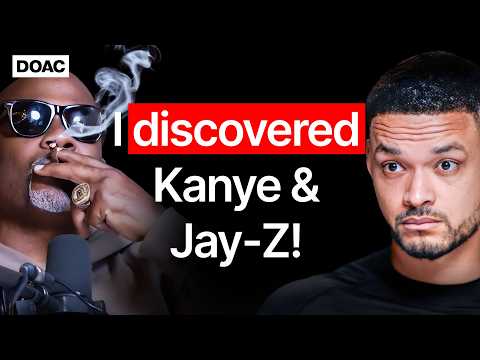
Dame Dash: The Man That DISCOVERED & Built Jay-z & Kanye West! | E192
Dame Dash (guest), Steven Bartlett (host), Narrator, Narrator
In this episode of The Diary of a CEO, featuring Dame Dash and Steven Bartlett, Dame Dash: The Man That DISCOVERED & Built Jay-z & Kanye West! | E192 explores dame Dash On Art, Loss, Roc-A-Fella, And Refusing To Conform Dame Dash recounts his journey from Harlem hustler to co‑founder of Roc‑A‑Fella, framing his life as a relentless pursuit of independence, art, and self‑respect. He explains how early trauma, especially the deaths of his mother and Aaliyah, stripped him of fear and recalibrated his sense of what really matters: health, freedom, love, and creative expression.
Dame Dash On Art, Loss, Roc-A-Fella, And Refusing To Conform
Dame Dash recounts his journey from Harlem hustler to co‑founder of Roc‑A‑Fella, framing his life as a relentless pursuit of independence, art, and self‑respect. He explains how early trauma, especially the deaths of his mother and Aaliyah, stripped him of fear and recalibrated his sense of what really matters: health, freedom, love, and creative expression.
He dissects the music industry’s exploitative structures, why Roc‑A‑Fella succeeded, and how his partnerships with Jay‑Z and Kanye West diverged because of differing values around money, art, and loyalty. Dash argues that society, schooling, and corporate culture are designed to produce obedient workers, not dreamers, and urges people to reclaim their power through ownership and entrepreneurship.
Now identifying primarily as an artist rather than a businessman, Dash describes building films, fashion, books, comics, and Dame Dash Studios independently, fully aware it’s slower and harder than taking corporate money—but, he insists, far more fulfilling. The conversation is underpinned by his insistence on honor, his distrust of traditional authority, and his belief that dreaming big and acting fearlessly are non‑negotiable.
Key Takeaways
Radical indifference to others’ judgment can be a powerful psychological shield.
At age four, Dame decided he would never feel embarrassed again after a nursery‑school incident. ...
Get the full analysis with uListen AI
Early trauma can destroy fear and clarify what counts as a ‘real’ problem.
Losing his mother at 16 and later Aaliyah made Dame “fearless”; death became his benchmark for hardship. ...
Get the full analysis with uListen AI
Ownership and partnership models can protect artists from exploitative industry norms.
Dash lays out how standard label deals exchange an advance for ownership and 8–10% royalties on an artist’s own work, which he calls logically absurd and emasculating (“I’m signed to another man”). ...
Get the full analysis with uListen AI
Roc‑A‑Fella’s success came from uncompromised belief and doing it independently when gatekeepers said no.
Every label passed on Jay‑Z—too old, rapped too fast—so Dame built Roc‑A‑Fella himself. ...
Get the full analysis with uListen AI
Artistic integrity often conflicts with corporate money, and choosing art slows the path but deepens fulfillment.
Dame contrasts two paths: exploiting artists for maximum profit versus empowering them and becoming an artist himself. ...
Get the full analysis with uListen AI
Systems of schooling, credit, and incarceration are, in his view, designed to produce controlled workers, not sovereign thinkers.
Dash argues school, jail, and hospitals visually and structurally resemble each other because they’re all instruments of control. ...
Get the full analysis with uListen AI
Grief, therapy, and parenting forced him to redefine strength and how he shows up for his children.
Therapy—initially court‑ordered and later voluntary—helped him separate street survival reactions from healthy responses, especially with his kids. ...
Get the full analysis with uListen AI
Notable Quotes
“My first real memory is saying at four years old, ‘I’m never gonna feel embarrassed again. Ever.’”
— Dame Dash
“You’re gonna give me an advance, I’m gonna give you all the rights to my records and then you’re gonna give me 10% of my art. That just didn’t make sense to me.”
— Dame Dash
“If somebody told you that you couldn’t sell companies and do the things that you did, to them it’s superhero shit. I know I’m a superhero.”
— Dame Dash
“When my moms died, I didn’t really care if I died, because I’d be like, ‘I’d be with my moms.’ I had no fear of anything at that point.”
— Dame Dash
“Money is man‑made. Real currency is love, and that’s God‑made. I’m going with God’s currency every time.”
— Dame Dash
Questions Answered in This Episode
You described therapy as needing to be ‘in the right language’ for Black trauma—what specifically do you think mainstream therapy gets wrong about Black male experiences, and how does your Healing is Gangster model address that?
Dame Dash recounts his journey from Harlem hustler to co‑founder of Roc‑A‑Fella, framing his life as a relentless pursuit of independence, art, and self‑respect. ...
Get the full analysis with uListen AI
Looking back at the dinner where Jay‑Z told you he’d take Def Jam’s presidency without you and Biggs, what concrete legal or structural protections would you now advise young founders to put in place so they don’t get sidelined in their own companies?
He dissects the music industry’s exploitative structures, why Roc‑A‑Fella succeeded, and how his partnerships with Jay‑Z and Kanye West diverged because of differing values around money, art, and loyalty. ...
Get the full analysis with uListen AI
You argue school, prisons, and hospitals are all part of a control system; if you bought a school tomorrow, what would the first year’s curriculum and daily experience look like in practical terms for a 10‑year‑old?
Now identifying primarily as an artist rather than a businessman, Dash describes building films, fashion, books, comics, and Dame Dash Studios independently, fully aware it’s slower and harder than taking corporate money—but, he insists, far more fulfilling. ...
Get the full analysis with uListen AI
You often say you chose art over ‘billions and billions’—can you name a specific opportunity you walked away from because it compromised your artistic or moral standards, and what the immediate financial upside would have been?
Get the full analysis with uListen AI
You insist on honoring your word even when it’s inconvenient, yet you also admit you trust virtually no one—how do you stop that deep mistrust from hardening into paranoia or isolation, especially when building large, diverse teams?
Get the full analysis with uListen AI
Transcript Preview
Kanye's whole thing is "I don't give a fuck." Art is something that you really fight for if you love it, even if your message is misunderstood.
Like White Lives Matter?
He's an artist that likes war. (instrumental music)
Oh!
Dave Dash in the fucking buildin'!
One of the founders of Roc-A-Fella, Rocawear. He discovered Jay-Z, Kanye West, and so many others. One of the biggest pioneers in hip-hop.
I took Jay-Z and shopped him to every single label and they all said no. (record scratching) I had to do it myself.
I really want to understand why Roc-A-Fella won.
I did partnerships with my artists. "I'm giving you all the rights to my records, my art, and then you're gonna give me 10% of my art." That just didn't make sense to me.
That whole stint of your career, the Roc-A-Fella chapter, do you have any regrets surrounding that when you look back?
I, I wouldn't, I wouldn't have been so generous with Jay. It was more friendship for me and money for him, but he did things that I thought he would never do.
What are those?
I'm just saying this. Let me just say this. (record scratching)
What was the hardest moment in your life?
When Aaliyah died. That breaks my heart.
Singer/actress Aaliyah is killed in a plane crash. I tried to play out what that would feel like for me.
Don't, don't do it. You don't wanna, you don't wanna go there. It's a, it's a pain that you don't, couldn't understand. (instrumental music)
Before this episode begins, I just wanna say a huge thank you to all of our new subscribers. 74% of you that watch this channel didn't subscribe before, and we're now down to about 71%. So, that helps us in a number of ways that are quite hard to explain, but simply, the bigger the channel gets, the bigger the guests get. So if you haven't yet subscribed to The Diary of a CEO, if I could have any favors from you, if you've ever watched this show and enjoyed it, it's just to, to please hit the subscribe button. Without further ado, I'm Steven Bartlett, and this is The Diary of a CEO. I hope nobody's listening, but if you are, then please keep this to yourself. (instrumental music) Dame, I always believe that in order to understand a man you have to understand their earliest context, because as childhood psychology often asserts, that's really when, um, our character and our, our shape is formed. So can you take me back to your earliest context, the context that's most relevant to who you went on to become in your life back in Harlem, um, on 109th & 1st Street?
My first, like, real memory of who I am is I remember being, like, four, and I was in nursery school, and the teacher yelled at me, or I got in trouble, and I felt embarrassed. I felt uncomfortable. And I remember saying to myself at, as a four-year-old, "I'm never gonna feel embarrassed again. Ever." I didn't like the way it felt. You know like when Fred Flintstone used to get yelled at and he'd start shrinking? And I just was like, "I'm never gonna put myself in a position to let any adult, teacher, whatever... I'm never gonna be embarrassed." I just hated that. I remember not liking that feeling. And I think that was the last time I felt it. Pause.
Install uListen to search the full transcript and get AI-powered insights
Get Full TranscriptGet more from every podcast
AI summaries, searchable transcripts, and fact-checking. Free forever.
Add to Chrome