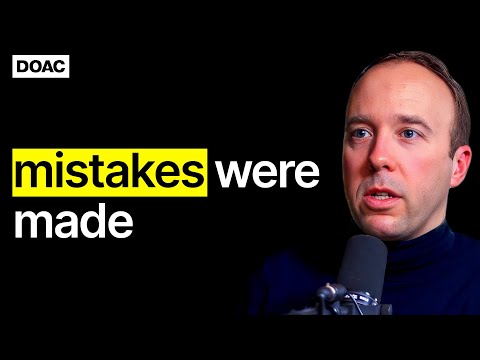
Matt Hancock: Opens Up About His Affair, Mistakes & The Pandemic | E121
Matt Hancock (guest), Steven Bartlett (host), Narrator
In this episode of The Diary of a CEO, featuring Matt Hancock and Steven Bartlett, Matt Hancock: Opens Up About His Affair, Mistakes & The Pandemic | E121 explores matt Hancock Confronts Pandemic Decisions, Power, Privilege, Love, And Failure Former UK Health Secretary Matt Hancock joins Stephen Bartlett to dissect his upbringing, political career, and his leadership during COVID-19, including contested decisions and admitted mistakes.
Matt Hancock Confronts Pandemic Decisions, Power, Privilege, Love, And Failure
Former UK Health Secretary Matt Hancock joins Stephen Bartlett to dissect his upbringing, political career, and his leadership during COVID-19, including contested decisions and admitted mistakes.
He explains how democratic politics relies on ministers as ‘representatives among experts’, defends and critiques key pandemic choices—from lockdown timing to care homes and vaccines—and reflects on the emotional and ethical weight of those calls.
Hancock also addresses the affair that led to his resignation, describing it as falling in love rather than hypocrisy, while accepting responsibility for breaking his own distancing guidance.
Now on the back benches, he is refocusing on campaigns like dyslexia identification and argues for a more empathetic, emotionally honest style of politics.
Key Takeaways
Ministers are meant to be ‘representatives among experts’, not technical masters.
Hancock argues that the job of a minister in areas like digital or health is not to be the foremost expert but to synthesize expert advice, weigh societal trade‑offs, and make democratically accountable decisions. ...
Get the full analysis with uListen AI
Early COVID decisions were made under extreme data scarcity, leading to serious misjudgments.
He describes January–March 2020 as a period of ‘total paucity of data’: no mass testing, incomplete understanding of symptoms, unknown infection fatality rates, and no reliable serology. ...
Get the full analysis with uListen AI
Care‑home policy failures came more from staff movement and late learning than hospital discharges.
Hancock disputes the popular narrative that mass hospital discharges seeded outbreaks in care homes, citing later analysis that only ~2% of infections came via that route and that discharged patients were supposed to isolate. ...
Get the full analysis with uListen AI
Belief in vaccines shaped the UK’s long‑term COVID strategy and risk appetite.
From late January 2020, Hancock says he and Jonathan Van‑Tam set an internal ‘mission’ to have a vaccine by Christmas, despite WHO scepticism and historical timelines of 5–10 years. ...
Get the full analysis with uListen AI
Hancock sees his affair as falling in love but accepts the charge of contradiction.
He rejects the framing of ‘casual sex’, insisting he ‘fell in love’ with longtime acquaintance and adviser Gina Coladangelo after working closely during the pandemic. ...
Get the full analysis with uListen AI
Emotional honesty and vulnerability are increasingly critical to public trust in politicians.
Hancock admits he too often defaulted to ‘alpha male’ defensiveness and political language, especially under hostile questioning, which made him appear like an ‘emotionless robot’. ...
Get the full analysis with uListen AI
His post‑cabinet focus is on dyslexia and structural educational change.
Identified as dyslexic only at university, Hancock recalls labelling himself ‘stupid’ at school due to undiagnosed difficulties. ...
Get the full analysis with uListen AI
Notable Quotes
“My job was not to be the expert. It was to be the people’s representative among the experts.”
— Matt Hancock
“I feel sad that the performance in the first half was not as good as it could have been, and pleased that we learned quite a few things and did better the second time round.”
— Matt Hancock
“We were constantly questioning ourselves… in hindsight some of it looks like hard and fast, obvious decisions. They weren’t obvious at all.”
— Matt Hancock
“I broke the guidance. I fell in love with somebody. There are only two people responsible for this, and ultimately that’s why I resigned.”
— Matt Hancock
“Maybe as politicians we try to hold it together too often. I should have just been more relaxed about showing the emotion.”
— Matt Hancock
Questions Answered in This Episode
Looking back now with even more distance, would you support formal, pre‑agreed ‘tripwire’ metrics (e.g., ICU occupancy, case growth thresholds) that automatically trigger restrictions in a future pandemic to avoid the kind of contested, delayed lockdown decisions you describe?
Former UK Health Secretary Matt Hancock joins Stephen Bartlett to dissect his upbringing, political career, and his leadership during COVID-19, including contested decisions and admitted mistakes.
Get the full analysis with uListen AI
You argue hospital discharges played a minimal role in care‑home outbreaks compared with staff movement; what precise data and methodological approach underpin that 2% figure, and should that evidence change how we talk about accountability for care‑home deaths?
He explains how democratic politics relies on ministers as ‘representatives among experts’, defends and critiques key pandemic choices—from lockdown timing to care homes and vaccines—and reflects on the emotional and ethical weight of those calls.
Get the full analysis with uListen AI
You describe your belief in a rapid vaccine as partly ‘faith’—how do you think policymakers should balance optimistic bets on innovation against the precautionary principle when millions of lives and livelihoods are at stake?
Hancock also addresses the affair that led to his resignation, describing it as falling in love rather than hypocrisy, while accepting responsibility for breaking his own distancing guidance.
Get the full analysis with uListen AI
Given your own experience of appearing ‘robotic’ under hostile questioning, what specific structural changes—e.g., interview formats, select committee practices, media training norms—would you introduce to make it safer for ministers to show genuine doubt and emotion without being punished for it?
Now on the back benches, he is refocusing on campaigns like dyslexia identification and argues for a more empathetic, emotionally honest style of politics.
Get the full analysis with uListen AI
You’ve made the case for non‑experts leading departments as democratic representatives; in hindsight, are there any decisions in health or digital where you now think a more technocratic model—putting a domain expert formally in charge—would have produced a better outcome, and why?
Get the full analysis with uListen AI
Transcript Preview
One of the reasons I wanted to come in and talk to you was because I want to just talk freely.
How does that all feel for you personally, that thought that one week earlier we could've saved 21,000 lives?
There were some mistakes that we made in terms of the measures-
Yeah.
... how they were brought in. Well, now you see, Stephen, you're getting into gotcha questions.
No, I genuinely-
It's just all total rubbish.
No, no.
I'm not gonna-
No. I've not even asked the question yet. There needs to be boundaries. You want to get-
No. No. No. Those rules-
Yeah.
... were not in place.
Can I ask the question?
You can ask a question.
I'm gonna ask the question, yeah.
Okay. This, this bit is really hard for me.
People say you, you are a contradiction.
Yeah.
What's your response to that?
(exhales) (instrumental music plays)
Could you do me a quick favor if you're listening to this? Please hit the Follow or Subscribe button. It helps more than you know, and we invite subscribers in every month to watch the show in person. When I started The Diary of a CEO, I wanted to create a platform where we get to see behind the scenes, where we get the truth, where we get the context. That is at least my attempt. The rest of it is up to the viewer to decide what they make of the conversation and what they take from the conversation, and the same applies to this episode. So without further ado, I'm Stephen Bartlett, and this is The Diary of a CEO. I hope nobody's listening, but if you are, then please keep this to yourself. (instrumental music plays) Matt, I was really, really keen to have you come and join me in my, in my kitchen here in, in London to talk in a, a long form way about a ton of different things that are front of mind for you that have gone on over the last couple of years. I think, you know, usually, and you've listened to this podcast before, so you know-
Yeah.
... I typically start about... with childhood and all those things, which I will get onto. But the question that was really front of mind for me-
Yeah.
... and I think will be for a lot of people is, why did you wanna have this conversation here?
Hmm. Well, uh, I love your podcast. One of the reasons I love it is 'cause I think what you manage to do is you manage to get people to be really, um, really honest about themselves, right? One of the things I admire about the podcast is that, um, it's important that we have a space where people can talk about where things go well and where people have failed and what they've learned from that. And you're so, um, sort of brutally honest with yourself about it, and you really put that on the line. And that in turn gets it out of other people.
Install uListen to search the full transcript and get AI-powered insights
Get Full TranscriptGet more from every podcast
AI summaries, searchable transcripts, and fact-checking. Free forever.
Add to Chrome