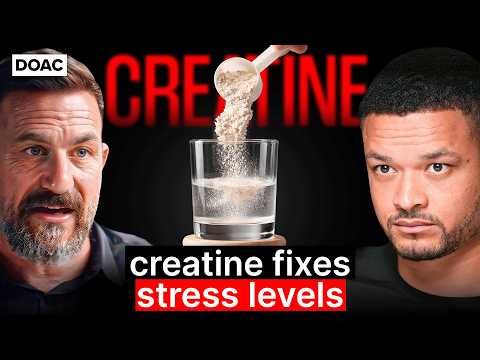
THIS Is The Fastest Way To Get Dementia...The 6 Science-Backed Brain Fixes!
Steven Bartlett (host), Dr Wendy Suzuki (guest), Dr Rhonda Patrick (guest), Andrew Huberman (guest), Dr Nathan Bryan (guest), Dr Daniel Amen (guest), Simon Mills (guest)
In this episode of The Diary of a CEO, featuring Steven Bartlett and Dr Wendy Suzuki, THIS Is The Fastest Way To Get Dementia...The 6 Science-Backed Brain Fixes! explores six science-backed habits to protect your brain and prevent dementia The episode compiles top neuroscientist interviews to outline how everyday behaviors shape long-term brain health, dementia risk, and cognitive performance. Core themes include exercise, sleep, diet, social connection, targeted supplements, and neuroplasticity. Guests explain how aerobic movement, quality sleep, Mediterranean-style eating, and strong relationships biologically grow and protect key brain regions. They also explore emerging evidence for creatine, nitric oxide support, and plant compounds, and emphasize that adults can rewire their brains at any age through focused learning and rest.
Six science-backed habits to protect your brain and prevent dementia
The episode compiles top neuroscientist interviews to outline how everyday behaviors shape long-term brain health, dementia risk, and cognitive performance. Core themes include exercise, sleep, diet, social connection, targeted supplements, and neuroplasticity. Guests explain how aerobic movement, quality sleep, Mediterranean-style eating, and strong relationships biologically grow and protect key brain regions. They also explore emerging evidence for creatine, nitric oxide support, and plant compounds, and emphasize that adults can rewire their brains at any age through focused learning and rest.
Key Takeaways
Prioritize regular aerobic exercise to grow and protect your brain.
Research shows 2–3 weekly 45-minute aerobic sessions improve mood, memory, and attention in low-fit people, and in fitter people, every additional workout produces measurable gains in hippocampal and prefrontal function—“every drop of sweat counts.”
Get the full analysis with uListen AI
Treat sufficient, consistent sleep as non-negotiable brain maintenance.
During sleep, the hippocampus consolidates memories and cerebrospinal fluid clears metabolic “garbage”; chronic sleep loss leads to “gunky” brains, impaired memory, and increased risk of neurodegeneration.
Get the full analysis with uListen AI
Adopt a Mediterranean-style, low-sugar diet to support vascular and brain health.
Colorful, minimally processed plant foods and healthy fats correlate with better cognition, while high sugar and refined carbs damage nitric oxide pathways, stiffen blood vessels, and drive diabetes, heart disease, and dementia risk.
Get the full analysis with uListen AI
Invest in social connections to extend lifespan and reduce dementia risk.
Frequent social interaction—from close relationships to simple daily greetings—predicts greater happiness, longer life, and better brain health; chronic loneliness creates toxic stress that shrinks and ages the brain.
Get the full analysis with uListen AI
Use targeted brain-supportive habits and compounds under stress.
Creatine (especially 10–20g in stressed or sleep-deprived states), green tea, turmeric/curcumin, rosemary, ginkgo, and high-cocoa dark chocolate all show evidence for improving blood flow, energy metabolism, inflammation, mood, and cognitive performance, especially when the brain is under load.
Get the full analysis with uListen AI
Leverage neuroplasticity by combining focused attention with rest and movement.
Adults can change their brains at any age, but need alert, focused engagement with what they want to learn, often paired with movement, followed by sleep or deep rest to consolidate those neural changes.
Get the full analysis with uListen AI
Avoid chronic sedentary behavior, toxic environments, and unchecked stress.
Sitting too much, chronic social media comparison, noisy environments, microplastics, work with constant stress or “assholes,” and unchecked cortisol all erode hippocampal volume, raise dementia risk, and impair day-to-day thinking.
Get the full analysis with uListen AI
Notable Quotes
“Every drop of sweat counts for building your brain into the big, fat, fluffy brain that you really want.”
— Neuroscientist guest on exercise and brain health
“You absolutely can change your brain, but you have to pay attention to the thing you want to incorporate into your brain—and then you absolutely have to go get some rest.”
— Neuroscientist guest on neuroplasticity
“Loneliness on the flip side causes stress, long-term stress that damages the brain and, in the long term, can make it smaller and less healthy.”
— Neuroscientist guest on social connection
“This simple molecule, nitric oxide gas, I'm absolutely convinced will eradicate and cure Alzheimer's—because it addresses every physiological root cause of Alzheimer's.”
— Nitric oxide researcher guest
“Cocoa, chocolate, dark chocolate is a medicine, end of.”
— Nutrition and brain-health expert guest
Questions Answered in This Episode
Which of my current daily habits most closely resemble the “fastest way to get dementia,” and what is the single most impactful change I should make first?
The episode compiles top neuroscientist interviews to outline how everyday behaviors shape long-term brain health, dementia risk, and cognitive performance. ...
Get the full analysis with uListen AI
How should an average, moderately active adult practically dose and time creatine if the goal is brain performance rather than muscle gain?
Get the full analysis with uListen AI
If nitric oxide is so central to vascular and brain health, what specific tests or markers can I use to know if I’m deficient and whether an intervention is working?
Get the full analysis with uListen AI
How can I deliberately design my week to maximize neuroplasticity—combining focused learning, movement, and sleep—in a realistic way alongside work and family?
Get the full analysis with uListen AI
Given the evidence for plant compounds like green tea, turmeric, rosemary, and dark chocolate, what would an optimal, brain-focused daily food and drink routine actually look like?
Get the full analysis with uListen AI
Transcript Preview
(upbeat music) I think everybody needs to listen to this episode if they wanna start 2026 properly. If there's one thing I've learned that's really stayed with me this year, it's from speaking to some of the world's leading minds about our brain, which might just be the most powerful asset that we all have. And if you listen to The Diary of a CEO, you're probably listening because you're trying to get something, whether it's information, inspiration, maybe entertainment, all of which because you're striving towards some kind of goal. And it's dawned on me this year, because I've interviewed so many incredible neuroscientists, that this all starts with having a healthy brain. Because all of our thoughts, our feelings, our relationships, our memories, our chance of having a future, start in the brain. So in this special Christmas episode, we're gonna focus on the brain, how you can have the most fundamentally healthy brain so you can live the most fundamentally meaningful life. I've been through all the episodes where we've talked about the brain, and I've looked at the moments that you shared and replayed the most, and the moments that added the most value to your life. And I've put all of them into this episode today. (upbeat music) Do you remember the first time you saw a human brain?
I do.
Did it change how you think about your own brain?
It changed my life because I was like, "I wanna study that. That is the coolest thing that I've ever seen in my whole life." It was life-changing.
I say that because we, you know, at the start of this conversation, we said that most of us don't appreciate our brain. A lot of people don't even realize it's there, but-
Yeah.
... the minute I had a brain scan one day-
Mm.
And that brain scan really changed my life, because seeing my own brain for the first time-
Yeah.
... it was the push that I needed to start caring more about how my decisions and behaviors are impacting it. So let's talk about how I can make that ball of tofu in my head super healthy-
Yeah.
... super big, fat and fluffy.
Right.
You, you talked about exercise early on-
Mm-hmm.
... but we didn't really dig, dig into exactly what you mean by exercise, 'cause exercise, I think, is multifaceted in its definition.
Yeah.
What kind of exercise should I be doing to make my ball of tofu in my head great?
Yeah.
Optimal?
Mm-hmm. Well, all the research shows that the best kind of exercise that you can do is anything that gives you aerobic activity, that is getting your heart rate up. So that, that goes for, you know, power walking will get your heart rate up, soccer, so many different things. Name your activity. So many people wanna say, "Oh, well, uh, my favorite activity, will that work?" And I always just say, "Is it, is your heart rate up when you're doing it?" If the answer is yes, then yeah, that, that works great. We know that that level of aerobic activity is critical, 'cause that's gonna release that growth factor maximally to get into your hippocampus, uh, that will grow those new brain cells.
Install uListen to search the full transcript and get AI-powered insights
Get Full TranscriptGet more from every podcast
AI summaries, searchable transcripts, and fact-checking. Free forever.
Add to Chrome