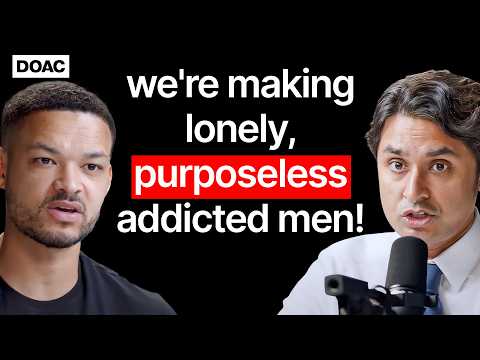
Dr K: We Are Producing Millions Of Lonely, Addicted, Purposeless Men & Women!
Dr. K (Alok Kanojia) (guest), Steven Bartlett (host), Narrator
In this episode of The Diary of a CEO, featuring Dr. K (Alok Kanojia) and Steven Bartlett, Dr K: We Are Producing Millions Of Lonely, Addicted, Purposeless Men & Women! explores inside-Out Healing: Dr K On Trauma, Love, Purpose And Peace Harvard-trained psychiatrist and former monk Dr. K (Alok Kanojia) explains why modern life is producing lonely, addicted, externally-driven people and how healing starts with deeply understanding oneself rather than chasing quick fixes. He blends neuroscience and Eastern spirituality to show how trauma, dopamine overuse, technology, and social conditioning distort motivation, relationships, and identity.
Inside-Out Healing: Dr K On Trauma, Love, Purpose And Peace
Harvard-trained psychiatrist and former monk Dr. K (Alok Kanojia) explains why modern life is producing lonely, addicted, externally-driven people and how healing starts with deeply understanding oneself rather than chasing quick fixes. He blends neuroscience and Eastern spirituality to show how trauma, dopamine overuse, technology, and social conditioning distort motivation, relationships, and identity.
He argues that most self-help is “toxic fuel” built on shame, and that real change comes from awareness, emotional processing, and rebuilding one’s internal narrative, not from more tactics, habits, or productivity hacks. The conversation ranges from men’s and women’s mental health to the neuroscience of attraction and sex, the impact of devices on love and social skills, and how yoga and stillness can rewire trauma.
Ultimately, Dr. K claims our true “purpose” is inner peace, and that a rich life is not about better goals or higher status, but about learning to simply be, respond to life without baggage, and live from the inside out rather than the outside in.
Key Takeaways
Stop jumping to solutions; start with honest self-understanding.
Most people respond to discomfort by immediately trying to change externals—more money, more status, better looks—without asking, “Why am I the way I am? ...
Get the full analysis with uListen AI
Information without experience creates self-help junkies who don’t change.
The brain evolved for efficiency and will choose easy pseudo-progress over hard action. ...
Get the full analysis with uListen AI
Venting can keep you stuck by draining the energy needed to change.
Negative emotions exist to signal danger and drive corrective action; the amygdala is wired tightly to learning and memory. ...
Get the full analysis with uListen AI
Trauma shifts you from future-building to survival mode, crippling self-starting.
Growing up in chaotic, abusive, or overly controlling environments teaches children that planning for the future is pointless or punished. ...
Get the full analysis with uListen AI
Dopamine-chasing destroys contentment, love, and sexual connection.
Dopamine drives pleasure and reinforcement but not fulfillment; it quickly builds tolerance, pushing people toward more extreme stimulation (social media, gaming, porn, thrill-seeking) for diminishing returns. ...
Get the full analysis with uListen AI
Technology is rusting our social brain and amplifying insecurity and narcissism.
Human communication is mostly nonverbal—tone, posture, micro-expressions—but text-based interaction deconditions those circuits. ...
Get the full analysis with uListen AI
Awareness—not more habits, hacks, or goals—is the core lever of change.
Automatic habits and compulsions live in different neural systems than conscious awareness. ...
Get the full analysis with uListen AI
Notable Quotes
“No amount of building something good will remove something bad. If I give you a glass of water, and then I piss in it, and then I add sugar, it doesn’t remove the piss.”
— Dr. K
“There are two kinds of people in life. There are people who have plans and goals and work towards those goals, and then there are the rest of us… whose default state, if you let me do what I want to do, is I’m gonna do nothing.”
— Dr. K
“Confidence doesn’t come from success, it comes from surviving failure.”
— Dr. K
“You don’t need habits, you don’t need willpower, you don’t need discipline. All you need is awareness.”
— Dr. K
“Purpose is an attitude, it’s not a thing you find.”
— Dr. K
Questions Answered in This Episode
You argued that talking about problems can make them worse unless there’s emotional catharsis. How can someone in everyday life (without a trained therapist) distinguish between healthy processing and unhelpful venting when they talk to friends or partners?
Harvard-trained psychiatrist and former monk Dr. ...
Get the full analysis with uListen AI
For people who recognise themselves in your 'toxic fuel' description—highly successful but driven by panic or shame—what are the earliest concrete signs that their drive is starting to shift from trauma-driven to genuinely healthy motivation?
He argues that most self-help is “toxic fuel” built on shame, and that real change comes from awareness, emotional processing, and rebuilding one’s internal narrative, not from more tactics, habits, or productivity hacks. ...
Get the full analysis with uListen AI
You linked dopamine exhaustion from phones, games, and porn to difficulty feeling attraction and falling in love. If someone is already deep into those habits, what specific 4–6 week protocol would you recommend to reset their dopaminergic system while still living a normal modern life?
Ultimately, Dr. ...
Get the full analysis with uListen AI
You suggested that a quarter-life crisis requires mentally checking out and creating space from one’s current path, yet many people are financially trapped in jobs they dislike. How can someone safely create the 'distance' you describe—psychological or physical—without blowing up their life or responsibilities?
Get the full analysis with uListen AI
You claim that awareness alone can dismantle habits because it recruits different brain regions than autopilot. What would a rigorous 'awareness training program' look like over 30–60 days—beyond just sitting still—that could convincingly demonstrate to a skeptical, results-oriented person that this actually works?
Get the full analysis with uListen AI
Transcript Preview
This is the whole problem that everyone makes. Any time we have a problem, the first thing that we do is we try to jump to a solution. If I'm unhappy in life, I need to make more money. If I'm struggling with dating, I need to be sexier. It's a concept that I call toxic fuel, and that will never work because if I give you a glass of water, and then I piss in it, and then I add sugar, it doesn't remove the piss, because no amount of building something good will remove something bad. In order to change behavior, what you need to do is-
Say (censored) to you. Dr. K is the Harvard-trained psychiatrist and former monk specializing in modern mental health-
Blending neuroscience with real-life wisdom to help millions of people unlock their true potential. There's a loneliness epidemic. Social anxiety is increasing, and falling in love seems harder, but we have all the answers. The problem is that everyone is doing the wrong things now. First of all, talking about our problems can absolutely make things worse because there's a particular way we have to talk, but we're not taught how to do that. The second thing is that we are struggling to fall in love, and that's actually because we're exhausting our dopamine through things like devices. Yeah. People don't realize. And then the rise in social anxiety is because everyone is texting. So the parts of our brain that reassure us in social situations are starting to rust. So there are core things that we have to start doing. So the first is that-
Dr. K, why don't people achieve their goals?
Now, this is really interesting. There are two kinds of people in life. There are people who are like, "I'm gonna advance towards my goals," and then there are the rest of us, who are like, "You know, I'm trying to be like these people who are productive, but I'm gonna do nothing." And trauma is the big difference here.
Really?
Yeah. And this is what tends to happen. So-
Question. If you could sit at a table with any four guests from The Diary of a CEO, who would you choose? Here's a challenge for the entire Diary of a CEO community. If we hit 10 million subscribers by the end of 2024, you will get to pick four guests for your dream conversation, and you can make it weird or you can make it wonderful. And here is the best part. 3,000 of you that subscribe will be invited to join this conversation live, in person, and for free. Subscribe now, and let's make this happen together. (instrumental music) Dr. K, if you had to summarize what you do for people, professionally, how would you summarize it?
I help them understand themselves.
And now expand for me-
(laughs)
... what that means. (laughs)
Yeah. So, so here's the thing, right? So there are two great traditions that have taught us about how humans work. One tradition is spirituality, which we've had for a couple thousand years. The other tradition is science, which we've seen an explosion of, especially in the fields of like neuroscience and psychiatry over the last 20 years. And so these are the two places that human beings learn about themselves. So when I work with someone, what I try to do is draw on both of those traditions, and I especially focus on the area of spirituality that has scientific verification and teach people like how they work. So in the same way that if we think about like, you know, when you buy a car, you have like a manual that is in the glove b- compartment that tells you what everything is and how it works. The problem is that in life, like we don't have that manual for ourselves, but we do have these two great traditions that can teach us so much about this stuff. And so what I try to do is basically translate those two traditions to an individual, the situation they face, the challenges they face, and the goals that they want to achieve.
Install uListen to search the full transcript and get AI-powered insights
Get Full TranscriptGet more from every podcast
AI summaries, searchable transcripts, and fact-checking. Free forever.
Add to Chrome