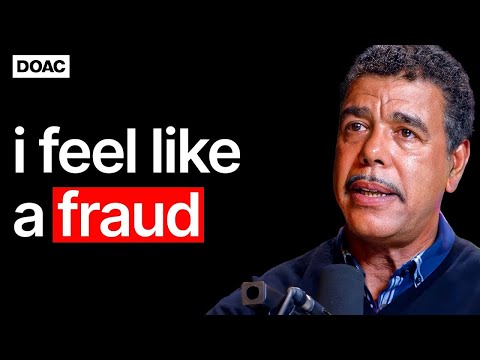
Chris Kamara: The Untold Heartbreaking Story Of A Football Legend!
Chris Kamara (guest), Steven Bartlett (host), Steven Bartlett (host), Steven Bartlett (host)
In this episode of The Diary of a CEO, featuring Chris Kamara and Steven Bartlett, Chris Kamara: The Untold Heartbreaking Story Of A Football Legend! explores chris Kamara Reveals Hidden Battles Behind A Beloved Football Icon Chris Kamara shares a deeply personal story spanning childhood racism, domestic violence at home, poverty, and his improbable rise from Navy recruit to professional footballer and iconic broadcaster.
Chris Kamara Reveals Hidden Battles Behind A Beloved Football Icon
Chris Kamara shares a deeply personal story spanning childhood racism, domestic violence at home, poverty, and his improbable rise from Navy recruit to professional footballer and iconic broadcaster.
He reflects on his parents’ complex legacy, particularly his father’s gambling and violence and his mother’s loyalty and resilience, and how those experiences shaped his approach to work, parenting, and dealing with racism.
Kamara details his recent health struggles with an underactive thyroid and apraxia of speech, the fear of losing his broadcasting identity, and the intense anxiety and impostor feelings that followed.
Despite everything, he remains focused on family, treatment, and using his visibility to inspire others facing illness or discrimination, seeing this new chapter as a different kind of mission.
Key Takeaways
Systemic racism and domestic instability can coexist with love and still forge resilience.
Growing up as the only Black family on their estate in 1960s Middlesbrough, Kamara’s family endured police suspicion, racist abuse, and poverty driven in part by his father’s gambling. ...
Get the full analysis with uListen AI
Racism leaves indelible memories that can shape behavior for decades.
Kamara can recall in vivid detail the first overtly racist incident at age eight in a corner shop, and later episodes such as being spat on at Millwall throw‑ins and being refused service in a Wetherby pub. ...
Get the full analysis with uListen AI
A single opportunity, combined with preparation, can radically alter a life trajectory.
Forced into the Navy against his will, Kamara persisted in chasing football. ...
Get the full analysis with uListen AI
Health conditions that affect communication can devastate identity, particularly for public figures.
Kamara describes his underactive thyroid and apraxia as turning his 300‑mph ‘motor mouth’ into someone he barely recognizes on screen. ...
Get the full analysis with uListen AI
Early, persistent investigation and holistic treatment can significantly improve complex neurological conditions.
After nearly 20 months of misattributing symptoms to general ill‑health, Kamara finally received the thyroid diagnosis, then apraxia, after brain scans ruled out stroke and Parkinson’s. ...
Get the full analysis with uListen AI
Impostor feelings can persist even when others clearly still value your contribution.
Kamara repeatedly says he feels “a fraud” on air, convinced producers and audiences are just “tolerating” him and that he’s tarnishing his legacy after Sky’s emotional farewell tribute. ...
Get the full analysis with uListen AI
Purpose evolves: from personal achievement to service, family, and representation.
As a child, Kamara’s singular ambition was to play for Middlesbrough and Leeds, which he eventually did, describing it as his greatest joy outside of having children. ...
Get the full analysis with uListen AI
Notable Quotes
“Every day I wake up, the first thing I think, 'Am I gonna be able to talk today?'”
— Chris Kamara
“I feel a fraud now in terms of broadcasting.”
— Chris Kamara
“As a young Black kid... ambition to play for Boro, dream to play for Leeds. Ambition and dream achieved.”
— Chris Kamara
“You did TV before diversity… you’re a trailblazer. You’re an icon.”
— Yung Filly (recounted by Chris Kamara)
“My mum was everything you could want in a mom… she was my world.”
— Chris Kamara
Questions Answered in This Episode
Looking back now, do you still wish you’d confronted your dad about the violence, or would you genuinely choose to stay silent on his deathbed if you could relive that moment?
Chris Kamara shares a deeply personal story spanning childhood racism, domestic violence at home, poverty, and his improbable rise from Navy recruit to professional footballer and iconic broadcaster.
Get the full analysis with uListen AI
How do you think your life and personality would have been different if your father had allowed you to join Middlesbrough instead of forcing you into the Navy?
He reflects on his parents’ complex legacy, particularly his father’s gambling and violence and his mother’s loyalty and resilience, and how those experiences shaped his approach to work, parenting, and dealing with racism.
Get the full analysis with uListen AI
You’ve described apraxia as feeling like someone else has taken over your voice box—are there specific triggers, environments, or emotions you’ve noticed that reliably make your speech better or worse?
Kamara details his recent health struggles with an underactive thyroid and apraxia of speech, the fear of losing his broadcasting identity, and the intense anxiety and impostor feelings that followed.
Get the full analysis with uListen AI
Given your father’s advice to ‘never react’ to racism, if a young Black player today came to you describing similar abuse, would you still give them the same advice—or something different?
Despite everything, he remains focused on family, treatment, and using his visibility to inspire others facing illness or discrimination, seeing this new chapter as a different kind of mission.
Get the full analysis with uListen AI
You worry about ‘tarnishing’ your legacy by staying on screen; what concrete signs—from viewers, colleagues, or your own feelings—would tell you it’s truly time to step back versus keep going?
Get the full analysis with uListen AI
Transcript Preview
Every day I wake up, the first thing I think, "Am I gonna be able to talk today?" There's been a red card, but for who, Chris Kamara? I don't know, Geoff Hazlett. One of Britain's best-loved football pundits- (buzzer) It's been a cracker, Geoff. You beauty! (laughs) Unbelievable, Geoff. What a cracking game! As a young Black kid, thinking that one day I'll play for Middlesbrough and for Leeds, ambition and dream achieved.
The story of your mother I found really difficult to read.
It was difficult in those days. Men, uh, were physical towards women. I made the mistake of telling my dad on his deathbed that it was wrong. I should've kept it to myself, hmm.
Why?
(sighs)
For someone that has never experienced apraxia, what does it feel like for you in your head?
I feel a fraud now in terms of broadcasting.
You feel a fraud?
Yeah. Hmm. Hmm. I was gonna quit everything.
Without further ado, I'm Steven Bartlett, and this is The Diary of a CEO. I hope nobody's listening, but if you are, then please keep this to yourself. Chris, what do I need to know about your earliest years to understand the man that you are today?
(smacks lips) Ooh. (sighs) I don't know really. Um, my childhood is slightly clouded, um, so I wouldn't change anything, 'cause you can't change the course of history, but life was difficult growing up, very difficult. Um, so, yeah, uh, I d- I wouldn't change anything, to be honest, yeah.
When you say clouded...
Well, good days, bad days. We had, uh, terrible racism at the time, uh, when I was growing up. I was born in '57, so in the '60s it wasn't good. We were the only Black family on our estate, so anything happened and the police would come knocking on our door, take our dad away and he'd have to get cleared and come home and it, the whole process would start again. "It's that Black family there who are causing all the problems." And occasionally, uh, not all the time, my dad w- liked to bet, so he would, on a Thursday, he, when he got paid, they got paid in cash then, brown envelopes, uh, would occasionally go to the bookies, and so we'd end up, you know, struggling for food. So, it's clouded in those ways. Um, I'm looking through those clouds now, but, you know, uh, thinking it didn't do me any harm. But it happened, you know?
Your, your mother and your father's relationship?
Uh, Mum was the most loyal wife you could ever have. Absolutely. Even if her and Dad had arguments or fights or whatever, she would vehemently stick up for him, you know, when anybody called him, you know, the N-word was vibrant back in those days, and, you know... I hear these stories now that it's impossible to understand, uh, racism if you're not Black. It's not true. It's totally not true. My mum got called a N-lover, uh, throughout, you know, the '60s, when I was aware of it, uh, and she came through it, so she knew exactly what racism was about. Hmm.
Install uListen to search the full transcript and get AI-powered insights
Get Full TranscriptGet more from every podcast
AI summaries, searchable transcripts, and fact-checking. Free forever.
Add to Chrome