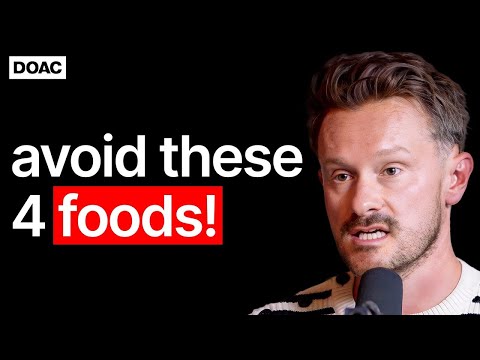
Fix Your Gut Health! The 4 Foods Fueling Inflammation & Disease! - Dr Will Cole
Dr Will Cole (guest), Steven Bartlett (host), Narrator
In this episode of The Diary of a CEO, featuring Dr Will Cole and Steven Bartlett, Fix Your Gut Health! The 4 Foods Fueling Inflammation & Disease! - Dr Will Cole explores transform Your Health: Gut, Trauma, And The Four Hidden Inflammatory Foods Dr. Will Cole explains how chronic inflammation and gut health underpin many modern issues, from autoimmune disease and weight gain to anxiety, depression, and burnout. He contrasts conventional medicine’s diagnose-and-drug model with functional medicine’s root-cause, nutrition-forward, and highly individualized approach. A central theme is the bidirectional link between “gut and feelings”: how diet, stress, shame, and even intergenerational trauma drive inflammation and dysregulate the nervous system. He offers practical strategies—removing key inflammatory foods, supporting the microbiome, regulating stress via breathwork and nature exposure, and setting life boundaries—to reclaim health in an increasingly misaligned modern world.
Transform Your Health: Gut, Trauma, And The Four Hidden Inflammatory Foods
Dr. Will Cole explains how chronic inflammation and gut health underpin many modern issues, from autoimmune disease and weight gain to anxiety, depression, and burnout. He contrasts conventional medicine’s diagnose-and-drug model with functional medicine’s root-cause, nutrition-forward, and highly individualized approach. A central theme is the bidirectional link between “gut and feelings”: how diet, stress, shame, and even intergenerational trauma drive inflammation and dysregulate the nervous system. He offers practical strategies—removing key inflammatory foods, supporting the microbiome, regulating stress via breathwork and nature exposure, and setting life boundaries—to reclaim health in an increasingly misaligned modern world.
Key Takeaways
Functional medicine looks for optimal—not merely ‘normal’—health markers.
Standard lab ranges are statistical averages of mostly unwell people, so ‘normal’ often means ‘common in sick populations. ...
Get the full analysis with uListen AI
Chronic inflammation is a silent driver of metabolic, autoimmune, and mental health conditions.
Inflammation itself is protective and necessary; the problem is when it becomes chronic—a ‘forest fire’ instead of a short, healing flare. ...
Get the full analysis with uListen AI
Your gut microbiome heavily influences mood, immunity, hormones, and cravings.
About 75% of the immune system and most serotonin (95%) and a large share of dopamine (50%) are produced in or regulated by the gut. ...
Get the full analysis with uListen AI
Stress, shame, and trauma—past and inherited—are biologically inflammatory.
Cole coins “shameflammation” to describe how self-criticism and unresolved emotional pain elevate inflammatory markers like IL‑6. ...
Get the full analysis with uListen AI
Regulating the nervous system via the vagus nerve is key to healing.
Polyvagal theory maps how our autonomic nervous system moves among calm/connected states, fight‑or‑flight, and shutdown/hypervigilance. ...
Get the full analysis with uListen AI
Four common food categories plus alcohol disproportionately fuel inflammation.
Cole’s “inflammatory core four” are: (1) gluten-containing grains (wheat, rye, barley, spelt), especially as hybridized, poorly prepared, and over-consumed modern wheat; (2) industrial seed oils (canola, soybean, generic ‘vegetable oil’) that skew omega‑3/omega‑6 balance; (3) conventional dairy with beta‑A1 casein, often poorly tolerated compared with grass‑fed, A2 or fermented forms; (4) added sugars in any disguise, including ‘natural’ agave. ...
Get the full analysis with uListen AI
Sustainable change comes from self-respect and boundaries, not perfectionism.
Cole warns that detoxes and extreme protocols often mirror old diet culture—short, intense bursts rather than sustainable habits. ...
Get the full analysis with uListen AI
Notable Quotes
“Just because something's common doesn't necessarily mean it's normal.”
— Dr. Will Cole
“Mental health is physical health. Our brain is a part of our body just like anything else.”
— Dr. Will Cole
“As trauma can be inherited, so can healing.”
— Dr. Will Cole
“If you care about your weight and your energy levels, you have to care about the microbiome, because if it's not healthy, you're not healthy.”
— Dr. Will Cole
“Avoiding things that don't love you back isn't restrictive. It's self-respect for your body.”
— Dr. Will Cole
Questions Answered in This Episode
You distinguish between ‘common’ and ‘normal’ when interpreting lab results—what specific optimal ranges or markers do you most often see missed in standard blood work?
Dr. ...
Get the full analysis with uListen AI
When someone suspects their anxiety or depression is inflammation-driven, what is the first 30-day protocol you’d recommend they try before changing medication?
Get the full analysis with uListen AI
Your ‘inflammatory core four’ includes gluten and conventional dairy; how would you respond to critics who say the evidence doesn’t justify such broad avoidance for people without clear allergies or celiac disease?
Get the full analysis with uListen AI
For a person with a high ACE score and signs of intergenerational trauma, how would you practically weave together therapy, somatic work, and functional lab testing into one integrated treatment plan?
Get the full analysis with uListen AI
You advocate intermittent fasting for metabolic flexibility, but also warn about stress and nervous system dysregulation—how do you decide when fasting helps versus when it becomes another stressor that worsens gut and hormone health?
Get the full analysis with uListen AI
Transcript Preview
If you care about mental health, care about your weight and your energy levels, you have to care about the ... because if it's not healthy, you're not healthy. Dr. Will Cole. Bestselling author. One of the top 50 functional medicine practitioners.
And is a health expert for the world's largest wellness brands, such as goop.
There's so much medical gaslighting going on. Your average conventional doctor would fail a basic nutrition test, and I find that to be problematic because you have the worst healthcare system, and yet you're criticizing people that are trying to do something different.
You define yourself as a functional medicine doctor.
The differences between mainstream medicine and functional medicine is they're trained to diagnose a disease and match it with a medication. But I think a nutrition-forward approach to healthcare is vastly important.
Why?
Because the vast majority of health problems are lifestyle-driven, foods we eat, exposure to toxins. These lifestyle things are really what's plaguing our society. 60 to 80% of all Western countries are dealing with some massive metabolic issues, in part fed by chronic stress. Part of our trauma in our life has to do with the trauma that our ancestors have gone through. It sounds science fiction, but looking at how trauma is literally stored in the cells and then passed through family lines is very much science.
Are you optimistic that there's things we can do to change it?
As trauma can be inherited, so can healing. There's three main things. First thing is ... Number two ... The third would be ...
Before we get into this episode, just wanted to say thank you, first and foremost, for being part of this community. Um, the team here at The Diary of a CEO is now almost 30 people, and that's literally because you watch and you subscribe and you, um, leave comments and you like the videos that th- this show's been able to grow. And it's the greatest honor of my life to sit here with these incredible people and just selfishly ask them questions that I'm pondering over or worrying about in my life. But this is just the beginning for The Diary of a CEO. We've got big, big plans to scale this show, um, to every corner of the world and to, to, to diversify our guest selection. And that's enabled by you, by a simple thing that you guys do, which is to watch. So, if there's one thing you could do to help this show and to help us continue to do what we do, it's just to hit the subscribe button. If you like this show, if you like what we do here, if you watch these episodes, please just hit that subscribe button. Means the world. Let's get on with it. Dr. Will.
My friend.
(laughs)
Th- thanks for having me.
I'm gonna start this, um, conversation where I started it quite recently when I spoke to Max, who I think you, you, you're familiar with, um, which is, what do you do and why do you do it?
Install uListen to search the full transcript and get AI-powered insights
Get Full TranscriptGet more from every podcast
AI summaries, searchable transcripts, and fact-checking. Free forever.
Add to Chrome