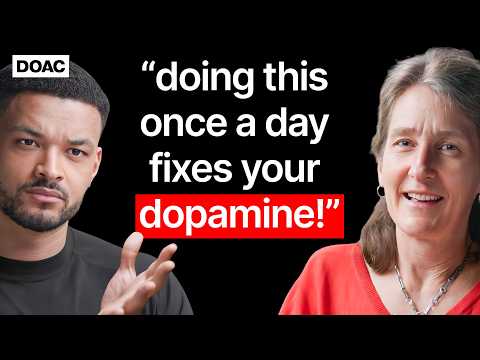
Dopamine Expert: Doing This Once A Day Fixes Your Dopamine! What Alcohol Is Doing To Your Brain!
Dr. Anna Lembke (guest), Steven Bartlett (host), Narrator, Narrator
In this episode of The Diary of a CEO, featuring Dr. Anna Lembke and Steven Bartlett, Dopamine Expert: Doing This Once A Day Fixes Your Dopamine! What Alcohol Is Doing To Your Brain! explores daily Painful Habits Can Heal Dopamine, Break Hidden Addictions Worldwide Dr. Anna Lembke, Stanford addiction psychiatrist and dopamine expert, explains how the same brain circuits process both pleasure and pain, and why modern life’s constant, easy pleasures are pushing our dopamine system into chronic imbalance. Using a simple ‘pleasure–pain scale’ analogy, she shows how repeated hits from alcohol, drugs, food, porn, social media, and even work cause the brain to overcorrect, leaving us in a dopamine-deficit state that feels like anxiety, depression, and craving.
Daily Painful Habits Can Heal Dopamine, Break Hidden Addictions Worldwide
Dr. Anna Lembke, Stanford addiction psychiatrist and dopamine expert, explains how the same brain circuits process both pleasure and pain, and why modern life’s constant, easy pleasures are pushing our dopamine system into chronic imbalance. Using a simple ‘pleasure–pain scale’ analogy, she shows how repeated hits from alcohol, drugs, food, porn, social media, and even work cause the brain to overcorrect, leaving us in a dopamine-deficit state that feels like anxiety, depression, and craving.
She argues that we’re wired for survival in a world of scarcity, but now live in an environment of abundance where almost everything is ‘drugified’—more potent, more accessible, more novel than our brains evolved to handle. Addiction, she says, is less about weakness and more about neurobiology, genetics, and environment, which reframes addicts as people trying to escape pain rather than self-destruct.
Lembke outlines practical tools: 30‑day ‘dopamine fasts’ from problem behaviors, self-binding strategies to reduce exposure to cues, and deliberately ‘pressing on the pain side’ through exercise, cold exposure, fasting, and tolerating discomfort in the present moment. She also warns about digital addictions (especially porn and social media), early exposure in children, and a cultural drift toward fragility and victim narratives that keep people stuck.
Ultimately, she argues that embracing discomfort, telling more responsible personal stories, and building lives less organized around constant rewards are essential for restoring dopamine balance, resilience, and genuine happiness.
Key Takeaways
Dopamine drives motivation more than pleasure, and pleasure and pain share a single, balancing system.
The rat experiment where dopamine is removed from the reward pathway shows rats will eat if food is placed in their mouths but will starve if food is even a body-length away, illustrating dopamine’s core role in ‘wanting’ and effort. ...
Get the full analysis with uListen AI
Modern abundance and ‘drugified’ experiences make almost everyone vulnerable to addiction.
We evolved for scarcity—lots of effort for small, occasional rewards. ...
Get the full analysis with uListen AI
Addiction is fundamentally about escaping pain, not seeking self-harm.
Lembke’s scale metaphor clarifies that addicts aren’t trying to ruin their lives; they’re urgently trying to get back to ‘level’ in a brain stuck on the pain side. ...
Get the full analysis with uListen AI
Deliberately doing hard things is a powerful, safer way to restore dopamine balance.
Pressing on the ‘pain side’ through exercise, cold water exposure, or intermittent fasting triggers the brain’s gremlins to jump to the pleasure side afterward, raising dopamine indirectly without the same crash. ...
Get the full analysis with uListen AI
A 30‑day ‘dopamine fast’ from a specific drug or behavior can reset your reward pathways and reveal hidden harms.
Lembke recommends a targeted 30‑day abstinence from the suspected problem (porn, gaming, sugar, romance novels, social media, alcohol) as an experiment. ...
Get the full analysis with uListen AI
Self-binding and environment design are essential because willpower alone usually fails.
Because cues (people, places, emotions like hunger, anger, loneliness, fatigue) trigger desire, Lembke emphasizes pre-committing to constraints: removing alcohol and junk food from the house, storing phones outside the bedroom, using timed lockboxes, deleting dealer contacts, and setting clear digital limits. ...
Get the full analysis with uListen AI
How you tell your life story predicts your mental health and capacity to recover.
Lembke sees narratives centered on pure victimhood (everything is someone else’s fault) as strongly associated with poor outcomes and ongoing dysfunction. ...
Get the full analysis with uListen AI
Notable Quotes
“Without dopamine, we’re not motivated to seek out the things that we need for our basic survival.”
— Dr. Anna Lembke
“We’re wired for survival in a world of scarcity. That’s not the world we live in now.”
— Dr. Anna Lembke
“People who are addicted aren’t trying to self-harm. What they’re trying to do is to deal with pain.”
— Dr. Anna Lembke
“If we intentionally press on the pain side of the balance, those gremlins will hop on the pleasure side and we will get our dopamine indirectly by paying for it upfront.”
— Dr. Anna Lembke
“How we narrate our lives is not just a way to understand our past. It actually is our roadmap for the future.”
— Dr. Anna Lembke
Questions Answered in This Episode
In your clinical experience, what specific patterns distinguish a ‘healthy high performer’ from someone whose work ethic has crossed into true work addiction?
Dr. ...
Get the full analysis with uListen AI
How would you design a practical 30-day dopamine fast for someone whose main issues are smartphone use and nightly pornography—what exact rules, substitutions, and self-binding tactics would you prescribe?
She argues that we’re wired for survival in a world of scarcity, but now live in an environment of abundance where almost everything is ‘drugified’—more potent, more accessible, more novel than our brains evolved to handle. ...
Get the full analysis with uListen AI
You mentioned that some trauma-focused therapies can inadvertently keep people stuck in victim narratives; what concrete signs should therapists and patients watch for that indicate a therapy is reinforcing helplessness rather than fostering agency?
Lembke outlines practical tools: 30‑day ‘dopamine fasts’ from problem behaviors, self-binding strategies to reduce exposure to cues, and deliberately ‘pressing on the pain side’ through exercise, cold exposure, fasting, and tolerating discomfort in the present moment. ...
Get the full analysis with uListen AI
Given your concern about children’s brain plasticity, what age- and stage-specific guidelines would you recommend to parents for sugar, gaming, social media, and smartphone access without being unrealistically strict?
Ultimately, she argues that embracing discomfort, telling more responsible personal stories, and building lives less organized around constant rewards are essential for restoring dopamine balance, resilience, and genuine happiness.
Get the full analysis with uListen AI
If we accept that future brain–computer interfaces will almost certainly arrive, what regulations or ethical guardrails would you want in place to prevent these technologies from massively amplifying dopamine-driven addiction and social isolation?
Get the full analysis with uListen AI
Transcript Preview
There is a very famous experiment in which rats were engineered to have no dopamine, and the scientists discovered that if they put food in the rat's mouth, the rat would eat. But if you put the food even a body length away, the rat will starve to death, which tells us that dopamine is fundamental to get the things that we need for our basic survival. Now, every time we're doing something that's pleasurable, from sugar, to video games, work, pornography, social media, that will affect dopamine. And the more dopamine that's released, the more likely that drug or behavior is to be addictive. But also, the genetic risk of addiction is about 50 to 60%. So if you have a biological parent or grandparent with addiction, you are more likely to develop that addiction. We have to keep it in balance in order to stay healthy.
Dr. Anna Lembke is Professor of Psychiatry at Stanford, Chief of the Stanford Addiction Clinic...
... and a world-leading expert on the subject of dopamine. She will tell you how this one powerful chemical is controlling your life and what to do about it.
One of the most important findings in neuroscience in the past 75 years is that the same parts of the brain that process pleasure also process pain, and the balance wants to remain level. The problem is that we automatically seek out pleasure and avoid pain, and we're exposed to all kinds of pleasures that we have in the modern world. And our brains are reeling in response to try to compensate. Now I need more of my drug in more potent forms to get the same effect, which then leads to addiction. And that's what happened to me when I got addicted to romance novels.
Take me into that phase of your life.
I was out of control and I needed to restore a level balance and take the advice I give my patients.
And what is that advice?
The Diary of a CEO is independently fact-checked. For any studies or science mentioned in this episode, please check the show notes.
This has always blown my mind a little bit. 53% of you that listen to this show regularly haven't yet subscribed to this show. So could I ask you for a favor before we start? If you like this show and you like what we do here and you wanna support us, the free simple way that you can do just that is by hitting the subscribe button. And my commitment to you is, if you do that, then I'll do everything in my power, me and my team, to make sure that this show is better for you every single week. We'll listen to your feedback, we'll find the guests that you want me to speak to, and we'll continue to do what we do. Thank you so much. (upbeat music) I've sat here for the last 20 minutes trying to figure out how to say this to you, so I'm just gonna say it how it comes out my mouth, and I apologize if this is messy. But if there was ever an episode this year that you should listen to, it is this one. I've li- since this episode was recorded about a month ago, all I've been thinking about is how on earth I get you to watch this. And I don't say this often. The last time I said this was the first time Mo Gawdat came on this podcast. This is the second time I've said this in almost four years of recording this podcast on YouTube. And the reason for that is, so many of the things that I know you're struggling with in your life that stand in the way of the person you wanna become, that relationship you have with your phone, the procrastination, the cycles of behavior that make you feel embarrassed and full of shame that you've just never been able to crack, all of them, all of them, I genuinely believe, for many of you, are going to be understood today if you listen to this episode. It has changed my life and it has changed much of the lives of my team. If, if I'm wrong here, you have the right to message me and tell me that I was wrong. Please listen to this episode. Really, really, I mean that from the bottom of my heart. And just to make sure you do, throughout this episode there's gonna be these pop-ups. If you collect eight of these codes that are gonna pop up on the screen and put them in the document link below, you'll unlock something very special, some additional content. Please listen to this episode. Dr. Anna Lembke, you wrote one of the most iconic well-known books about dopamine, which propelled the subject matter of dopamine into the public consciousness. But I guess the most important question I should ask you is, why does dopamine matter?
Install uListen to search the full transcript and get AI-powered insights
Get Full TranscriptGet more from every podcast
AI summaries, searchable transcripts, and fact-checking. Free forever.
Add to Chrome