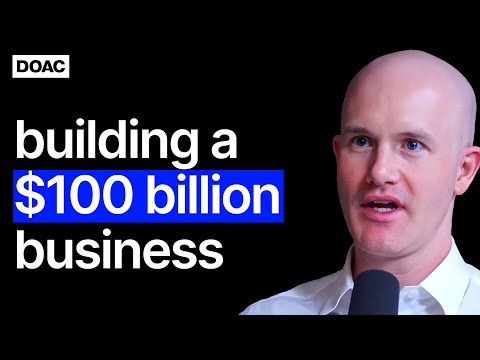
Coinbase Founder: The Crazy Journey Of Building A $100 Billion Company: Brian Armstrong
Brian Armstrong (guest), Steven Bartlett (host)
In this episode of The Diary of a CEO, featuring Brian Armstrong and Steven Bartlett, Coinbase Founder: The Crazy Journey Of Building A $100 Billion Company: Brian Armstrong explores from Introverted Coder To Coinbase: Brian Armstrong’s Turbulent $100B Journey Brian Armstrong, CEO and co-founder of Coinbase, recounts his path from shy, introverted computer geek to leading the largest U.S. cryptocurrency exchange through extreme volatility, hypergrowth, and public scrutiny.
From Introverted Coder To Coinbase: Brian Armstrong’s Turbulent $100B Journey
Brian Armstrong, CEO and co-founder of Coinbase, recounts his path from shy, introverted computer geek to leading the largest U.S. cryptocurrency exchange through extreme volatility, hypergrowth, and public scrutiny.
He explains how early experiences—building a small tutoring startup, living in hyperinflationary Argentina, and working at Airbnb—shaped his worldview on money, entrepreneurship, and culture.
Armstrong details Coinbase’s evolution: finding product–market fit, raising capital, scaling too fast, managing layoffs, losing a co-founder, and navigating crypto booms and busts while trying to preserve his own and the company’s long‑term sustainability.
Throughout, he emphasizes determination, mission-driven work, hiring top talent, setting cultural boundaries (including a controversial ‘no politics at work’ stance), and shifting personal motivation from fear and ego to joy and purpose.
Key Takeaways
Let action generate information when you don’t yet know the ‘right’ idea.
Armstrong repeatedly started by building something small—his tutoring marketplace, then early Bitcoin apps—without perfect clarity. ...
Get the full analysis with uListen AI
Solve real pain and remove friction; stop over‑extracting value.
His tutoring marketplace stagnated while taking a 10% cut and managing payments; users quickly went around the platform and paid tutors directly. ...
Get the full analysis with uListen AI
Choose a mission you’d pursue for a decade, even without success.
In Buenos Aires, Armstrong forced himself—using ideas from Seth Godin’s ‘The Dip’—to ask what he’d still want to be doing in 10 years even if it hadn’t yet ‘worked’. ...
Get the full analysis with uListen AI
Design your founder role around your strengths to avoid burnout.
An introvert who loves building and learning, Armstrong realized that traditional CEO expectations—12+ direct reports, heavy people management, constant crisis‑mode—drained him. ...
Get the full analysis with uListen AI
Institutionalize repeatable innovation with explicit resource allocation.
To avoid becoming a ‘one‑product’ company, Coinbase uses a 70/20/10 model: 70% of resources on the core business, 20% on adjacent bets, and 10% on high‑risk ‘venture’ bets. ...
Get the full analysis with uListen AI
Scale hiring slowly and ruthlessly prioritize top talent and culture fit.
Armstrong’s early mistake was not codifying mission and values and relying on organic culture as Coinbase grew. ...
Get the full analysis with uListen AI
Balance authenticity and boundaries in company culture, including politics.
As internal debates over broader societal issues increasingly dominated Q&As and Slack, Armstrong felt he was failing as a leader and even considered resigning. ...
Get the full analysis with uListen AI
Notable Quotes
“Action produces information.”
— Brian Armstrong
“Everybody I talked to actually thought it was a bad idea… Any reasonable person would have quit.”
— Brian Armstrong (on early Coinbase)
“If the thing that got you started in the first place was fear… you’re just gonna give up.”
— Brian Armstrong
“It’s a real superpower to care less what other people think.”
— Brian Armstrong
“I had to transition from running the company with my co‑founder to building an executive team around me… It was like a second founding moment.”
— Brian Armstrong
Questions Answered in This Episode
You described the early tutoring startup as exposing how broken payments and banking were; if you were rebuilding that exact marketplace today using crypto rails, concretely how would it work differently for students and tutors?
Brian Armstrong, CEO and co-founder of Coinbase, recounts his path from shy, introverted computer geek to leading the largest U. ...
Get the full analysis with uListen AI
During the 2015–2016 ‘blockchain, not Bitcoin’ era, you said you’d have rather shut Coinbase down than pivot to bank software; what were the specific internal debates or board conversations where you held that line, and what did you risk personally in doing so?
He explains how early experiences—building a small tutoring startup, living in hyperinflationary Argentina, and working at Airbnb—shaped his worldview on money, entrepreneurship, and culture.
Get the full analysis with uListen AI
You’ve argued that growing headcount more than 2x per year breaks culture and operations; if crypto enters another multi‑year bull market, what precise constraints or mechanisms will you put in place to avoid repeating the 2021 over‑hiring mistake?
Armstrong details Coinbase’s evolution: finding product–market fit, raising capital, scaling too fast, managing layoffs, losing a co-founder, and navigating crypto booms and busts while trying to preserve his own and the company’s long‑term sustainability.
Get the full analysis with uListen AI
Your ‘mission‑focused, no politics at work’ memo led ~5% of Coinbase employees to leave; in retrospect, is there anything you would change about how you communicated or implemented that stance to reduce unnecessary polarization while preserving the principle?
Throughout, he emphasizes determination, mission-driven work, hiring top talent, setting cultural boundaries (including a controversial ‘no politics at work’ stance), and shifting personal motivation from fear and ego to joy and purpose.
Get the full analysis with uListen AI
You hold a contrarian view that much regulation ultimately harms innovation more than it helps; if you were designing a regulatory framework for crypto from scratch, how would you balance consumer protection with avoiding the ossification you see in aviation and finance?
Get the full analysis with uListen AI
Transcript Preview
(dramatic music plays) Everybody I talked to actually thought it was a bad idea. Like, any reasonable person would have quit. I was filled with self-doubt. And then Coinbase was valued at a billion dollars.
Crazy. Brian Armstrong.
CEO, co-founder of Coinbase. The largest US cryptocurrency exchange. I saw technology as a way to try to have a big impact on the world. If the thing that got you started in the first place was, like, fear, like, fear of never being important, or fear of never feeling fulfilled, you're just gonna give up. Cryptocurrency is the biggest transformation of money since the invention of paper.
Coinbase was being deemed the most trustworthy brand in crypto.
It tipped at a certain point from, like, "Oh, this growth is really good," to, "Okay, things are getting a little crazy here." If you kind of more than double a company in a year, you're really gonna start to see a lot of stuff break. This morning, Coinbase just telling employees in an email that it plans to lay off 18% of its workforce. We had never done a layoff before. I had never done one. And I remember I went up in front of the company and my voice cracked. I mean, it was awful. Oh, man.
I actually think Coinbase is in deep trouble here. And let me tell you why. The pressure, and the scrutiny, and the headlines, how are you dealing with your emotions?
This is getting very personal. (dramatic music plays) It's a real superpower to, like, care less what other people think.
So, without further ado, I'm Steven Bartlett, and this is The Diary of a CEO. I hope nobody's listening, but if you are, then please keep this to yourself. (music) Brian, I... When I read through people's, people's stories, there's sometimes really obvious, um, causal factors that led them to become the people they are today. But with you, I'm, I'm more compelled by the less obvious factors. If we go back to your early years, when you were a, a young man on the West Coast-
Yeah.
... of the United States?
Yeah.
What are the, the, the less obvious reasons as to why you've ended up where you are today and achieved what you've achieved in your life?
Hmm. Great question. Um, one of the less obvious reasons probably is that I was an introvert. I just wasn't really th- very good with people. I didn't really have that many friends. You know, as a, as a young person, I was quite shy. Um, I really found a love of computers, and I liked just being by myself and playing with computers, learning about how they worked, programming. And, you know, in our technological age, I suppose, um, some of the people who got excited about computers early on and just lo- ha- found a love of building things have now become, you know, CEOs of companies, which is kind of a strange thing. For a long time, I didn't think I could be a CEO, because I envisioned CEOs of companies as being, like, these military generals who barked orders at people, and they were these, like, strong, charismatic leaders. And I always felt like, "Well, that's not me. I'm kind of, like, an engineer. I'm kind of a nerd," (laughs) you know? And what I've learned over time is, now, reading enough books and things historically, you know, introverts can make actually really good CEOs. Um, of, of course, by the way, there's lots of different types of CEOs. There's not just one mold. There's people who love marketing, people who love operations, people who love sales, people who... And then there are engineer CEOs. Um, so that's one reason that I think it's maybe a little bit less known why, why I'm here. Another, another reason is that, um, I just became very passionate about this idea of trying to have an impact on the world, and I think... And again, it may have come from that, that introversion as a kid, and I, and I felt like, "Hey, I have good ideas, but it's hard for me to get them out there and for people to listen to them." And, um, I didn't feel confident, like, you know, speaking in some public setting or whatever. I have lots of practice doing it now, so I can. I, I'm-
Install uListen to search the full transcript and get AI-powered insights
Get Full TranscriptGet more from every podcast
AI summaries, searchable transcripts, and fact-checking. Free forever.
Add to Chrome